

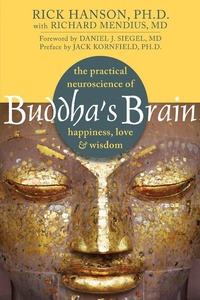
Buddha's Brain
Description

If you change your brain, you can change your life.
Great teachers like the Buddha, Jesus, Moses, Mohammed, and Gandhi were all born with brains built essentially like anyone else's¿and then they changed their brains in ways that changed the world. Science is now revealing how the flow of thoughts actually sculpts the brain, and more and more, we are learning that it's possible to strengthen positive brain states.
By combining breakthroughs in neuroscience with insights from thousands of years of mindfulness practice, you too can use your mind to shape your brain for greater happiness, love, and wisdom. Buddha's Brain draws on the latest research to show how to stimulate your brain for more fulfilling relationships, a deeper spiritual life, and a greater sense of inner confidence and worth. Using guided meditations and mindfulness exercises, you'll learn how to activate the brain states of calm, joy, and compassion instead of worry, sorrow, and anger. Most...
More details
Other editions
Additional editions
Person
Rick Hanson, PhD, is a psychologist, meditation teacher, and the author of Buddha's Brain. A summa cum laude graduate of the University of California, Los Angeles, he cofounded the Wellspring Institute for Neuroscience and Contemplative Wisdom and edits the Wise Brain Bulletin. He and his wife have two children.
Content
- Intro
- Contents
- Foreword
- Preface to the Fifteenth Anniversary Edition
- Preface to the First Edition
- Acknowledgements
- Introduction
- chapter 1. The Self-Transforming Brain
- Part One: The Causes of Suffering
- chapter 2. The Evolution of Suffering
- chapter 3. The First and Second Dart
- Part Two: Happiness
- chapter 4. chapter Taking in the Good
- chapter 5. Cooling the Fires
- chapter 6. Strong Intentions
- chapter 7. Equanimity
- Part Three: Love
- chapter 8. Two Wolves in the Heart
- chapter 9. Compassion and Assertion
- chapter 10. Boundless Kindness
- Part Four: Wisdom
- chapter 11. Foundations of Mindfulness
- chapter 12. Blissful Concentration
- chapter 13. Relaxing the Self
- Appendix: Nutritional Neurochemistry by Jan Hanson, L.Ac.
- References
- About the Authors
