

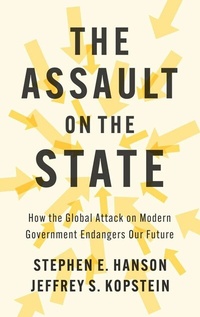
The Assault on the State
Description

What if the state as we know it didn't exist? Our air would be poisonous, our votes uncounted, and our markets dysfunctional. Yet across the world, in countries as diverse as Hungary, Israel, the U.K., and the U.S., attacks on the modern state and its workforce are intensifying. They are morphing into power grabs by self-aggrandizing politicians who attempt to seize control of the state for themselves and their cronies. What replaces the modern state once it is fatally undermined is not the free market and the flowering of personal liberty. Instead, the death of government agencies organized under the rule of law inevitably leads to the only realistic alternative: the rule of men. In The Assault on the State, political scientists Stephen Hanson and Jeffrey Kopstein offer an impassioned plea to defend modern government against those who seek to destroy it. They dissect the attack on the machinery of government from its origins in post-Soviet Russia to the core powers of Western democracy. The dangers of state erosion imperil every aspect of our lives. Hanson and Kopstein outline a strategy that can reverse this destructive trend before humanity is plunged back into the pathological personalistic politics of premodern times. Also available as an audiobook.
More details
Other editions
Additional editions
Persons
Stephen E. Hanson is the Lettie Pate Evans Professor of Government at William & Mary. He is the author of numerous scholarly books and articles on Russian, post-communist, and European politics in comparative perspective.
Jeffrey S. Kopstein is Dean's Professor of Political Science and Director of the Center for Jewish Studies at the University of California, Irvine. He has written widely on democracy and dictatorship, political violence, and comparative politics.
Content
Acknowledgements
1. At the Precipice
2. The Deep State Bogeyman
3. Beyond the Democracy Debate
4. How Vladimir Putin Resurrected Tsarism
5. The Wave: From East to West
6. Reclaiming the Modern State
Notes
1
At the Precipice
Americans love to hate the state. It's difficult now to find anyone in American politics who defends the positive contributions of "state bureaucrats" to our way of life. On the left, democratic socialists see the state as an instrument of wealthy corporate interests, while anarchists continue their quest to smash the state entirely. On the right, Christian nationalists and supporters of enhanced presidential executive power have allied to undermine the power of the secular "administrative state." Meanwhile, influential billionaires promote the staunchly anti-statist philosophy of libertarianism at think-tanks, universities, and chambers of commerce across the country.
Sometimes, hatred of the state can take fanciful forms. Silicon Valley tech mogul Peter Thiel, for example, has allied with Patri Friedman - grandson of famed libertarian economist Milton Friedman - to promote the concept of "seasteading," that is, the creation of voluntary cities on the ocean outside of any state's jurisdiction, made up of individual floating homes that can re-dock elsewhere whenever the local seasteading rules get too oppressive. And extremist groups promoting the "sovereign citizen movement," which claims that states have no legal authority over individuals whatsoever, have grown significantly since the COVID-19 pandemic. Given all of these diverse movements depicting central government as their mortal enemy, it's no wonder that belief in the existence of a global "deep state" conspiracy to stamp out human liberty is at an all-time high.1
But as annoying as state bureaucracies and government experts sometimes are, all of us depend on them to live what we now consider normal lives. Like the air we breathe, government agencies are mostly invisible, but without them we would be in grave danger. Without them, our food, water, and air would be poisonous, our money worthless, our children taught by incompetents or worse, our votes uncounted, and our national security violated. What if we no longer had legally constituted states, qualified experts, and well-organized bureaucracies to keep us secure, healthy, and democratic? What if we were to revert in the twenty-first century to premodern forms of personalistic rule? Not so long ago, kings, queens, royal children, grand viziers, and various hangers-on responded to public health crises, natural disasters, and questions of national security with quack remedies, consultation with oracles and soothsayers, or casting blame on "impure" outsiders. This was considered normal, and the results were horrifying: millions of needless deaths in plagues, floods, and genocides. In the modern world, a return to this sort of rule would threaten the very survival of our species. And as unlikely as it sounds, we are far closer to that precipice than most people imagine.
This is not another book about democracy's demise. It is about something far graver: the assault on the modern state itself, by both elected and unelected leaders. Some of its enemies call for the elimination of the "administrative state," the dense web of government agencies, staffed by professionals, with a degree of autonomy in deciding how laws are enacted. Others of a more conspiratorial bent see themselves engaged in a pitched battle with a shadowy "deep state." In essence, both terms have come to refer simply to the modern state as we know it - that is, central government administered according to the rule of law and staffed by employees recruited for their merit and expertise rather than due to their personal connections. This assault is part of a terrifying global trend toward resurrecting older models of state-building based on personalistic authority, one that started in Vladimir Putin's Russia but has since spread throughout the world. In countries as diverse as Hungary, Israel, the United Kingdom, and the United States, vituperative attacks on "unelected bureaucrats" have morphed into power grabs by self-aggrandizing politicians who attempt to seize control of the state for themselves and their cronies. Unfortunately, what replaces the administrative state, once it is fatally undermined, is not the free market and the flowering of personal liberty; instead, the death of government agencies organized under the rule of law inevitably brings about its only realistic political alternative: the rule of men. The logical endpoint of this trend would be a global return to a bygone era of rule by traditional sovereigns. And the threat of such an outcome is growing.
Certainly, the destruction of the impersonal state bureaucracy in the United States remains an obsession for many in the Republican Party. Former President Donald J. Trump has depicted his entire presidency as one locked in a mortal struggle with the deep state. Florida Governor Ron DeSantis enthusiastically picked up this theme in his own presidential campaign, proclaiming that "too much power has accumulated in D.C., and the result is a detached administrative state that rules over us and imposes its will on us." He put it even more bluntly to a New Hampshire audience in summer 2023: "On bureaucracy, you know, we're going to have all these deep state people, you know, we're going to start slitting throats on day one and be ready to go." Not to be outdone by Trump or DeSantis, Arkansas Governor Sarah Huckabee Sanders tried to force all applicants to nonpartisan state board and committee jobs to write up to five hundred words on what they "admire" about her accomplishments - before flipflopping and blaming this on a "design error" in her hiring questionnaire. And Representative Marjorie Taylor Greene has gone as far as to propose a "national divorce" involving the separation of "red states and blue states" - essentially, the disintegration of the United States itself - in order to "shrink the federal government."2
Lest one think that such criticisms are mere flights of overheated rhetoric, it's important to emphasize that the assault on the modern state has already done a great deal of damage. Consider a revealing incident midway through the Trump presidency, when his Agriculture Secretary, Sonny Perdue, announced the relocation of the USDA's Economic Research Services and the National Institute of Food and Agriculture from Washington, DC to Kansas City, Missouri. Rather than move, about half the employees of both agencies chose to quit. This result was intentional: to wipe out the department's capacity to provide accurate information about the impact of climate change, threats to food security, and tax breaks to farmers. As one USDA official noted: "We've lost hundreds, if not thousands of staff years of expertise." Another summed up the aftermath as follows: "The agencies have been decimated. Their ability to perform the functions they were created to perform - it doesn't exist anymore." Trump advisor Steve Bannon, who had promised to "deconstruct the administrative state" (a phrase adapted, sometimes with attribution, from Vladimir Lenin), got exactly what he wanted.3
But this is just a small taste of what might await us in the future. Trump made it clear that one of his first acts, were he to be returned to the presidency, would be to revive "Schedule F," a drastic reduction in civil service protections for federal employees implemented in the last days of his administration. "We need to make it much easier to fire rogue bureaucrats who are deliberately undermining democracy or, at a minimum, just want to keep their jobs," Trump declared. "Congress should pass historic reforms empowering the president to ensure that any bureaucrat who is corrupt, incompetent or unnecessary for the job can be told - did you ever hear this - 'You're fired, get out, you're fired.' Have to do it. Deep state. Washington will be an entirely different place." Following Trump's lead, Governor DeSantis proposed "parceling out federal agencies to other parts of the country" as a way to "re-constitutionalize government." And the devastating implications of Representative Greene's "national divorce" for the ability of the US administrative state to carry out its essential functions can scarcely be imagined.
Much of the analysis of the Trump phenomenon has depicted the ex-president as a would-be dictator - with the implication that his supporters are implicitly antidemocratic as well. Of course, one can read the unfolding of the Trump presidency, from his dalliances with Vladimir Putin to his efforts to undermine the US legal system and hold onto power, as a story of democratic decline. Yet Trumpism is much more than this and will certainly outlast Trump himself. Whether by publicly attacking his own foreign policy and intelligence apparatus, contradicting and upstaging his leading medical specialists, or denigrating the leadership of US law enforcement agencies, Trump promoted his personal power - and that of his cronies - at the direct expense of the experts we used to trust to manage the complex challenges of the modern era. And he's not alone. When Trump and others like him promise to destroy the deep state, they are really threatening to undermine legally constituted state bureaucracies altogether.
But...
