

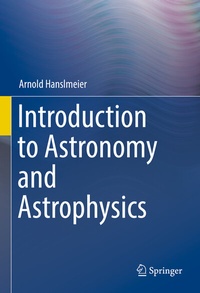
Introduction to Astronomy and Astrophysics
Description

This textbook provides the basic theoretical and practical knowledge of astronomy and astrophysics. It provides an overview from classical astronomy and observational methods to solar physics and astrophysics of stars and galaxies. It concludes with chapters on cosmology, astrobiology, and mathematical and numerical methods. Numerous color illustrations, examples of calculations, and exercises with solutions make this work a useful companion to undergraduate astronomy lectures.
The book is suitable for students of physics and astronomy at teacher training level or in the Bachelor's degree - but also people interested in natural sciences with appropriate basic knowledge of mathematics and physics will find here an appealing introduction to the subject.
This fourth edition has been updated and revised with respect to the latest developments in astronomy. The chapter on mathematical methods has been redesigned and the software used is now exclusively Python.From thecontents: Spherical astronomy - History of astronomy - Celestial mechanics - Astronomical instruments - Physics of the bodies of the solar system - The Sun - State variables of the stars - Stellar atmospheres - Stellar structure - Stellar evolution - Interstellar matter - The Galaxy - Extragalactic systems - Cosmology - Astrobiology - Mathematical methods.
This book is a translation of the original German 4 th edition Einführung in Astronomie und Astrophysik by Arnold Hanslmeier, published by Springer-Verlag GmbH Germany, part of Springer Nature in 2020. The translation was done with the help of artificial intelligence (machine translation by the service DeepL.com). A subsequent human revision was done primarily in terms of content, so that the book will read stylistically differently from a conventional translation. Springer Nature works continuously to further the development of tools for the production of books and on the related technologies to support the authors.
Reviews / Votes
"Wow, was für ein Buch. Ich habe schon viele Bücher rezensiert, aber das vorliegende Buch ist das Beste was ich je auf dem Schreibtisch hatte. Bei ihm stimmt alles, von der Fülle der Informationen, die auf den Punkt gebracht werden, über den Aufbau und die wunderbare Bebilderung, einfach klasse! ..."Besonder hervorzuheben: "... Ein Buch, welches in keiner Handbibliothek eines Physikers fehlen sollte. Das Buch ist der Hammer!!!" (Horst Sauer)
More details
Other editions
Additional editions
Person
Professor Arnold Hanslmeier is an astrophysicist at the Institute of Physics at the University of Graz. In addition to more than 400 scientific publications and several specialized books, he also devotes himself with great pleasure to the comprehensible dissemination of the fascinating findings of modern astrophysics. He lectures at the University of Graz and is a visiting professor at the Universities of Vienna, Innsbruck, Toulouse, La Laguna, Tenerife and the Kiepenheuer Institute in Freiburg. Due to his special didactic abilities to present complicated things in a simple and vivid way, he is a much sought-after speaker internationally.
