

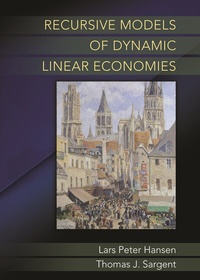
Recursive Models of Dynamic Linear Economies
1st Edition
Published on 16. June 2015
424 pages
978-1-4008-4818-8 (ISBN)
Description

A guide to the economic modeling of household preferences, from two leaders in the field
A common set of mathematical tools underlies dynamic optimization, dynamic estimation, and filtering. In Recursive Models of Dynamic Linear Economies, Lars Peter Hansen and Thomas Sargent use these tools to create a class of econometrically tractable models of prices and quantities. They present examples from microeconomics, macroeconomics, and asset pricing. The models are cast in terms of a representative consumer. While Hansen and Sargent demonstrate the analytical benefits acquired when an analysis with a representative consumer is possible, they also characterize the restrictiveness of assumptions under which a representative household justifies a purely aggregative analysis.
Hansen and Sargent unite economic theory with a workable econometrics while going beyond and beneath demand and supply curves for dynamic economies. They construct and apply competitive equilibria for a class of linear-quadratic-Gaussian dynamic economies with complete markets. Their book, based on the 2012 Gorman lectures, stresses heterogeneity, aggregation, and how a common structure unites what superficially appear to be diverse applications. An appendix describes MATLAB programs that apply to the book's calculations.
A common set of mathematical tools underlies dynamic optimization, dynamic estimation, and filtering. In Recursive Models of Dynamic Linear Economies, Lars Peter Hansen and Thomas Sargent use these tools to create a class of econometrically tractable models of prices and quantities. They present examples from microeconomics, macroeconomics, and asset pricing. The models are cast in terms of a representative consumer. While Hansen and Sargent demonstrate the analytical benefits acquired when an analysis with a representative consumer is possible, they also characterize the restrictiveness of assumptions under which a representative household justifies a purely aggregative analysis.
Hansen and Sargent unite economic theory with a workable econometrics while going beyond and beneath demand and supply curves for dynamic economies. They construct and apply competitive equilibria for a class of linear-quadratic-Gaussian dynamic economies with complete markets. Their book, based on the 2012 Gorman lectures, stresses heterogeneity, aggregation, and how a common structure unites what superficially appear to be diverse applications. An appendix describes MATLAB programs that apply to the book's calculations.
All prices
More details
Edition
Course Book
Language
English
Place of publication
Princeton, NJ
United States
Publishing group
De Gruyter
Target group
Professional and scholarly
Edition type
Digital original
Product notice
Reflowable
Illustrations
20 line illus.
File size
2,07 MB
ISBN-13
978-1-4008-4818-8 (9781400848188)
Schweitzer Classification
Other editions
Additional editions
Lars Peter Hansen | Thomas J. Sargent
Recursive Models of Dynamic Linear Economies
Book
07/2018
Princeton University Press
€37.80
Available immediately
Lars Peter Hansen | Thomas J. Sargent
Recursive Models of Dynamic Linear Economies
Book
12/2013
Princeton University Press
€61.00
Shipment within 10-20 days
Persons
Lars Peter Hansen is the David Rockefeller Distinguished Service Professor at the University of Chicago, where he is also the research director of the Becker Friedman Institute. Thomas J. Sargent is professor of economics at New York University and a senior fellow at the Hoover Institution at Stanford University. His books include Rational Expectations and Inflation and The Conquest of American Inflation (both Princeton). Hansen and Sargent are the coauthors of Robustness (Princeton). Sargent was awarded the Nobel Prize in economics in 2011 and Hansen received it in 2013.
Content
Frontmatter, pg. i
Contents, pg. vii
Preface, pg. xiii
Acknowledgments, pg. xv
Chapter 1. Theory and Econometrics, pg. 3
Chapter 2. Linear Stochastic Difference Equations, pg. 15
Chapter 3. Efficient Computations, pg. 33
Chapter 4. Economic Environments, pg. 61
Chapter 5. Optimal Resource Allocations, pg. 79
Chapter 6. A Commodity Space, pg. 125
Chapter 7. Competitive Economies, pg. 131
Chapter 8. Statistical Representations, pg. 153
Chapter 9. Canonical Household Technologies, pg. 191
Chapter 10. Examples, pg. 217
Chapter 11. Permanent IncomeModels, pg. 233
Chapter 12. Gorman Heterogeneous Households, pg. 253
Chapter 13. Complete Markets Aggregation, pg. 269
Chapter 14. Periodic Models of Seasonality, pg. 291
Appendix A. MATLAB Programs, pg. 327
References, pg. 379
Subject Index, pg. 393
Author Index, pg. 397
MATLAB Index, pg. 399
The Gorman Lectures in Economics, pg. 401
Contents, pg. vii
Preface, pg. xiii
Acknowledgments, pg. xv
Chapter 1. Theory and Econometrics, pg. 3
Chapter 2. Linear Stochastic Difference Equations, pg. 15
Chapter 3. Efficient Computations, pg. 33
Chapter 4. Economic Environments, pg. 61
Chapter 5. Optimal Resource Allocations, pg. 79
Chapter 6. A Commodity Space, pg. 125
Chapter 7. Competitive Economies, pg. 131
Chapter 8. Statistical Representations, pg. 153
Chapter 9. Canonical Household Technologies, pg. 191
Chapter 10. Examples, pg. 217
Chapter 11. Permanent IncomeModels, pg. 233
Chapter 12. Gorman Heterogeneous Households, pg. 253
Chapter 13. Complete Markets Aggregation, pg. 269
Chapter 14. Periodic Models of Seasonality, pg. 291
Appendix A. MATLAB Programs, pg. 327
References, pg. 379
Subject Index, pg. 393
Author Index, pg. 397
MATLAB Index, pg. 399
The Gorman Lectures in Economics, pg. 401

