

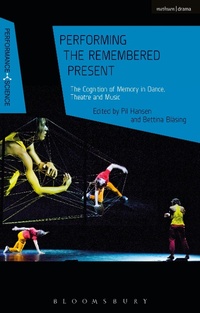
Performing the Remembered Present
The Cognition of Memory in Dance, Theatre and Music
1st Edition
Published on 28. December 2017
288 pages
978-1-4742-8472-1 (ISBN)
Description

This international collection brings together scientists, scholars and artist-researchers to explore the cognition of memory through the performing arts and examine artistic strategies that target cognitive processes of memory. The strongly embodied and highly trained memory systems of performing artists render artistic practice a rich context for understanding how memory is formed, utilized and adapted through interaction with others, instruments and environments. Using experimental, interpretive and Practice-as-Research methods that bridge disciplines, the authors provide overview chapters and case studies of subjects such as:
* collectively and environmentally distributed memory in the performing arts;
* autobiographical memory triggers in performance creation and reception;
* the journey from learning to memory in performance training;
* the relationship between memory, awareness and creative spontaneity, and
* memorization and embodied or structural analysis of scores and scripts.
This volume provides an unprecedented resource for scientists, scholars, artists, teachers and students looking for insight into the cognition of memory in the arts, strategies of learning and performance, and interdisciplinary research methodology.
* collectively and environmentally distributed memory in the performing arts;
* autobiographical memory triggers in performance creation and reception;
* the journey from learning to memory in performance training;
* the relationship between memory, awareness and creative spontaneity, and
* memorization and embodied or structural analysis of scores and scripts.
This volume provides an unprecedented resource for scientists, scholars, artists, teachers and students looking for insight into the cognition of memory in the arts, strategies of learning and performance, and interdisciplinary research methodology.
More details
Series
Edition
1. Auflage
Language
English
Place of publication
London
United Kingdom
Publishing group
Bloomsbury Publishing PLC
Target group
College/higher education
Professional and scholarly
Illustrations
15 bw illus
ISBN-13
978-1-4742-8472-1 (9781474284721)
Copyright in bibliographic data and cover images is held by Nielsen Book Services Limited or by the publishers or by their respective licensors: all rights reserved.
Schweitzer Classification
Other editions
Additional editions
Pil Hansen | Bettina Blaesing
Performing the Remembered Present
The Cognition of Memory in Dance, Theatre and Music
Book
06/2019
Methuen Drama
€62.08
Shipment within 15-20 days
Persons
Pil Hansen is an Assistant Professor and Graduate Program Director at the School of Creative and Performing Arts, University of Calgary, Canada; a founding member of Vertical City Performance; and a dramaturg. Her empirical and PaR experiments examine cognitive dynamics of memory and perception in creative processes. With Bruce Barton, she developed the multi-disciplinary research model 'Research-Based Practice'. Hansen chairs the PSi Working Group on Dramaturgy and Performance; her award-winning creative work has toured nationally and internationally; and her scholarly research is published in Connection Science, Journal of Dramatic Theory and Criticism, TDR: The Drama Review, Performance Research, Theatre Topics, and Koreografisk Journal among other journals and ten essay collections on dramaturgy, cognitive performance studies, and research methods. Hansen co-edited the essay collection Dance Dramaturgy: Modes of Agency, Awareness and Engagement (2015). Current and recent artistic collaborators are: Kaeja d'Dance, Theatre Junction Grand, Toronto Dance Theatre, and Public Recordings.
Bettina Bläsing is a responsible investigator at the Center of Excellence Cognitive Interaction Technology (CITEC) at Bielefeld University, Germany. She studied Biology at Bielefeld University and Applied Animal Behaviour and Welfare at the University of Edinburgh, Scotland. Bettina worked as science journalist and editor, and as a postdoctoral researcher at the Max Planck Institute for Evolutionary Anthropology and University of Leipzig before joining the Neurocognition and Action Research Group at Bielefeld University in 2006. Her main research interests are mental representations of body, movement and space; the control and learning of complex movements and manual actions; and expertise in dance.
Bettina Bläsing is a responsible investigator at the Center of Excellence Cognitive Interaction Technology (CITEC) at Bielefeld University, Germany. She studied Biology at Bielefeld University and Applied Animal Behaviour and Welfare at the University of Edinburgh, Scotland. Bettina worked as science journalist and editor, and as a postdoctoral researcher at the Max Planck Institute for Evolutionary Anthropology and University of Leipzig before joining the Neurocognition and Action Research Group at Bielefeld University in 2006. Her main research interests are mental representations of body, movement and space; the control and learning of complex movements and manual actions; and expertise in dance.
Content
List of Illustrations
Notes on Contributors
1. Introduction: Studying the Cognition of Memory in the Performing Arts- Pil Hansen and Bettina Bläsing (University of Calgary, Canada and Bielefeld University, Germany)
PART I) Overview: Memory and the Performing Arts
2. Memory and Dance: 'Bodies of Knowledge' in Contemporary Dance - Catherine J. Stevens (Western Sydney University, Australia)
Review of insights from experimental psychology
3. Memory in Music Listening and Performance - Jane Ginsborg (Royal Northern College of Music, UK)
Cross-disciplinary review
4. Distributed Cognition, Memory and Theatrical Performance - Evelyn Tribble (University of Otago, New Zealand)
Analytical theory construction and review
PART II) Learning to Perform from Memory: Effects of Embodiment, Analysis and Expertise
5. Action, Memory and Meaning: Embodied Cognition and the Actor's Fictional Present - Rick Kemp (Indiana University of Pennsylvania, USA)
Analytical theory construction
6. Learning Complex Actions Through Physical vs. Observational Experience: Implications and Applications for Dance and Other Performing Arts - Dilini K. Sumanapala and Emily S. Cross (Bangor University, UK)
Neurocognitive review and quantitative experiment
7. Analytical Aspects in Children's Performance of Music from Memory - Anna Maria Bordin (Conservatory of Genoa, Italy)
Mixed methods behavioural experiment
PART III) Re/Constructing Embodied Memories: Relationships between Memory and Self in Performance
8. Music Improvisation, Identity and Embodied Cognition - Robert J. Oxoby (University of Calgary, Canada)
Quantitative, behavioural experiments
9. Dancing With a Bullet: Moving into Memory with Music - Vahri McKenzie (Edith Cowan University, Western Australia)
Qualitative case study
10. Already Seen, Already Heard, Already Visited: Constructing the Experience of Déjà States within Live Intermedial Performance - Deidre McLaughlin and Joanne Scott ( The Royal Central School of Speech and Drama, UK and University of Salford, UK)
Practice as Research investigation
Notes
References
Index
Notes on Contributors
1. Introduction: Studying the Cognition of Memory in the Performing Arts- Pil Hansen and Bettina Bläsing (University of Calgary, Canada and Bielefeld University, Germany)
PART I) Overview: Memory and the Performing Arts
2. Memory and Dance: 'Bodies of Knowledge' in Contemporary Dance - Catherine J. Stevens (Western Sydney University, Australia)
Review of insights from experimental psychology
3. Memory in Music Listening and Performance - Jane Ginsborg (Royal Northern College of Music, UK)
Cross-disciplinary review
4. Distributed Cognition, Memory and Theatrical Performance - Evelyn Tribble (University of Otago, New Zealand)
Analytical theory construction and review
PART II) Learning to Perform from Memory: Effects of Embodiment, Analysis and Expertise
5. Action, Memory and Meaning: Embodied Cognition and the Actor's Fictional Present - Rick Kemp (Indiana University of Pennsylvania, USA)
Analytical theory construction
6. Learning Complex Actions Through Physical vs. Observational Experience: Implications and Applications for Dance and Other Performing Arts - Dilini K. Sumanapala and Emily S. Cross (Bangor University, UK)
Neurocognitive review and quantitative experiment
7. Analytical Aspects in Children's Performance of Music from Memory - Anna Maria Bordin (Conservatory of Genoa, Italy)
Mixed methods behavioural experiment
PART III) Re/Constructing Embodied Memories: Relationships between Memory and Self in Performance
8. Music Improvisation, Identity and Embodied Cognition - Robert J. Oxoby (University of Calgary, Canada)
Quantitative, behavioural experiments
9. Dancing With a Bullet: Moving into Memory with Music - Vahri McKenzie (Edith Cowan University, Western Australia)
Qualitative case study
10. Already Seen, Already Heard, Already Visited: Constructing the Experience of Déjà States within Live Intermedial Performance - Deidre McLaughlin and Joanne Scott ( The Royal Central School of Speech and Drama, UK and University of Salford, UK)
Practice as Research investigation
Notes
References
Index
