

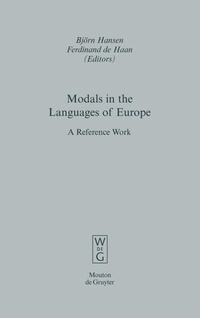
Modals in the Languages of Europe
Description

This book is the first comprehensive survey of modals and modal constructions in the languages of Europe. It is a collaborative effort between scholars from Europe and the United States, stemming from a workshop on Modals in the Languages of Europe in Valencia.
The aim of this book is to describe the properties of modals and modal constructions in the European area and to compare the systems in individual languages or language families from an areal and genetic perspective. For the sake of contrast, the book also looks at the expression of modality in some languages just outside of Europe. The book consists of fourteen chapters on modal systems in individual languages or language families, written by experts in the respective languages, and an introductory and concluding chapter, written by the editors.
The book gives both a description of the modals in the individual languages and an account of the nature and status of modals in general. It provides the reader with a theoretical account of how modals and modal constructions are grammaticalized. This theoretical account is informed by the parameters of grammaticalization of Christian Lehmann. These parameters were chosen because they are language-independent, as opposed to more language specific criteria (for instance, the NICE-criteria for English). The parameters themselves are examined as well for their suitability as part of any theory of grammaticalization.
The book thus gives readers access to a collection of data on modality that surpasses most works in this field and also provides a fresh perspective on issues of grammaticalization and language contact. It is therefore of interest to scholars of modality, language contact and areal linguistics, grammaticalization theory and typology.
Reviews / Votes
"This book provides excellent new research on modality in languages where studies on modal constructions are rarely conducted. It also emphasizes the impact of language contact in modality."Stella Gevorgyan-Ninness in Linguist List 22.186 "This is a useful reference guide for students of comparative linguistics."In: Scitech Book News Book News Inc. 2/2010More details
Other editions
Additional editions
Persons
Content
2 - List of contributors [Seite 8]
3 - Abbreviations used in glossing [Seite 13]
4 - 1. Introduction [Seite 16]
5 - A. Modals in Indo-European languages (Western branch) [Seite 24]
5.1 - 2. Modals in the Germanic languages [Seite 26]
5.2 - 3. Modals in Irish [Seite 86]
5.3 - 4. Modals in the Romance languages [Seite 122]
5.4 - 5. Modals in Greek [Seite 154]
6 - B. Modals in Indo-European languages (Eastern branch) [Seite 180]
6.1 - 6. Modals in the Slavonic languages [Seite 182]
6.2 - 7. Modals in Baltic [Seite 214]
6.3 - 8. Modals in Albanian [Seite 244]
6.4 - 9. Modality in Romani [Seite 282]
7 - C. Modals in Non-Indo-European languages [Seite 338]
7.1 - 10. The grammaticalisation of modal auxiliaries in Maltese and Arabic vernaculars of the Mediterranean area [Seite 340]
7.2 - 11. Modal verbs in Balto-Finnic [Seite 378]
7.3 - 12. Modals in Hungarian [Seite 418]
7.4 - 13. Mood and modality in Berber [Seite 446]
7.5 - 14. Modality in Basque [Seite 472]
7.6 - 15. Modals in Turkic [Seite 502]
7.7 - 16. Concluding chapter: modal constructions in the languages of Europe [Seite 526]
8 - Subject index [Seite 576]
9 - Languages and language varieties index [Seite 584]
