

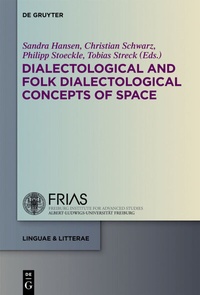
Dialectological and Folk Dialectological Concepts of Space
Description

In variational linguistics, the concept of space has always been a central issue. However, different research traditions considering space coexisted for a long time separately. Traditional dialectology focused primarily on the diatopic dimension of linguistic variation, whereas in sociolinguistic studies diastratic and diaphasic dimensions were considered. For a long time only very few linguistic investigations tried to combine both research traditions in a two-dimensional design - a desideratum which is meant to be compensated by the contributions of this volume. The articles present findings from empirical studies which take on these different concepts and examine how they relate to one another. Besides dialectological and sociolinguistic concepts also a lay perspective of linguistic space is considered, a paradigm that is often referred to as "folk dialectology". Many of the studies in this volume make use of new computational possibilities of processing and cartographically representing large corpora of linguistic data. The empirical studies incorporate findings from different linguistic communities in Europe and pursue the objective to shed light on the inter-relationship between the different concepts of space and their relevance to variational linguistics.
More details
Other editions
Additional editions
Persons
Content
2 - Countering the urbanist agenda in variationist sociolinguistics: dialect contact, demographic change and the rural-urban dichotomy [Seite 20]
3 - Dialectal concepts of space and linguistic variation [Seite 39]
4 - Dialektalität, Dialektwissen und Hyperdialektalität aus soziolinguistischer Perspektive [Seite 56]
5 - A perceptual study of ethnicity and geographical location in London and Birmingham [Seite 83]
6 - Der Sprachgebrauch "bei uns" - Arealbildung in Karten des Atlas zur deutschen Alltagssprache, objektive Grenzen und subjektive Räume [Seite 104]
7 - Making sense of space - on dialect production and perception at the Finland-Sweden border [Seite 127]
8 - The folk linguistic construction of local dialect areas - linguistic and extra-linguistic factors [Seite 150]
9 - Mapping the perceptions of non-linguists in Northern England [Seite 172]
10 - Konservative vs. innovative Dialektgebiete. Ein quantitativer Ansatz zu ihrer Bestimmung auf der Grundlage spontansprachlicher Daten aus Südwestdeutschland [Seite 187]
11 - Dialectometric concepts of space: Towards a variant-based dialectometry [Seite 207]
12 - Geography is overrated [Seite 223]
13 - Dialektareale in Baden-Württemberg. Dialektometrische Analysen spontansprachlicher Daten aus Südwestdeutschland und Überlegungen zum Zusammenhang von objektiven Dialektgrenzen und mentalen Raumkonzepten [Seite 240]
14 - The measurement of Dutch dialect change in the sound components [Seite 258]
15 - Appendix/colour maps [Seite 277]
