

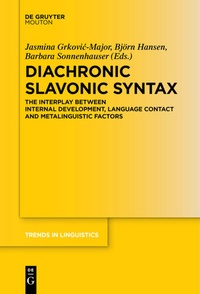
Diachronic Slavonic Syntax
The Interplay between Internal Development, Language Contact and Metalinguistic Factors
1st Edition
Published on 5. March 2018
VI, 410 pages
978-3-11-053143-5 (ISBN)
Description

The book is dedicated to the study of the causes and mechanisms of syntactic change in Slavonic languages, including internally motivated syntactic change, syntactic change under contact conditions (structural convergence, pattern replication, shift-induced transfer etc.): It also explores metalinguistic factors such as ideologically driven selection and propagation of syntactic structures.
More details
Series
Language
English
Place of publication
Berlin/Boston
Germany
Publishing group
de Gruyter Mouton
Target group
Professional and scholarly
US School Grade: College Graduate Student
Illustrations
26 ill., 27 tbl.
File size
1,84 MB
ISBN-13
978-3-11-053143-5 (9783110531435)
Schweitzer Classification
Other editions
Additional editions
Björn Hansen | Jasmina Grkovic-Major | Barbara Sonnenhauser
Diachronic Slavonic Syntax
The Interplay between Internal Development, Language Contact and Metalinguistic Factors
Book
12/2019
1st Edition
De Gruyter Mouton
€39.95
Shipment within 7-9 days
Björn Hansen | Jasmina Grkovic-Major | Barbara Sonnenhauser
Diachronic Slavonic Syntax
The Interplay between Internal Development, Language Contact and Metalinguistic Factors
Book
03/2018
1st Edition
De Gruyter Mouton
€169.95
The article will not be published
Björn Hansen | Jasmina Grkovic-Major | Barbara Sonnenhauser
Diachronic Slavonic Syntax
The Interplay between Internal Development, Language Contact and Metalinguistic Factors
Book
03/2018
1st Edition
De Gruyter Mouton
€169.95
Shipment within 7-9 days
Björn Hansen | Jasmina Grkovic-Major | Barbara Sonnenhauser
Diachronic Slavonic Syntax
The Interplay between Internal Development, Language Contact and Metalinguistic Factors
E-Book
03/2018
1st Edition
De Gruyter Mouton
€169.95
Available for download
Persons
Björn Hansen
, University of Regensburg;
Jasmina Grkovic-Major
, University of Novi Sad;
Barbara Sonnenhauser
, University of Zurich.
Content
- Intro
- Contents
- Introduction
- Part I: The noun phrase
- Some observations on the usage of adnominal genitives and datives in Middle Bulgarian Church Slavonic
- Quantifying syntactic influence: Word order, possession and definiteness in Old Church Slavonic and Greek
- The decay of cases in Molise Slavonic
- Part II: The verbal phrase and related topics
- Null subjects and person in Old North Russian
- On the permeability of grammars: Syntactic pattern replications in heritage Croatian and heritage Serbian spoken in Germany
- Possessive resultative constructions in Old and Middle Polish
- Mechanisms of word order change in 12⊃&th&/sup& and 13⊃&th&/sup& century Serbian
- Historical development and contemporary usage of discourse structuring elements based on verba dicendi in Croatian
- Part III: The complex sentence
- The status and origin of the accusativus cum infinitivo construction in Old Church Slavonic
- On triangulation in the domain of clause linkage and propositional marking
- The development of perception verb complements in the Serbian language
- A tale of two pathways: On the development of relative clause chaining in East Slavonic
- Relativisation strategies in Slovene: Diachrony between language use and language description
- Index
