

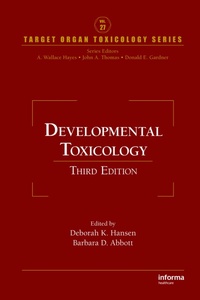
Developmental Toxicology
3rd Edition
Published on 22. October 2008
496 pages
978-1-4200-5438-5 (ISBN)
Description

Highlighting latest advances in genetics and biochemistry, the completely revised Third Edition reviews the field from basic science, clinical, epidemiological, and regulatory perspectives. Contributions from top opinion leaders in the field bring together developments in molecular embryology and cell biology as they apply to problems in developmental toxicology. It covers testing of pharmaceutical and environmental agents and interpretation of developmental toxicology data, highlighting mathematical and statistical techniques, as well as the effects of toxic exposure on the functional development of various organs.
The relationship between maternal and developmental toxicology is examined, in addition to current techniques for studying chemical disposition, metabolism, and placental transfer. Close attention is given to the regulatory aspects of testing and risk assessment. Pre- and postconceptional clinical care and genetic factors in clinical developmental toxicology are also discussed.
Key topics include:
the roles of apoptosis and signal transduction pathways in normal and abnormal development
the role of epigenetic changes in development
the role of nutrition and individual susceptibility
the utility of bioinformatics
global and targeted gene expression changes.
The relationship between maternal and developmental toxicology is examined, in addition to current techniques for studying chemical disposition, metabolism, and placental transfer. Close attention is given to the regulatory aspects of testing and risk assessment. Pre- and postconceptional clinical care and genetic factors in clinical developmental toxicology are also discussed.
Key topics include:
the roles of apoptosis and signal transduction pathways in normal and abnormal development
the role of epigenetic changes in development
the role of nutrition and individual susceptibility
the utility of bioinformatics
global and targeted gene expression changes.
More details
Series
Edition
3rd edition
Language
English
Place of publication
Baton Rouge
United States
Publishing group
Taylor & Francis Inc
Target group
Professional and scholarly
Biomedical scientists and engineers, obstetricians, and gynecologists.
Edition type
Revised edition
Illustrations
45 s/w Abbildungen, 22 farbige Abbildungen, 22 s/w Tabellen, 17 s/w Photographien bzw. Rasterbilder
45 b/w images, 22 color images, 22 tables and 17 halftones
File size
9,93 MB
ISBN-13
978-1-4200-5438-5 (9781420054385)
Copyright in bibliographic data and cover images is held by Nielsen Book Services Limited or by the publishers or by their respective licensors: all rights reserved.
Schweitzer Classification
Other editions
Additional editions
Deborah K. Hansen | Barbara D. Abbott
Developmental Toxicology
Book
11/2018
3rd Edition
CRC Press
€96.82
Shipment within 10-20 days
Deborah K. Hansen | Barbara D. Abbott
Developmental Toxicology
Book
10/2008
3rd Edition
CRC Press
€234.50
Article not available at the moment
Persons
DEBORAH K. HANSEN is a research biologist in the Division of Genetic and Reproductive Toxicology, the National Center for Toxicological Research, Jefferson and Adjunct Associate Professor of Pharmacology and Interdisciplinary Toxicology, University of Arkansas for Medical Sciences, Little Rock, Arkansas, USA. She received her M.S. in genetics from Iowa State University, Ames, Iowa and her Ph.D. in medical genetics from Indiana University School of Medicine, Indianapolis, Indiana, USA. Dr. Hansen is a member of both the Teratology Society, of which she is Secretary, and the Society of Toxicology. She has contributed to numerous peer-reviewed publications on the subjects of reproductive toxicology, embryotoxicity, and developmental toxicology.
BARBARA D. ABBOTT is Research Biologist in the Reproductive Toxicology Division of the U.S. Environmental Protection Agency (EPA), Research Triangle Park, North Carolina, USA. She received both her M.S. and Ph.D. in toxicology from North Carolina State University, Raleigh, North Carolina, USA. Dr. Abbott is a member of the Teratology Society and the Society of Toxicology. She is Associate Editor of Toxicological Sciences and serves on the editorial board of Reproductive Toxicology. Dr. Abbott has also received several Scientific and Technological Achievement awards from the U.S. EPA and has been a frequent invited lecturer at international meetings and symposiums. Her main area of interest is developmental toxicity, particularly complex, interactive signal transduction and receptor-mediated pathways.
BARBARA D. ABBOTT is Research Biologist in the Reproductive Toxicology Division of the U.S. Environmental Protection Agency (EPA), Research Triangle Park, North Carolina, USA. She received both her M.S. and Ph.D. in toxicology from North Carolina State University, Raleigh, North Carolina, USA. Dr. Abbott is a member of the Teratology Society and the Society of Toxicology. She is Associate Editor of Toxicological Sciences and serves on the editorial board of Reproductive Toxicology. Dr. Abbott has also received several Scientific and Technological Achievement awards from the U.S. EPA and has been a frequent invited lecturer at international meetings and symposiums. Her main area of interest is developmental toxicity, particularly complex, interactive signal transduction and receptor-mediated pathways.
Content
1. Role of Apoptosis in Normal and Abnormal Development. 2. Signal transduction pathways as targets for teratogens. 3. Nutrition in Developmental Toxicology. 4. Epigenetic Mechanisms-Role of DNA Methylation, Histone Modifications and Imprinting. 5. Personalized Nutrition and Medicine in Perinatal Development. 6. Targeted Gene changes affecting Developmental Toxicity. 7. Use of mammalian in vitro systems, including embryonic stem cells, in developmental toxicity testing. 8. Zebrafish: a Non-Mammalian Model of Developmental Toxicology. 9. Physiologically-Based Pharmacokinetic Modeling in the risk assessment of developmental toxicants. 10. Integration of whole animal developmental toxicity data into risk assessment. 11. Genomic Approaches in Developmental Toxicology. 12. Comparative Bioinformatics and Computational Toxicology. 13. Investigating Drug Effects in Human Pregnancy.
