

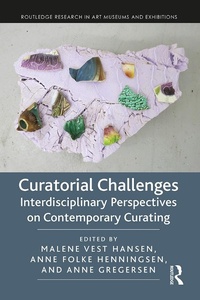
Curatorial Challenges
Interdisciplinary Perspectives on Contemporary Curating
1st Edition
Published on 4. March 2019
266 pages
978-1-351-17449-7 (ISBN)
Description

Curatorial Challenges investigates the challenges faced by curators in contemporary society and explores which practices, ways of thinking, and types of knowledge production curating exhibitions could challenge. Bringing together international curators and researchers from the fields of art and cultural history, the book provides new research and perspectives on the curatorial process and aims to bridge the traditional gap between theoretical and academic museum studies and museum practices.
The book focuses on exhibitions as a primary site of cultural exchange and argues that, as highly visible showcases, producers of knowledge, and historically embedded events, exhibitions establish and organize meanings of art and cultural heritage. Temporary exhibitions continue to increase in cultural significance and yet the traditional role of the museum as a Bildung institution has changed. As exhibitions gain in significance, so too do curatorial strategies. Arguing that new research is needed to help understand these changes, the book presents original research that explores how curatorial strategies inform both art and cultural history museums in contemporary society. The book also investigates what sort of critical, transformative, and perhaps even conservative, potential can be traced in exhibition cultures.
Curatorial Challenges fosters innovative interdisciplinary exchange and brings new insights to the field of curatorial studies. As such, it should be of great interest to academics, researchers, and postgraduate students engaged in the study of curatorial practice, museum studies, the making of exhibitions, museum communication, and art history.
The book focuses on exhibitions as a primary site of cultural exchange and argues that, as highly visible showcases, producers of knowledge, and historically embedded events, exhibitions establish and organize meanings of art and cultural heritage. Temporary exhibitions continue to increase in cultural significance and yet the traditional role of the museum as a Bildung institution has changed. As exhibitions gain in significance, so too do curatorial strategies. Arguing that new research is needed to help understand these changes, the book presents original research that explores how curatorial strategies inform both art and cultural history museums in contemporary society. The book also investigates what sort of critical, transformative, and perhaps even conservative, potential can be traced in exhibition cultures.
Curatorial Challenges fosters innovative interdisciplinary exchange and brings new insights to the field of curatorial studies. As such, it should be of great interest to academics, researchers, and postgraduate students engaged in the study of curatorial practice, museum studies, the making of exhibitions, museum communication, and art history.
More details
Series
Edition
1. Auflage
Language
English
Place of publication
London
United Kingdom
Publishing group
Taylor & Francis Ltd
Target group
College/higher education
File size
34,24 MB
ISBN-13
978-1-351-17449-7 (9781351174497)
Copyright in bibliographic data and cover images is held by Nielsen Book Services Limited or by the publishers or by their respective licensors: all rights reserved.
Schweitzer Classification
Other editions
Additional editions
Malene Vest Hansen | Anne Folke Henningsen | Anne Gregersen
Curatorial Challenges
Interdisciplinary Perspectives on Contemporary Curating
Book
12/2020
1st Edition
Routledge
€67.50
Shipment within 15-20 days
Malene Vest Hansen | Anne Folke Henningsen | Anne Gregersen
Curatorial Challenges
Interdisciplinary Perspectives on Contemporary Curating
Book
03/2019
1st Edition
Routledge
€205.80
Shipment within 15-20 days
Persons
Malene Vest Hansen is Associate Professor of Art History at the University of Copenhagen.
Anne Folke Henningsen is Associate Professor of Ethnology at the University of Copenhagen.
Anne Gregersen is Curator at the J.F. Willumsens Museum and a Postdoctoral Fellow at the University of Copenhagen.
Anne Folke Henningsen is Associate Professor of Ethnology at the University of Copenhagen.
Anne Gregersen is Curator at the J.F. Willumsens Museum and a Postdoctoral Fellow at the University of Copenhagen.
Content
List of Figures
List of contributors
Introduction: Thinking and Doing Exhibitions
Anne Folke Henningsen, Anne Gregersen, and Malene Vest Hansen
Part I. Curating within the Changing Role of Museums as Bildung Institutions
1. Curatorship as Bildungsroman: Or, From Hamlet to Hjelmslev
Donald Preziosi
2. Curating the Nude in Istanbul: Some Curatorial Challenges
Ahu Antmen
3. Curating the Dead Body between Medicine and Culture
Karin Tybjerg
4. Fashion Curation: Unpacking a New Discipline and Practice
Marie Riegels Melchior
5. Exhibition Addresses: The Production of Publics in Exhibitions on Colonial History
Mathias Danbolt
6. Multi-Sited Curating as a Critical Mode of Knowledge Production
Sabine Dahl Nielsen
Part II - Exhibitions and/as Research
7. Curating and Research: An Uneasy Alliance
Simon Sheikh
8. Exhibitions as Research, Curator as Distraction
Peter Bjerregaard
9. Curating a Mild Apocalypse. Researching Anthropocene Ecologies through Analytical Figures
Nathalia Brichet and Frida Hastrup
10. Curating experimental entanglements
Adam Bencard, Louise Whiteley and Caroline Heje Thon
11. The forgotten and the forgettable: the making of The World Goes Pop and Other Stories
Flavia Frigeri
12. Looters, Smugglers, and Collectors: Rethinking Models of Ownership Research and How to Mediate It through the Form of the Exhibition
Tone Hansen
Part III - Revisiting the Past and Challenging Canons
13. Multiple Modernisms: Curating the Postwar Era for the Present
Kristian Handberg
14. Contested Paradise: Exhibiting Images from the Former Danish West Indies
Mette Kia Krabbe Meyer
15. Against the Grain of Neutralization: Exhibiting the Documentary as a Curatorial Production of Subjective Knowledge
Susanne Neubauer
16. Innovative, Polemical, Dogmatic: The Case of Soviet Experimental Museum Displays in 1930-1933
Masha Chlenova
Concluding remarks
Anne Folke Henningsen, Anne Gregersen and Malene Vest Hansen
Index
List of contributors
Introduction: Thinking and Doing Exhibitions
Anne Folke Henningsen, Anne Gregersen, and Malene Vest Hansen
Part I. Curating within the Changing Role of Museums as Bildung Institutions
1. Curatorship as Bildungsroman: Or, From Hamlet to Hjelmslev
Donald Preziosi
2. Curating the Nude in Istanbul: Some Curatorial Challenges
Ahu Antmen
3. Curating the Dead Body between Medicine and Culture
Karin Tybjerg
4. Fashion Curation: Unpacking a New Discipline and Practice
Marie Riegels Melchior
5. Exhibition Addresses: The Production of Publics in Exhibitions on Colonial History
Mathias Danbolt
6. Multi-Sited Curating as a Critical Mode of Knowledge Production
Sabine Dahl Nielsen
Part II - Exhibitions and/as Research
7. Curating and Research: An Uneasy Alliance
Simon Sheikh
8. Exhibitions as Research, Curator as Distraction
Peter Bjerregaard
9. Curating a Mild Apocalypse. Researching Anthropocene Ecologies through Analytical Figures
Nathalia Brichet and Frida Hastrup
10. Curating experimental entanglements
Adam Bencard, Louise Whiteley and Caroline Heje Thon
11. The forgotten and the forgettable: the making of The World Goes Pop and Other Stories
Flavia Frigeri
12. Looters, Smugglers, and Collectors: Rethinking Models of Ownership Research and How to Mediate It through the Form of the Exhibition
Tone Hansen
Part III - Revisiting the Past and Challenging Canons
13. Multiple Modernisms: Curating the Postwar Era for the Present
Kristian Handberg
14. Contested Paradise: Exhibiting Images from the Former Danish West Indies
Mette Kia Krabbe Meyer
15. Against the Grain of Neutralization: Exhibiting the Documentary as a Curatorial Production of Subjective Knowledge
Susanne Neubauer
16. Innovative, Polemical, Dogmatic: The Case of Soviet Experimental Museum Displays in 1930-1933
Masha Chlenova
Concluding remarks
Anne Folke Henningsen, Anne Gregersen and Malene Vest Hansen
Index
