

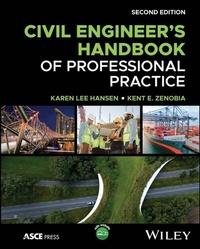
Civil Engineer's Handbook of Professional Practice
Description

A single-source guide to the professional practice of civil engineering
Civil Engineer's Handbook of Professional Practice, Second Edition assists students and practicing and professional engineers in addressing the many challenges they face. This guide expands on the practical skills defined by the American Society of Civil Engineers' (ASCE's) Civil Engineering Body of Knowledge (CEBOK) and provides illuminating techniques, quotes, example problems/solutions, case studies, and valuable information that engineers encounter in the real world. Including critical information on project management, leadership, and communication, this powerful resource distills the Accreditation Board for Science and Technology's (ABET's) requirements for a successful career and licensure.
Due to the large amount of information that is presented in an easy-to-digest way, this handbook enables civil engineers to be competitive at an international level, building on their traditional strengths in technology and science while also providing the ability to master the business of civil engineering.
In this second edition, readers will find:
- Modern business topics such as design thinking, affirmative action, equal opportunity and diversity, negotiation, health and safety requirements, construction management, body language interpretation skills, project management, and scheduling
- Key discussions of executing a professional commission, the engineer's role in project development, professional engagement, and ethics
- Updated examples of everyday challenges for civil engineers, including defining the project, establishing objectives and innovative approaches, identifying resources and constraints, preparing a critical path schedule, quality control, and orchestrating project delivery
- The latest applications of emerging technologies, globalization impacts, and new sustainability applications for civil engineers
- Examples of a civil engineering request for proposal and corresponding workplan and feasibility study, technical report, specification, contracts, and scheduling and cost control tools
Providing comprehensive coverage and in-depth guidance from leading industry and academic professionals, Civil Engineer's Handbook of Professional Practice, Second Edition is a valuable reference for early-career and experienced civil engineers alike. It is also highly appropriate for upper-level undergraduate and graduate courses in Professional Practice and Engineering Project Management. Instructors have access to an instructor's manual via the book's companion website.
More details
Other editions
Additional editions
Persons
Karen Lee Hansen, Ph.D., ASCE, Assoc. AIA, DBIA is Professor of Civil Engineering and Construction Management at California State University and holds a Master of Science in construction engineering and management and a doctorate in civil engineering from Stanford University. She also performed post-doctorate modeling design requirements at University of Strathclyde in Glasgow, Scotland. A former engineering manager at The Boeing Company, Dr. Hansen has worked as senior project executive for large commercial and industrial contractors and has been employed by national and international universities and AEC firms.
Kent E. Zenobia, P.E., F. ASCE, BCEE is a registered civil engineer in four states with more than 35 years' experience in civil, water resources, hazardous waste management, site restoration, and environmental engineering in private industry, engineering consulting, and California state government with a BSCE from New Jersey Institute of Technology and an Master of Science in Environmental Engineering from Drexel University. For his outstanding contributions to civil engineering, Mr. Zenobia has been recognized formally by the American Society of Civil Engineers and the American Academy of Environmental Engineering.
Content
Contributing Authors xxi
Contributing Editors xxvii
Preface xxxi
Acknowledgments xxxiii
List of Abbreviations xxxv
About the Companion Website xlv
Chapter 1 Introduction 1
1.1 Background 2
1.2 The Need for Accreditation 3
1.3 American Society of Civil Engineers 4
1.4 21st Century Engineer 12
1.5 Goal of This Book 17
1.6 Readers' Guide 17
1.7 Summary 19
Bibliography 20
Chapter 2 Background and History of the Profession 21
2.1 Background 22
2.2 Civil Engineering's Historical Inheritance 22
2.3 The Ancient Engineers 23
2.4 Engineering in Medieval Times 44
2.5 Engineering in the Renaissance and the Age of Enlightenment 46
2.6 The Industrial Revolution 48
2.7 Modern Civil Engineering 53
2.8 Summary 58
Bibliography 59
Chapter 3 Ethics 61
3.1 Introduction 62
3.2 Defining the Engineer's Ethical Code 64
3.3 ASCE's New Code of Ethics- Summary Part 1 of 2 66
3.4 ASCE's New Code of Ethics-Summary Part 2 of 2 69
3.5 The American Society of Civil Engineers Code of Ethics 73
3.6 The American Council of Engineering Companies Ethical Conduct Guidelines 75
3.7 The International Federation of Consulting Engineers (FIDIC) Code of Ethics 78
3.8 FIDIC Code of Ethics 78
3.9 Important and Relevant Policy Statements by ASCE and NSPE 80
3.10 Summary 89
Bibliography 91
Chapter 4 Professional Engagement 93
4.1 Introduction 94
4.2 Contracting with the Government 96
4.3 Fee-Based Selection 107
4.4 Writing Engineering Proposals 108
4.5 The Contract 114
4.6 Budgeting 120
4.7 Enhancing the Engineering Firm's Probability for a Successful Professional Engagement 121
4.8 Working Example of a Request for Proposals (RFPs) 122
4.9 Typical Civil Engineering Proposal 123
4.10 Typical Engineering Feasibility Study 124
4.11 Summary 125
Bibliography 125
Chapter 5 The Engineer's Role in Project Development 127
5.1 Background 128
5.2 Participants in the Process-The Players 129
5.3 The Flow of Work 134
5.4 Predesign 134
5.5 Design 142
5.6 Design During Bid and Construction 151
5.7 Post-construction Activity 153
5.8 Summary 157
Bibliography 157
Chapter 6 What Engineers Deliver 161
6.1 Background 162
6.2 Contract Documents 163
6.3 Drawings 166
6.4 Specifications 173
6.5 Drawings and Specifications - Final Thoughts 181
6.6 Technical Memos and Reports 182
6.7 Calculations 183
6.8 Other Deliverables 185
6.9 Summary 186
Bibliography 186
Chapter 7 Executing a Professional Commission-Project Management 187
7.1 Introduction 188
7.2 The Basics of Project Management 197
7.3 The Major Parties on a Project 199
7.4 Project Sectors 200
7.5 Project Teams 202
7.6 Project Initiation 203
7.7 Project Estimates 204
7.8 Project Management Plan Components 210
7.9 Staff Selection Guidelines for the PM 212
7.10 The Project Manager's Responsibilities 215
7.11 Project Risk Management 221
7.12 Design Coordination 222
7.13 Summary 228
Bibliography 229
Chapter 8 Permitting 231
8.1 Introduction 232
8.2 Accept the Requirements for Permits 234
8.3 Respect the Staff Implementing the Permits 234
8.4 Initiate the Permitting Processing Early 235
8.5 Identifying Permits with the US Environmental Protection Agency (USEPA) 238
8.6 Managing Permits 241
8.7 Streamlining Permits 244
8.8 Sample Permit Table 244
8.9 Sample United States Army Corps of Engineers (USACE), Section 408 Permit 249
8.10 Summary 253
Bibliography 254
Chapter 9 The Client Relationship and Business Development 255
9.1 Introduction 256
9.2 The Foundation of a Lasting Relationship 258
9.3 Building upon the Relationship-the Superstructure 260
9.4 Maintaining the Relationship 261
9.5 Cultivating Business Opportunities 264
9.6 Business Development 265
9.7 Conflict Management 267
9.8 Summary 270
Bibliography 270
Chapter 10 Leadership 271
10.1 Introduction 273
10.2 Background 273
10.3 Leadership Styles 279
10.4 Tools for Leadership and Management 286
10.5 Four Key Skill Sets Possessed by Effective Civil Engineering Leaders 289
10.6 Secret Recipe for an Effective Leader 298
10.7 Summary 299
Bibliography 299
Chapter 11 Legal Aspects of Professional Practice 301
11.1 Introduction 302
11.2 US Legal System 303
11.3 Statutory Law 304
11.4 Common Law 304
11.5 Contract Law 309
11.6 Procurement Method 326
11.7 Risk Management 330
11.8 Insurance and Bonds 341
11.9 Dispute Resolution 346
11.10 Alternative Dispute Resolution 353
11.11 Affirmative Action, Equal Opportunity, and Diversity 356
11.12 Summary 358
Bibliography 358
Chapter 12 Managing the Civil Engineering Enterprise 361
12.1 Introduction 362
12.2 The Influence of Economics on Project Development 363
12.3 Financial Reporting 370
12.4 Professional Human Resources Management 374
12.5 Career Planning and Execution 375
12.6 Specialization 376
12.7 Certification and Registration 377
12.8 Professional Services Marketing 378
12.9 Professional Business Development 382
12.10 Professional and Trade Organization Activities 384
12.11 Summary 385
Bibliography 385
Chapter 13 Communicating as a Professional Engineer 387
13.1 Introduction 388
13.2 Communication Conduits 391
13.3 Body Language-How to Read Unspoken Signals 394
13.4 Conflict Resolution 399
13.5 Behavioral Characteristics of Team Members, Friends, or Family 401
13.6 Typical Report Format 402
13.7 Useful Forms for the Engineer 405
13.8 Useful Letters (or E-Mails) for the Engineer 405
13.9 Sample PowerPoint Presentation 411
13.10 Summary 411
Bibliography 411
Chapter 14 Balancing Life, Family, and Career 413
14.1 Introduction 414
14.2 A Concept from Physics and Thermodynamics Called Negentropy and Posentropy 415
14.3 The Key Components to Your Being 418
14.4 The Mind 418
14.5 The Body 421
14.6 The Spirit 422
14.7 The Effective Combination of Mind, Body, and Spirit 423
14.8 Laugh and Have Fun 423
14.9 Self-Assessment-Please Challenge Yourself 426
14.10 Analysis of the Assessment 427
14.11 Summary 432
Bibliography 434
Chapter 15 Globalization 435
15.1 Introduction 436
15.2 The Globalization Process 437
15.3 Global Climate Change-A World View and a State Perspective 439
15.4 Outcomes of Globalization and Climate Change 457
15.5 Learning to Project Manage a Mega-Project-The Case of BAA and Heathrow Terminal 5 460
15.6 Civil Engineering Practice-A Wider Community Viewpoint 470
15.7 Summary 479
Bibliography 481
Chapter 16 Sustainability 485
16.1 Introduction 486
16.2 Sustainability Defined 489
16.3 Sustainable Engineering 490
16.4 Systems Thinking 492
16.5 Ecodesign 493
16.6 Toward New Values and Processes 495
16.7 Expanded Project Delivery Process 499
16.8 Integrative Approaches 499
16.9 Sustainable Design and Materials Strategies 501
16.10 Lifecycle Cost Analysis 505
16.11 Leadership in Energy and Environmental Design 511
16.12 Future Directions 517
16.13 Four Ways Civil Engineers Can Become More Sustainable 519
16.14 Summary 525
References 526
Chapter 17 Emerging Technologies 529
17.1 Introduction 530
17.2 Current Emerging and Innovative Technologies 531
17.3 The Nature of Change 538
17.4 Information Technology-Enabled Process Change 540
17.5 Building Information Modeling 543
17.6 Integrated Project Delivery 548
17.7 FIATECH Roadmap-An Organizing Principle 553
17.8 Engineering Thinking 558
17.9 Summary 567
References 567
Chapter 18 Human Relations Policies and Employment Practices 569
18.1 Introduction 570
18.2 Rules of Engagement 572
18.3 Compliance with Employment Laws and Typical Human Resources Policies 573
18.4 Forecasting 582
18.5 Hiring 584
18.6 Training 587
18.7 Compensation and Benefits Plans 592
18.8 Health and Safety 594
18.9 Employee Retention 595
18.10 Summary 596
Bibliography 596
Chapter 19 Construction Management for Engineers 597
19.1 Introduction 598
19.2 Project Planning 600
19.3 Parties to a Project 605
19.4 Work Breakdown Structure 610
19.5 Project Scheduling 617
19.6 Project Estimating 626
19.7 Project Close-Out 636
19.8 Summary 641
Bibliography 641
Chapter 20 Health and Safety Knowledge for Civil Engineers 643
20.1 Introduction 644
20.2 The Occupational Safety and Health Administration (OSHA) and its Importance to Civil Engineers 646
20.3 Health and Safety Programs and Project Plans 655
20.4 Civil Engineer's Health and Safety Toolbox 659
20.5 OSHA Quick Reference Card for Top 4 Construction Site Hazards and Construction Personal Protective Equipment (PPE) 675
20.6 Organization/Company/Employee Responsibilities and Employee Rights 675
20.7 Summary 677
Bibliography 678
Chapter 21 What Civil Engineers Need to Know 679
21.1 Background 680
21.2 Civil Engineering as a Profession 680
21.3 Civil Engineering Education 682
21.4 Civil Engineering Careers 684
21.5 What Successful Civil Engineers Need to Know 686
21.6 Summary 701
Bibliography 702
Appendix A Example Request for Proposal (RFP) 703
Appendix B Example Proposal 713
Appendix C Example Feasibility Study Report 729
Appendix D Example Short Technical Report: The Benefits of Green Roofs 777
Appendix E Example Specification: Cast-in-Place Concrete 785
Appendix F EJCDC® Model Contract - Agreement Between Owner and Engineer for Study and Report Professional Services 795
Appendix G Design and Construction Documents Mosquito Bridge Project 821
Index 839
Contributing Authors
Keith A. Bisharat, BS, MS is an emeritus professor in the Department of Construction Management at California State University, Sacramento. Keith has a Bachelor of Science in Architecture and a Master of Science in Engineering and Project Management from the University of California, Berkeley He is also a licensed general contractor with more than 35 years of experience in construction as a sole proprietor, partner, forensic construction consultant, developer, building designer, project manager, superintendent, project engineer, carpenter, and laborer. He is author of Construction Graphics: A Practical Guide to Interpreting Working Drawings, a book that shows how construction graphics "translate" into construction methods and practices.
Mary Balogh, MS obtained her BS degrees in Natural Resource Management & Water Quality Management and a MS degree in Remote Sensing from the University of Wisconsin. She worked for the US Fish & Wildlife Service (USFWS) where she provided GIS, Global Positioning System (GPS), and Remote Sensing support to the regional office and field offices. She also mapped vegetation at National Wildlife Refuges in support of Comprehensive Conservation Plans. While at the USFWS Mary has written training documentation for GIS, GPS, and Remote Sensing and has published and edited articles for Photogrammetric Engineering & Remote Sensing, a peer reviewed scientific journal.
Dr. Tim Brady has been researching innovation and innovation management since 1980. He is a Principal Research Fellow at the Center for Research and Innovation Management (CENTRIM), at the University of Brighton, United Kingdom. He joined CENTRIM in 1994 to work on a study of the management of innovation within complex product systems (CoPS) and later became Deputy Director of the Economic and Social Research Council (ESRC)-funded CoPS Innovation Centre. His current research interests include learning and capability development in project- based business, and the emergence of integrated solutions. He was a member of the Engineering and Physical Sciences Research Council (EPSRC) network: Rethinking Project Management and organized the eighth International Network on Organizing by Projects (IRNOP) research conference, which took place in Brighton in September 2007. He previously worked at the Science Policy Research Unit (SPRU), University of Sussex, and at the University of Bath. Dr. Brady's Ph.D. dissertation examined business software 'make-or-buy' decisions.
Jody Bussey, DBIA, PMP has worked for architects, general contractors, and construction management firms since 2000. She graduated magna cum laude from California State University, Sacramento with a BS in Construction Management with a minor in Business Administration. Her involvement on a LEED Gold high rise construction project introduced her to sustainable design and construction. Jody worked at PMA Consultants, acting as a senior engineer assisting with construction management services on the San Francisco Water System Improvement Program, involving multiple pipelines, a water treatment facility, and crossover valve facility projects totaling $300M. The projects include the $85M Tesla UV Water Treatment Plant, a LEED-certified facility that at the time was the third largest in the country and the largest in California. These projects are part of a $4B overall program utilizing state of the art construction management software and award-winning best practices procedures. Jody currently works at McCarthy Building Companies, Inc. as a project executive.
E.J. Koford is a biologist and project manager with 20 years of experience preparing environmental permitting documents, wildlife, and fisheries investigations, threatened and endangered species surveys, EIS/EIRs, water quality evaluations, and environmental regulatory compliance with requirements of CEC, FERC, SMARA, CERCLA, RCRA, NEPA, and CEQA. He has performed field surveys in 18 states and countries. Mr. Koford has an M.S. in Ecology from the University of California at Davis, an A.B. in Zoology from the University of California at Berkeley and is a Certified Wildlife Biologist of the Wildlife Society.
Dr. Iain A. MacLeod, a Chartered Member and Fellow of both the Institute of Civil Engineers (ICE) and Institution of Structural Engineers (IStructE), was a Professor Emeritus in the Department of Civil Engineering, Strathclyde University. He worked as a design engineer and consultant in the United States and Canada and in design research with the Portland Cement Association in the United States. He was Professor of Structural Engineering at the University of Strathclyde in Glasgow for 23 years and Professor and Head of Department at Paisley University. He was a former Lecturer at the University of Glasgow. His research work has spanned a range of topics in the design of buildings, including the analysis of tall buildings, the use of information technology (IT) in design and studies in design process. He is author of Modern Structural Analysis: Modelling Process and Guidance, published by Thomas Telford Ltd., a book that redresses the imbalance in risk between computer models based around generally determinate calculation outputs and possibly non-de- terminate understandings of the actual modeling process.
Dr. Jane E. Millar, principal of Jane Millar & Associates in Brighton, United Kingdom, consults in Policy Research. She has been a Senior Research Fellow at the Migration Research Unit (MRU), University College London; at the Institute for Public Policy Research in London; and at the Policy Research Unit (SPRU), University of Sussex. She holds a Ph.D. in Cognitive and Computing Sciences from the University of Sussex and managed a wide range of projects in both industry and academia.
Brian Neale, a Chartered Engineer, a Fellow of both the Institution of Civil Engineers (ICE) and the Institution of Structural Engineers (IStructE), and an Honorary Fellow of the Institute of Demolition Engineers (IDE) in the United Kingdom, where he is a former independent consultant and former Executive Secretary of the UK based Hazards Forum. Previously he worked for various Government departments and other professional Civil Engineering organizations. He has been active at various stages with each of those three professional bodies as well as in national and international standards-making. An example includes chairing the drafting committee of the BS6187:2011 Code of Practice for Full and Partial Demolition standard and also its 2010 predecessor. A further example is as a European Committee for Standardization (CEN) convenor, where Mr. Neale oversaw the drafting of one of the Structural Eurocodes as well as contributing to others. He initiated and chaired the Organizing Committees of the four International Conferences on Forensic Engineering from 2001 organized by the ICE and supported by the American Society of Civil Engineers (ASCE) and was editor of the associated published proceedings. His published papers include an international dimension, and his consultancy includes a training element.
Danny Nguyen, E.I.T . has a Bachelor of Science degree from California State University, Sacramento in Civil Engineering and is currently a CSUS graduate student in Transportation/Civil Engineering. With a leadership background, experience in field work, and high activity in both student and professional organizations, Danny gives frequent presentations as part of the civil engineering educational curriculum. He is bilingual and biliterate in Vietnamese and is bilingual in Spanish and Japanese. He is a current active member of the Institute of Transportation Engineers (ITE) and was the past President and is a member of the University Chapter ASCE.
Rob Nixon, PE, GE, is a licensed civil and geotechnical engineer, and has been working in the engineering consulting industry since 1994. He has served in roles including project manager, group manager, contract manager, client account manager, capture manager, department manager, regional market sector leader, growth leader, and division leader. His experience includes design, construction, and supervision of staff and resources, to support development of large-scale public works civil infrastructure. Mr. Nixon received his Bachelor of Science degree in Civil Engineering from California Polytechnic State University, San Luis Obispo, and most recently serves as Vice President at AECOM.
Greg Oslund, P.E. has more than 22 years of experience in the planning, approval, design, management and oversight of transportation projects. He has spent his entire career developing a comprehensive understanding of the project development phases required for these projects including project initiation, planning, programming, project approval and environmental (PA&ED), design (PS&E), utility coordination, permit- ting, R/W acquisition and engineering support during construction. He has served as project engineer, project manager and/or principal in charge for more than 25 large transportation projects. In addition, Mr. Oslund has more than 15 years business development experience involving major transportation project pursuits as the prime consul- tant. He has served as client service manager, pursuit manager and regional business development manager responsible for setting and implementing the business develop and marketing strategy for a large engineering and construction firm.
George T. Qualley,...
