

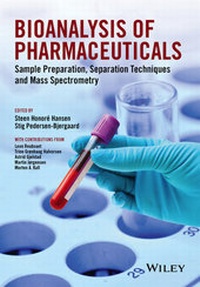
Bioanalysis of Pharmaceuticals
Description

More details
Other editions
Additional editions
Persons
Content
Preface xi
1. Introduction 1
Stig Pedersen-Bjergaard
1.1 What Is Bioanalysis? 1
1.2 What Is the Purpose of Bioanalysis, and Where Is It Conducted? 2
1.3 Bioanalysis Is Challenging 6
1.4 The Different Sections of This Textbook 7
2. Physicochemical Properties of Drug Substances 9
Steen Honoré Hansen and Leon Reubsaet
2.1 Bioanalysis in General 9
2.2 Protolytic Properties of Analytes 10
2.3 Partitioning of Substances 12
2.4 Stereochemistry 15
2.5 Peptides and Proteins 18
3. Biological Samples: Their Composition and Properties, and Their Collection and Storage 23
Steen Honoré Hansen
3.1 Introduction 23
3.2 Blood, or Whole Blood 24
3.3 Plasma and Serum 26
3.4 Urine 26
3.5 Feces 27
3.6 Saliva 28
3.7 Cerebrospinal Fluid 28
3.8 Synovial Fluid 28
3.9 Hair and Nails 29
3.10 Tissue (Biopsies) 29
4. General Chromatographic Theory and Principles 31
Steen Honoré Hansen
4.1 General Introduction 31
4.2 General Chromatographic Theory 32
4.3 Theory of Partition 33
4.4 Retention 34
4.5 Separation Efficiency 35
4.6 Resolution 36
4.7 Selectivity 37
4.8 The Separation Process 38
4.9 Chromatographic Principles 41
4.10 Reversed Phase Chromatography 45
4.11 Size Exclusion Chromatography (SEC) 54
4.12 Ion Exchange Chromatography 56
4.13 Chiral Separations 57
5. Quantitative and Qualitative Chromatographic Analysis 61
Steen Honoré Hansen
5.1 Collection of Chromatographic Data 61
5.2 Quantitative Measurements 62
5.3 Calibration Methods 63
5.4 Validation 67
5.5 Qualitative Analysis 69
6. Sample Preparation 73
Stig Pedersen-Bjergaard, Astrid Gjelstad, and Trine Grønhaug Halvorsen
6.1 Why Is Sample Preparation Required? 73
6.2 What Are the Main Strategies? 75
6.3 Protein Precipitation 75
6.4 Liquid-Liquid Extraction 80
6.5 Solid-Phase Extraction 94
6.6 Dilute and Shoot 110
6.7 What Are the Alternative Strategies? 113
7. High-Performance Liquid Chromatography (HPLC) and High-Performance Liquid Chromatography-Mass Spectrometry (LC-MS) 123
Steen Honoré Hansen and Leon Reubsaet
7.1 Introduction 123
7.2 The Solvent Delivery System 125
7.3 Degassing and Filtering of Mobile Phases 127
7.4 Injection of Samples 128
7.5 Temperature Control 128
7.6 Mobile Phases 129
7.7 Stationary Phases and Columns 130
7.8 Detectors 135
7.9 Mass Spectrometric Detection 143
8. Gas Chromatography (GC) 173
Stig Pedersen-Bjergaard
8.1 Basic Principles of GC 173
8.2 GC Instrumentation 174
8.3 Carrier Gas 177
8.4 Stationary Phases 178
8.5 Separation Selectivity in GC 180
8.6 Columns 182
8.7 Injection Systems 183
8.8 Detectors 185
8.9 Derivatization 187
8.10 Gas Chromatography-Mass Spectrometry (GC-MS) 188
9. Analysis of Small-Molecule Drugs in Biological Fluids 207
Steen Honoré Hansen and Stig Pedersen-Bjergaard
9.1 Plasma and Serum Samples 207
9.2 Whole Blood Samples 234
9.3 Dried Blood Spots 241
9.4 Urine Samples 245
9.5 Saliva 253
References 259
10. Analysis of Peptide and Protein Drugs in Biological Fluids 261
Leon Reubsaet and Trine Grønhaug Halvorsen
References 282
11. Regulated Bioanalysis and Guidelines 283
Martin Jørgensen and Morten A. Kall
11.1 Introduction 283
11.2 The Evolution of Regulated Bioanalysis 284
11.3 Bioanalytical Method Validation 286
11.4 Pre-study Validation 287
11.5 In-Study Validation 299
11.6 Documentation 300
11.7 Regulatory Requirements to Bioanalysis 300
11.8 Quality Systems in Regulated Bioanalysis 301
Index 305
