

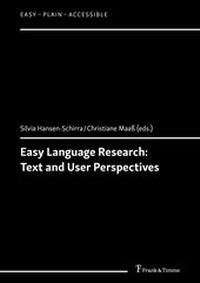
Easy Language Research: Text and User Perspectives
1st Edition
Published on 28. October 2020
288 pages
978-3-7329-9302-4 (ISBN)
Description

This volume presents new approaches in Easy Language research from three different perspectives: text perspective, user perspective and translation perspective. It explores the field of comprehensibility-enhanced varieties at different levels (Easy Language, Plain Language, Easy Language Plus). While all are possible solutions to foster communicative inclusion of people with disabilities, they have varying impacts with regard to their comprehensibility and acceptability. The papers in this volume provide insights into the current scientific activities and results of two research teams at the Universities of Hildesheim and Mainz and present innovative theoretical and empirical perspectives on Easy Language research. The approaches comprise studies on the cognitive processing of Easy Language, on Easy Language in multimodal and multicodal texts and different situational settings as well as translatological considerations on Easy Language translation and interpreting.
Silvia Hansen-Schirra, Professor for English Linguistics and Translation Studies, Johannes Gutenberg University Mainz, Faculty of Translation Studies in Germersheim. Director of the Translation & Cognition (TRA&CO) Center, Head of the research group 'Simply complex - Easy Language'. Christiane Maaß, Professor for Media Linguistics, University of Hildesheim, Institute for Translatology and Specialised Communication, Director of the Research Centre for Easy Language (Forschungsstelle Leichte Sprache), Head of the PhD research team 'Accessible Medical Communication'.
Silvia Hansen-Schirra, Professor for English Linguistics and Translation Studies, Johannes Gutenberg University Mainz, Faculty of Translation Studies in Germersheim. Director of the Translation & Cognition (TRA&CO) Center, Head of the research group 'Simply complex - Easy Language'. Christiane Maaß, Professor for Media Linguistics, University of Hildesheim, Institute for Translatology and Specialised Communication, Director of the Research Centre for Easy Language (Forschungsstelle Leichte Sprache), Head of the PhD research team 'Accessible Medical Communication'.
More details
Other editions
Additional editions
Silvia Hansen-Schirra | Christiane Maaß
Easy Language Research: Text and User Perspectives
Book
09/2020
1st Edition
Frank & Timme
€49.80
Shipment within 7-9 days
Persons
Silvia Hansen-Schirra, Professor for English Linguistics and Translation Studies, Johannes Gutenberg University Mainz, Faculty of Translation Studies in Germersheim. Director of the Translation & Cognition (TRA&CO) Center, Head of the research group "Simply complex - Easy Language".
Christiane Maaß, Professor for Media Linguistics, University of Hildesheim, Institute for Translatology and Specialised Communication, Director of the Research Centre for Easy Language (Forschungsstelle Leichte Sprache), Head of the PhD research team "Accessible Medical Communication".
Christiane Maaß, Professor for Media Linguistics, University of Hildesheim, Institute for Translatology and Specialised Communication, Director of the Research Centre for Easy Language (Forschungsstelle Leichte Sprache), Head of the PhD research team "Accessible Medical Communication".
Content
- Intro
- Part 1: Setting the Stage
- Silvia Hansen-Schirra, Christiane Maaß
- Introduction
- Silvia Hansen-Schirra, Christiane Maaß
- Easy Language, Plain Language, Easy Language Plus: Perspectives on Comprehensibility and Stigmatisation
- 1 Current situation
- 2 Research perspectives
- 3 Modelling Easy Language +
- 4 Target group-specific methodological battery
- 5 Modelling intralingual translation expertise and workflows
- 6 Conclusion
- Part 2: Expert Texts and Translation into Easy Language
- Christiane Maaß, Isabel Rink
- Scenarios for Easy Language Translation: How to Produce Accessible Content for Users with Diverse Needs
- 1 Introduction: Dilemmas in Easy Language Translation
- 2 Enabling participation through EL texts
- 2.1 Scenario A: The target text contains the same amount of information, but is excessively long
- 2.2 Scenario B: The target text contains processable amounts of information but lacks content
- 2.3 Scenario C: The target text is retrievable, perceptible, comprehensible, linkable, acceptable and action-oriented
- 3 Linguistic, conceptual and medial strategies
- 4 Text types in EL translation
- 5 Conclusion
- Loraine Keller
- People with Cognitive Disabilities and their Difficulties with Specialised Interactive Texts
- 1 Introduction
- 2 Corpus background
- 3 Methods
- 4 Theoretical framework
- 5 Results
- 6 Conclusion
- Sarah Ahrens
- Easy Language and Administrative Texts: Second Language Learners as a Target Group
- 1 Introduction
- 2 Administrative language
- 3 Comprehensibility
- 4 Target group: German as a second language learners
- 5 Source text: Hearing Concerning Overpayments
- 6 Easy Language for GSL learners in administration
- 7 Conclusion
- Silvia Hansen-Schirra, Jean Nitzke, Silke Gutermuth, Christiane Maaß, Isabel Rink
- Technologies for the Translation of Specialised Texts into Easy Language
- 1 Introduction
- 2 Strategies in Easy Language translation
- 3 Intralingual terminology management
- 4 Translation memory and intralingual alignment
- 4.1 Fuzzy matches
- 4.2 Intralingual alignment
- 5 Automatising intralingual translation
- 6 Conclusion: professionalisation of Easy Language translation
- Part 3: Multimodal and Multicodal Easy Language Texts
- Christiane Maaß, Sergio Hernández Garrido
- Easy and Plain Language in Audiovisual Translation
- 1 Introduction
- 2 Easy and Plain Language as means of accessible communication
- 2.1 Easy and Plain Language translation as a means to overcome communication barriers
- 2.2 Easy Language
- 2.3 Plain Language
- 3 Easy and Plain Language in audiovisual translation
- 3.1 Audiovisual translation
- 3.1.1 Dubbing
- 3.1.2 Audio description
- 3.1.3 Supertitles
- 3.1.4 Subtitles
- 3.1.5 Subtitles for the Deaf and Hard of Hearing
- 3.1.6 Voiceover
- 3.1.7 Film interpreting
- 3.1.8 Speech-to-text interpreting
- 3.2 Parameters of EL/PL AV translation
- 3.2.1 New creation vs. translation:
- 3.2.2 Inclusive vs. accessible
- 3.2.3 Fictional vs. non-fictional
- 3.2.4 Children vs. adults
- 3.3 Challenges to EL/PL AV translation
- 3.3.1 Limited acceptability
- 3.3.2 Medial restrictions
- 3.3.3 AV translation as partial translation
- 3.4 EL and PL in the different AV translation forms
- 3.4.1 Dubbing
- 3.4.2 Audio description
- 3.4.3 Supertitles
- 3.4.4 Subtitles
- 3.4.5 Subtitles for the deaf and hard of hearing (SDH)
- 3.4.6 Voiceover
- 3.4.7 Film interpreting
- 3.4.8 Speech-to-text interpreting
- 4 Synthesis
- 5 Conclusion
- Rebecca Schulz, Julia Degenhardt, Kirsten Czerner-Nicolas
- Easy Language Interpreting
- 1 Introduction
- 2 Interpreting
- 2.1 Interpreting competence in interlingual interpreting
- 2.2 Interpreting competence in Easy Language interpreting
- 3 The emergence and current situation of Easy Language interpreting in Germany
- 3.1 Origin
- 3.2 Development of the market for Easy Language interpreting in subsequent years
- 4 Conclusion and outlook
- Janina Kröger
- Communication Barriers and Cultural Participation: A Visit to a Wildlife Park as a Multicodal Accessible Text
- 1 Introduction
- 2 Multimodal and multicodal texts
- 3 A visit to a wildlife park as a multicodal text
- 4 Barriers for a visit to a wildlife park
- 5 Analysis
- 6 Conclusion
- Part 4: Cognitive Processing of Easy Language
- Silvia Hansen-Schirra, Walter Bisang, Arne Nagels, Silke Gutermuth, Julia Fuchs, Liv Borghardt, Silvana Deilen, Anne-Kathrin Gros, Laura Schiffl, Johanna Sommer
- Intralingual Translation into Easy Language - Or how to Reduce Cognitive Processing Costs
- 1 Introduction
- 2 Easy Language as intralingual translation
- 3 Modelling complexity for Easy Language
- 4 Empirical evidence for processing costs
- 4.1 Morphology
- 4.2 Lexis
- 4.3 Syntax
- 4.4 Semantics
- 4.5 Text
- 5 Empirical research desiderata for Easy Language
- Laura Schiffl
- Hierarchies in Lexical Complexity: Do Effects of Word Frequency, Word Length and Repetition Exist for the Visual Word Processing of People with Cognitive Impairments?
- 1 Introduction
- 2 Scientific problem and hypotheses
- 3 Procedure
- 3.1 Participants
- 3.2 Methods and materials
- 3.3 Analysis
- 4 Challenges
- 5 Perspectives
- Silvana Deilen
- Visual Segmentation of Compounds in Easy Language: Eye Movement Studies on the Effects of Visual, Morphological and Semantic Factors on the Processing of German Noun-Noun Compounds
- 1 Introduction
- 2 Research questions and hypotheses
- 3 Method
- 3.1 Materials
- 3.2 Participants
- 3.3 Apparatus
- 3.4 Procedure
- 3.5 Analyses
- 4 First results
- 5 Discussion
- Johanna Sommer
- A Study of Negation in German Easy Language - Does Typographic Marking of Negation Words Cause Differences in Processing Negation?
- 1 Easy Language in German - what and why?
- 2 Negation and its processing costs - why it is useful to transform negation?
- 3 The present study (experiment 1)
- 4 Perspectives (experiment 2)
- 5 Conclusion
- Silvana Deilen, Laura Schiffl
- Using Eye-Tracking to Evaluate Language Processing in the Easy Language Target Group Deilen/Schiffl
- 1 Introduction
- 2 Experimental design: planning the experiment
- 3 Data collection
- 4 Conclusion
- On the Authors
