

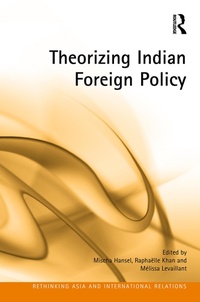
Theorizing Indian Foreign Policy
1st Edition
Published on 21. April 2017
236 pages
978-1-317-01090-6 (ISBN)
Description

Examined from a non-Western lens, the standard International Relations (IR) and Foreign Policy Analysis (FPA) approaches are ill-adapted because of some Eurocentric and conceptual biases. These biases partly stem from: first, the dearth of analyses focusing on non-Western cases; second, the primacy of Western-born concepts and method in the two disciplines. That is what this book seeks to redress. Theorizing Indian Foreign Policy draws together the study of contemporary Indian foreign policy and the methods and theories used by FPA and IR, while simultaneously contributing to a growing reflection on how to theorise a non-Western case. Its chapters offer a refreshing perspective by combining different sets of theories, empirical analyses, historical perspectives and insights from area studies. Empirically, chapters deal with different issues as well as varied bilateral relations and institutional settings. Conceptually, however, they ask similar questions about what is unique about Indian foreign policy and how to study it. The chapters also compel us to reconsider the meaning and boundary conditions of concepts (e.g. coalition government, strategic culture and sovereignty) in a non-Western context. This book will appeal to both specialists and students of Indian foreign policy and International Relations Theory.
Reviews / Votes
"Though it is often called the "largest democracy on earth," Indian foreign policy remains under-theorized. This timely volume, therefore, represents a significant contribution to the literature. Historical, analytical, cultural, and critical insights can all be found within its pages. Scholars of Indian politics as well as Foreign Policy Analysis will find the diverse chapters very useful as they attempt to parse Indian foreign policy." - Valerie M. Hudson, Texas A&M University"After the new wave of Indian foreign policy scholarship that brought archival research and frameworks of international and global history to bear on the subject, this volumes presages a second new wave of scholarship, combining theory, eclectic methods, and rich empirics. Vigorous, insightful, and ranging over historical and contemporary foreign policy cases, this is a stimulating addition to the emerging literature on India's external relations and policies." - Kanti Bajpai, Wilmar Chair in Asian Studies, Lee Kuan Yew School of Public Policy, National University of Singapore
More details
Series
Edition
1. Auflage
Language
English
Place of publication
London
United Kingdom
Publishing group
Taylor & Francis Ltd
Target group
College/higher education
Illustrations
2 Tables, black and white; 3 Line drawings, black and white; 3 Illustrations, black and white
File size
2,73 MB
ISBN-13
978-1-317-01090-6 (9781317010906)
Copyright in bibliographic data and cover images is held by Nielsen Book Services Limited or by the publishers or by their respective licensors: all rights reserved.
Schweitzer Classification
Other editions
Additional editions
Mischa Hansel | Raphaelle Khan | Melissa Levaillant
Theorizing Indian Foreign Policy
Book
07/2019
1st Edition
Routledge
€65.30
Shipment within 15-20 days
Mischa Hansel | Raphaelle Khan | Melissa Levaillant
Theorizing Indian Foreign Policy
Book
04/2017
1st Edition
Routledge
€206.30
Shipment within 10-20 days
Persons
Mischa Hansel is an Assistant Professor (Wissenschaftlicher Mitarbeiter) at the RWTH Aachen University. Previously he worked at the Justus Liebig University Giessen and the University of Cologne where he obtained his Ph.D in 2012. Several of his works deal with the question of whether or not liberal and constructivist FPA approaches are suitable to the study of Indian foreign policy. Recent articles appeared in Global Change, Peace & Security and Asian Politics and Policy respectively. Other research interests include the norms and discourses guiding decisions on military interventions, Western and Non-western military transformation processes, arms control regimes, and German foreign policy.
Raphaelle Khan is a PhD candidate in History/International Politics at King's College London. Her work focuses on India's emergence as an international sovereign actor between the 1920s and the 1960s, through an analysis of Indian understandings of sovereignty. She holds a double Master's Degree in European Studies from the London School of Economics and Political Science (LSE) and the Institut d'Etudes Politiques de Paris (Sciences Po). Her research interests include India's diplomacy in multilateral arenas, International Organisations, International Politics of South Asia, Rising Powers, and Europe-India relations.
Melissa Levaillant is a Researcher at the Institute of Strategic Research (IRSEM) of the French Ministry of Defence. She obtained her PhD from Science Po Paris in 2016, where she teaches World Politics and South Asian Security. Her dissertation was on the institutionalisation of India's ministry of External Affairs, from 1947 to 2015. Her other main research interests include India's foreign policy towards the Middle East and security issues in the Indian Ocean. In 2012, she published a book on India's foreign policy towards Iran.
Raphaelle Khan is a PhD candidate in History/International Politics at King's College London. Her work focuses on India's emergence as an international sovereign actor between the 1920s and the 1960s, through an analysis of Indian understandings of sovereignty. She holds a double Master's Degree in European Studies from the London School of Economics and Political Science (LSE) and the Institut d'Etudes Politiques de Paris (Sciences Po). Her research interests include India's diplomacy in multilateral arenas, International Organisations, International Politics of South Asia, Rising Powers, and Europe-India relations.
Melissa Levaillant is a Researcher at the Institute of Strategic Research (IRSEM) of the French Ministry of Defence. She obtained her PhD from Science Po Paris in 2016, where she teaches World Politics and South Asian Security. Her dissertation was on the institutionalisation of India's ministry of External Affairs, from 1947 to 2015. Her other main research interests include India's foreign policy towards the Middle East and security issues in the Indian Ocean. In 2012, she published a book on India's foreign policy towards Iran.
Content
Chapter 1. Historiography of South Asia's International Relations.
Chapter 2. International Relations and Foreign Policy in India: Policy-oriented Works between Discipline and State.
Chapter 3. More than a Rule Taker: The India Way of Multilateralism.
Chapter 4. India as a Norm Claimer: Normative Struggles and the Assertion of Sovereignty at the San Francisco Conference (1945)
Chapter 5. Theorizing Indian Strategic Culture(s): Taking Stock of a Controversial Debate.
Chapter 6. In Modi's Might? Maintenance Processes and Prospects for De-escalation in the India-Pakistan Rivalry, 1997-2015
Chapter 7. India and Liberal IR Theory: What Role for Public Opinion?
Chapter 8. The Contribution of Neo-institutionalism to the Analysis of India's Diplomacy in the Making.
Chapter 9. India's Taliban Dilemma: To Contain or to Engage?
Chapter 10 Inside Out? Assessing the Domestic Determinants of India's External Behavior
Chapter 2. International Relations and Foreign Policy in India: Policy-oriented Works between Discipline and State.
Chapter 3. More than a Rule Taker: The India Way of Multilateralism.
Chapter 4. India as a Norm Claimer: Normative Struggles and the Assertion of Sovereignty at the San Francisco Conference (1945)
Chapter 5. Theorizing Indian Strategic Culture(s): Taking Stock of a Controversial Debate.
Chapter 6. In Modi's Might? Maintenance Processes and Prospects for De-escalation in the India-Pakistan Rivalry, 1997-2015
Chapter 7. India and Liberal IR Theory: What Role for Public Opinion?
Chapter 8. The Contribution of Neo-institutionalism to the Analysis of India's Diplomacy in the Making.
Chapter 9. India's Taliban Dilemma: To Contain or to Engage?
Chapter 10 Inside Out? Assessing the Domestic Determinants of India's External Behavior
