

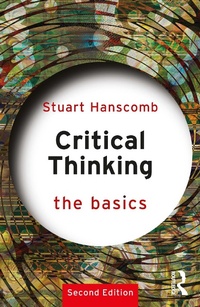
Critical Thinking: The Basics
2nd Edition
Published on 28. June 2023
286 pages
978-1-000-89752-4 (ISBN)
Description

Critical Thinking: The Basics is an accessible and engaging introduction to the field of critical thinking, drawing on philosophy, communication, and psychology. Emphasising its relevance both to academic literacy and to decision-making in a range of contexts, this book introduces and explains the knowledge, methods, and skills needed to identify and avoid poor reasoning, reconstruct and evaluate arguments, and engage constructively in dialogues.
Topics covered include:
The relationship between critical thinking, emotions, and the psychology of persuasion
The role of character dispositions such as open-mindedness, courage, and self-knowledge
Argument identification and reconstruction
Fallacies and argument evaluation.
This second edition has been revised and updated throughout, and includes an additional chapter on the relationship between critical thinking and emotions. There are also new sections on concepts such as the 'experiential mind' and 'need for cognitive closure', and contemporary examples drawn from issues including conspiracy theories, the pandemic, and misuses of social media.
With updated and expanded discussion questions/exercises and suggestions for further reading at the end of each main chapter, this book is an essential read for students approaching the field of critical thinking for the first time, and for the general reader wanting to improving their thinking skills and decision-making abilities.
Topics covered include:
The relationship between critical thinking, emotions, and the psychology of persuasion
The role of character dispositions such as open-mindedness, courage, and self-knowledge
Argument identification and reconstruction
Fallacies and argument evaluation.
This second edition has been revised and updated throughout, and includes an additional chapter on the relationship between critical thinking and emotions. There are also new sections on concepts such as the 'experiential mind' and 'need for cognitive closure', and contemporary examples drawn from issues including conspiracy theories, the pandemic, and misuses of social media.
With updated and expanded discussion questions/exercises and suggestions for further reading at the end of each main chapter, this book is an essential read for students approaching the field of critical thinking for the first time, and for the general reader wanting to improving their thinking skills and decision-making abilities.
Reviews / Votes
Praise for the previous edition:'Critical Thinking: The Basics covers the basics engagingly and without unnecessary jargon, provides lots of well-chosen examples and practice exercises, and, unlike most critical thinking textbooks, explains the theoretical background to the recent rise of critical thinking in education.' - Justine Kingsbury, University of Waikato, New Zealand
'This is an excellent contribution to the growing literature on critical thinking. The discussion on causal reasoning, heuristics and biases, framing, social power, metacognition, and self-deception are timely and valuable. Critical Thinking: The Basics helps to bring together the literature on the psychology and sociology of human judgement with the philosophical art of argument analysis.' - Ted Poston, University of South Alabama, USA
'This text is loaded with references, explanations, history and examples from the development and enhancement of the understanding of critical thinking. It offers a coverage of the basics of critical thinking and also provides a sense of how the field and individual expectations of critical thinking are changing.' - Charles Blatz, Professor Emeritus at University of Toledo, USA.
More details
Series
Edition
2nd edition
Language
English
Place of publication
London
United Kingdom
Publishing group
Taylor & Francis Ltd
Target group
College/higher education
ISBN-13
978-1-000-89752-4 (9781000897524)
Copyright in bibliographic data and cover images is held by Nielsen Book Services Limited or by the publishers or by their respective licensors: all rights reserved.
Schweitzer Classification
Other editions
Additional editions
Book
06/2023
2nd Edition
Routledge
€30.60
Shipment within 10-20 days
Stuart Hanscomb
Critical Thinking: The Basics
Book
06/2023
2nd Edition
Routledge
€200.86
Shipment within 10-20 days
Person
Stuart Hanscomb is a Senior Lecturer in Philosophy and Communication at the University of Glasgow, UK. With Benjamin Franks and Sean Johnston he is author of Environmental Ethics and Behavioural Change, also available from Routledge.
Content
Introduction 1. Rationality, biases and emotions 2. Emotions 3. Critical Thinking and Dispositions 4. Arguments and argument reconstruction 5. Argument forms and fallacies 6. Arguments referring to expertise, power, and message source (I) 7. Arguments referring to expertise, power, and message source (II) 8. Causal arguments, generalisations, arguments from consequences and slippery slope arguments 10. Further fallacies Conclusion. Glossary References Index
