

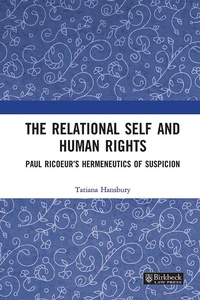
The Relational Self and Human Rights
Paul Ricoeur's Hermeneutics of Suspicion
1st Edition
Published on 18. May 2022
206 pages
978-1-000-58339-7 (ISBN)
Description

This book takes up Paul Ricoeur's relational idea of the self in order to rethink the basis of human rights.
Many schools of critical theory argue that the idea of human rights is based on a problematic conception of the human subject and the legal person. For liberals, the human is a possessive and self-interested individual, such that others are either tools or hurdles in their projects. This book offers a novel reading of subjectivity and rights based on Paul Ricoeur's re-interpretation of human subjectivity as a relational concept. Taking up Ricoeur's idea of recognition as a 'reciprocal gift', it argues that gift exchange is the relation upon which authentic, non-abstract, human subjectivity is based. Seen in this context, human rights can be understood as tokens of mutual recognition, securing a genuinely human life for all. The conception of human rights as gift effectively counters their moral individualism and possessiveness, as the philosophical anthropology of an isolated ego is replaced by that of a related, dependent and embedded self.
This original reinterpretation of human rights will appeal to scholars of legal theory, jurisprudence, politics and philosophy.
Many schools of critical theory argue that the idea of human rights is based on a problematic conception of the human subject and the legal person. For liberals, the human is a possessive and self-interested individual, such that others are either tools or hurdles in their projects. This book offers a novel reading of subjectivity and rights based on Paul Ricoeur's re-interpretation of human subjectivity as a relational concept. Taking up Ricoeur's idea of recognition as a 'reciprocal gift', it argues that gift exchange is the relation upon which authentic, non-abstract, human subjectivity is based. Seen in this context, human rights can be understood as tokens of mutual recognition, securing a genuinely human life for all. The conception of human rights as gift effectively counters their moral individualism and possessiveness, as the philosophical anthropology of an isolated ego is replaced by that of a related, dependent and embedded self.
This original reinterpretation of human rights will appeal to scholars of legal theory, jurisprudence, politics and philosophy.
More details
Series
Edition
1. Auflage
Language
English
Place of publication
London
United Kingdom
Publishing group
Taylor & Francis Ebooks
Target group
College/higher education
ISBN-13
978-1-000-58339-7 (9781000583397)
Copyright in bibliographic data and cover images is held by Nielsen Book Services Limited or by the publishers or by their respective licensors: all rights reserved.
Schweitzer Classification
Other editions
Additional editions
Book
01/2024
1st Edition
Taylor & Francis
€65.10
Shipment within 10-20 days
Book
05/2022
1st Edition
Taylor & Francis
€206.10
Shipment within 10-20 days
Person
Tatiana Hansbury, Birkbeck Law School, University of London.
Content
Introduction
Outline of the problem
The 'relational turn'
Challenges to the reconceptualisation of rights
The approach
Why Ricoeur?
Structure
I. Conditions and limits of a relational reinterpretation of human rights
The evolution and critique of liberal subjectivity and rights
The others of liberalism: communitarianism and relational theory on the rightful place for rights
Addressing entrenchment and indeterminacy
The limits of reinvention: human rights as tradition and critique
II. Configuring a relation: elements of a relational theory of human rights
Self as relation
Human rights as relations
Rights as formal relations
Rights as 'suprapersonal existences'
Concluding remarks; rights' discursive existence
III. Life unfolding, life recounted relational subject in the first-person perspective
In search of the self: the structure of a hermeneutical inquiry
Idem and ipse: the dialectics of selfhood and sameness
Ipseity as commitment to being: narrative and promise
Narrative identity and a relational subject of rights
Promise: ethical self-maintenance
Capacities, incapacities and rights
Esteem and respect: the link between capacities and rights
An incapable subject: a relational corrective
Attestation and trust: epistemology of subjectivity
Concluding remarks: relational subject of rights as a 'life'
IV. Neighbourly dwelling: subjectivity as a dialogue and an institution
Neighbour as an encounter: you and I
Alterity, 'othering', reciprocity and likeness
'Who is my neighbour?': solicitude and equality
Neighbour as the institution
.Neighbour as the institutional other
The 'problematic role of the state'
'In just institutions'
Concluding remarks: subject of rights as 'neighbour'
V. Human rights as gifts between strangers
Rights and gifts: rivals or allies?
Mutual recognition as reciprocal gift
Resistance is futile: the 'struggle for recognition' questioned
Gift as the source of reciprocal obligations
Gift and the recognition/redistribution divide
'Ownership is not what matters': human rights as the gifted property of persons
Questioning the property metaphor
Rights between givers
'A rally of the really human things': the priceless objects of rights
The facets of the priceless
'Life' and 'dwelling' as purposive spheres of human rights
Conclusion
Outline of the problem
The 'relational turn'
Challenges to the reconceptualisation of rights
The approach
Why Ricoeur?
Structure
I. Conditions and limits of a relational reinterpretation of human rights
The evolution and critique of liberal subjectivity and rights
The others of liberalism: communitarianism and relational theory on the rightful place for rights
Addressing entrenchment and indeterminacy
The limits of reinvention: human rights as tradition and critique
II. Configuring a relation: elements of a relational theory of human rights
Self as relation
Human rights as relations
Rights as formal relations
Rights as 'suprapersonal existences'
Concluding remarks; rights' discursive existence
III. Life unfolding, life recounted relational subject in the first-person perspective
In search of the self: the structure of a hermeneutical inquiry
Idem and ipse: the dialectics of selfhood and sameness
Ipseity as commitment to being: narrative and promise
Narrative identity and a relational subject of rights
Promise: ethical self-maintenance
Capacities, incapacities and rights
Esteem and respect: the link between capacities and rights
An incapable subject: a relational corrective
Attestation and trust: epistemology of subjectivity
Concluding remarks: relational subject of rights as a 'life'
IV. Neighbourly dwelling: subjectivity as a dialogue and an institution
Neighbour as an encounter: you and I
Alterity, 'othering', reciprocity and likeness
'Who is my neighbour?': solicitude and equality
Neighbour as the institution
.Neighbour as the institutional other
The 'problematic role of the state'
'In just institutions'
Concluding remarks: subject of rights as 'neighbour'
V. Human rights as gifts between strangers
Rights and gifts: rivals or allies?
Mutual recognition as reciprocal gift
Resistance is futile: the 'struggle for recognition' questioned
Gift as the source of reciprocal obligations
Gift and the recognition/redistribution divide
'Ownership is not what matters': human rights as the gifted property of persons
Questioning the property metaphor
Rights between givers
'A rally of the really human things': the priceless objects of rights
The facets of the priceless
'Life' and 'dwelling' as purposive spheres of human rights
Conclusion
