

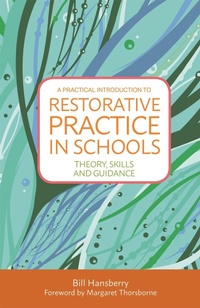
A Practical Introduction to Restorative Practice in Schools
Theory, Skills and Guidance
Published on 21. July 2016
312 pages
978-1-78450-232-4 (ISBN)
Description

Proven to reduce bad behaviour and exclusions, and encourage happier, safer school environments, restorative justice is an effective approach to conflict resolution.
Suitable for education settings from preschool to college, this guide explains what restorative justice is, how it can be used in schools, what it looks like in the classroom and how it can be implemented. Featuring case studies that illuminate the underlying restorative principles and practices, this book covers a wide range of topics from the basics of restorative justice, through to school-wide processes for embedding the approach in policy and practice.
Drawing on the expertise of educators and consultants, this is a must-have resource for any school or centre that is serious about reducing bad behaviour and developing safer learning communities.
Suitable for education settings from preschool to college, this guide explains what restorative justice is, how it can be used in schools, what it looks like in the classroom and how it can be implemented. Featuring case studies that illuminate the underlying restorative principles and practices, this book covers a wide range of topics from the basics of restorative justice, through to school-wide processes for embedding the approach in policy and practice.
Drawing on the expertise of educators and consultants, this is a must-have resource for any school or centre that is serious about reducing bad behaviour and developing safer learning communities.
Reviews / Votes
As a growing community of schools across the globe embrace Restorative Practices, there exists a greater need for resource materials that will give as much careful attention to restorative values and principles as they do to technical guidance around restorative tools. Bill Hansberry has found that sweet spot. Readers who embrace both aspects of this book will be as grounded in their understanding of the vital role of emotion in effective restorative practices as they will be enriched in their ability to practice a variety of restorative approaches. -- Lauren Abramson, Ph.D., Founding Director, Community Conferencing Center, Baltimore, Maryland, USA As interest grows in the use of restorative practice in schools, this new book by Bill Hansberry is a welcome addition to the resources available on the subject. Drawing on the author's personal experience, it provides both valuable insight into the theory underpinning restorative practice and practical advice on how it can be implemented in a school environment. By using case studies, the author also brings to life in an accessible and engaging way what the benefits of a restorative approach can be. Restorative practice should be integral to every school and this book can help to achieve this. -- Jon Collins, Chief Executive, Restorative Justice Council Of the many gifts in this book, I'd like to emphasize a few. Bill mounts compelling arguments for restorative approaches to problem-solving. These arguments are presented in a comprehensive way that will be useful for readers wishing to influence others. Bill's conference preparation, told through his case studies, is impeccable - challenging us to lift our practice, I believe, to new levels. His detailed follow-up work described in section 4 also reminds us that the game is not over once a process has happened. His insights into how children and young people feel and think is very helpful, again helping us to think carefully about our own practice, thoughts and feelings. Finally, though, the whole section called Feeling Restoratively is a must read, if we still need convincing that we need to change the way we work with young people. Bill's grasp of Affect and Script Psychology (Human Being Theory) allows the reader to understand in a deep way, our emotional selves as humans - we are after all, social animals, and we are wired to live in good relationship with others. Important issues around accountability, responsibility, mercy, forgiveness and redemption must be tackled if we are to change our schools, and eventually our communities and world. This book is full of useful ideas and I hope it will become a well-thumbed resource for restorative practitioners. It's a great read. -- From the foreword by Margaret ThorsborneMore details
Edition
Digital original
Language
English
Place of publication
London
United Kingdom
Target group
College/higher education
Professional and scholarly
Primary & secondary/elementary & high school
Edition type
Digital original
File size
1,97 MB
ISBN-13
978-1-78450-232-4 (9781784502324)
Copyright in bibliographic data and cover images is held by Nielsen Book Services Limited or by the publishers or by their respective licensors: all rights reserved.
Schweitzer Classification
Other editions
Additional editions
Bill Hansberry
A Practical Introduction to Restorative Practice in Schools
Theory, Skills and Guidance
Book
07/2016
Jessica Kingsley Publishers
€38.00
Shipment within 15-20 days
Persons
Bill Hansberry runs an education consultancy (www.hansberryec.com.au). Bill is widely recognised for his knowledge about behaviour management, restorative justice and cultural renewal in educational settings. He is also known for his passion for relational teaching, strategic community building and Circle Time, as well as his unique and engaging style in facilitating professional learning workshops for schools, school clusters and other organisations. Bill lives in Adelaide, Australia.
Content
- Intro
- Half Title
- Of Related Interest
- Title Page
- Copyright
- Dedication
- Contents
- Foreword by Margaret Thorsborne
- Acknowledgements
- Preface
- Part 1. Thinking Restoratively: Challenging Paradigms about What to Do when Things Go Wrong
- 1 An Intractable Conflict
- 2 Courage, Connectedness and Restorative Work
- 3 How to be in Charge - Four Modes of Discipline and Control: More Asking and Less Telling
- 4 Restorative Practice in Action: The Case of Tristan and Jason
- 5 Different Questions, Different Outcomes
- Part 2. Feeling Restoratively: A Psychological Framework for Restorative Practice
- 6 Silvan Tomkins and Humans as Emotional Beings
- 7 Affect: What Makes Humans Tick?
- 8 A Blueprint for Mentally Healthy Schools
- 9 Affect Shame: Our Inbuilt Social Alarm Bell
- 10 Grasping the Nettle: Shame's Difficult Demand
- 11 The Compass of Shame
- Part 3. Working Restoratively: Restorative Approaches for Different Ages and Situations
- 12 Continuums of Responses to Disruption and Wrongdoing
- 13 Positive Behaviour Correction
- 14 Affective Statements and Conversations
- 15 The Individual Conference
- 16 The Small Group Conference
- 17 The Large Group Conference
- 18 The Classroom Conference
- 19 The Community Conference
- 20 The Leaving Well Conference
- 21 The Path to Better Restorative Conversations
- 22 Circles for Building Community and Teaching Restorative Thinking
- Part 4. Following Through Restoratively: Managing a Restorative Programme through Follow-Up, Accountability and Relationship Management
- 23 'What Have We Agreed to Here?': Holding Young People Accountable
- 24 Creating Conference Agreements
- 25 Recording and Managing New Conference Agreements
- 26 After the Conference: Relationship Management and Accountability
- 27 How to Review Conference Agreements
- 28 Keeping Colleagues in the Loop About Conference Agreements
- 29 Keeping Parents in the Loop About Conference Agreements
- 30 Concluding Thoughts
- Appendix 1: Pre-No-Blame Classroom Conference Student Reporting Pro Forma
- Appendix 2: Example No-Blame Classroom Conference Pre-Conference Letter to Parents
- Appendix 3: Example No-Blame Classroom Conference Post-Conference Survey
- References
- Subject Index
- Author Index
