

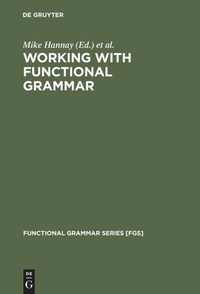
Working with Functional Grammar
Descriptive and Computational Applications
1st Edition
Published on 6. February 2013
XVIII, 272 pages
978-3-11-085990-4 (ISBN)
Description

No detailed description available for "Working with Functional Grammar".
More details
Series
Edition
Reprint 2012
Language
English
Place of publication
Berlin/Boston
Germany
Publishing group
de Gruyter Mouton
Target group
Professional and scholarly
US School Grade: College Graduate Student
Illustrations
Zahlr. Abb.
Num. figs.
File size
7,71 MB
ISBN-13
978-3-11-085990-4 (9783110859904)
Schweitzer Classification
Other editions
Additional editions
Mike Hannay | Elseline Vester
Working with Functional Grammar
Descriptive and Computational Applications
Book
01/1990
1st Edition
De Gruyter Mouton
€169.95
Article exhausted; check different version
Mike Hannay | Elseline Vester
Working with Functional Grammar
Descriptive and Computational Applications
Book
01/1990
1st Edition
De Gruyter Mouton
€119.95
Shipment within 7-9 days
Content
- Intro
- FOREWORD
- LIST OF ABBREVIATTONS
- THE SOURCE OF THE DATIVE PERSPECTIVE IN POLISH PSEUDO-REFLEXIVES
- 1. Introduction
- 2. The structures to be considered
- 3. Dative experiencers vs transitive agents
- 4. Pseudo-reflexives
- 5. The possessive dative
- 6. The source of the dative in inchoative-like structures
- 7. Conclusion
- BULGARIAN SE-CONSTRUCTIONS
- 1. Introduction
- 2. Types of se-construction in Bulgarian
- 3. Valency reduction in FG
- 4. An argument-reduction approach to se-constructions
- 5. Conclusion
- IMPERSONAL CONSTRUCTIONS IN SPANISH
- 1. Introduction
- 2. Non-specific agent predications
- 3. Se -constructions
- 4. Conclusion
- PREDICATE FORMATION IN BANTAWA
- 1. Introduction
- 2. Benefactive in Bantawa
- 3. Causative in Bantawa
- 4. Progressive and perfective aspect in Bantawa
- 5. Conclusion
- RESTRICTIVE RELATIVES IN ARABIC: A FUNCTIONAL APPROACH
- 1. Introduction
- 2. The facts
- 3. Restrictive relative formation
- 4. Conclusion
- ON THE SUBJECTHOOD OF EXISTENTIAL THERE
- 1. Introduction
- 2. Coding and behavioural properties of the existential there
- 3. Raising out of existential constructions
- 4. An extension of the no-subject-assignment issue
- 5. Conclusion
- SEMANTIC FUNCTIONS AND SUBJECT ASSIGNMENT REVISITED. EVIDENCE FROM CLASSICAL SANSKRIT
- 1. Introduction
- 2. Theoretical preliminaries for handling the Sanskrit data
- 3. The Sanskrit verbal system
- 4. The corpus
- 5. Analysis of the corpus
- 6. An alternative analysis
- 7. Conclusion
- THE SATELLITE STATUS OF GERUND AND GERUNDIVE IN LATIN
- 1. Introduction
- 2. The layered sentence model
- 3. The use of gerund and gerundive
- 4. Gerund and gerundive as satellites
- 5. Conclusion
- GETTING AHEAD WITH PREDICATIONAL TERMS, NOUN PREDICATION TERMS, AND DOMINANT PARTICIPLES
- 1. Introduction
- 2. The basic idea
- 3. Predicational terms
- 4. Noun predication terms
- 5. Dominant participle terms
- 6. A typology of terms
- LET'S GET OUR HEADS TOGETHER: A REPLY TO VAN DER AUWERA
- 1. Introduction
- 2. Dominant-participle constructions
- 3. Heads
- 4. Nominalizations
- 5. 'Noun predication terms'
- 6. Conclusion
- REFERENTIALITY AND THE REPRESENTATION OF PREDICATE NOMINALS
- 1. Introduction
- 2. Dik's treatment of non-verbal predicates
- 3. Referential and non-referential nominal predicates
- 4. (Non-)referentiality and (in)definiteness
- 5. A typology of copular sentence types
- 6. The representation of classifying and identifying constructions
- 7. Conclusion
- MENTAL PROCESSES AND RELATIONAL VERBS AND THE TYPOLOGY OF STATES OF AFFAIRS IN FG
- 1. Introduction
- 2. Mental, relational and existential processes
- 3. Observations and questions
- 4. Experiences in FG
- 5. Relational verbs in FG
- 6. Conclusion
- MORPHOLOGY AND THE TYPOLOGY OF EXPRESSION RULES
- 1. Introduction
- 2. Trigger versus placement rules
- 3. Triggers
- 4. Primary and secondary triggers
- 5. Ordering
- 6. Morphology
- 7. Conclusion
- HOW TO BUILD A NATURAL LANGUAGE USER
- 1. Introduction
- 2. One cognitive language?
- 3. Some relevant properties of Functional Grammar
- 4. Knowledge representation
- 5. Logic
- 6. Translation
- 7. Results obtained so far
- FUNCTIONAL GRAMMAR AS A UNIFICATION GRAMMAR: IS IT A WORTHWHILE INVESTIGATION?
- 1. Introduction
- 2. The unification formalism
- 3. Towards a unification grammar realization of FG
- 4. Results and code
- 5. Conclusion
- A FUNCTIONAL GRAMMAR MACHINE
- 1. Introduction
- 2. An overview of FGM
- 3. Underlying representations
- 4. Expression rules
- 5. The lexicon
- 6. Procedural aspects: sentence generation
- 7. Final remarks
- REFERENCES
- AUTHOR INDEX
- SUBJECT INDEX
