

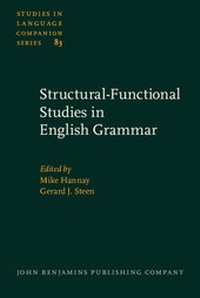
Structural-Functional Studies in English Grammar
In honour of Lachlan Mackenzie
1st Edition
Published on 29. March 2007
VI, 393 pages
978-90-272-9259-9 (ISBN)
Description

This collection presents a number of studies in the lexico-grammar of English which focus on the one hand on close reading of language in context and on the other hand on current functional theoretical concerns. The various contributions represent distinct functionalist models of language, including Functional Grammar and Functional Discourse Grammar, Systemic-Functional Grammar, Role and Reference Grammar, Cognitive Grammar and Construction Grammar. Taken together, however, they typify current work being conducted from the grammatical perspective within the functionalist enterprise, emphasizing on the relation between structure and usage. A fundamental goal of the enterprise is to identify linguistic structures which are constrained by specific features of use, or which actually encode specific features of use, as many of the contributions here show.
More details
Other editions
Additional editions
Mike Hannay | Gerard J. Steen
Structural-Functional Studies in English Grammar
In honour of Lachlan Mackenzie
Book
03/2007
John Benjamins Publishing Co
€132.50
Shipment within 10-15 days
Persons
Content
- Structural-Functional Studies in English Grammar
- Editorial page
- Title page
- LCC data
- Table of contents
- Introduction
- References
- Corpus-based studies
- No doubt and related expressions
- 1. Introduction
- 2. A synchronic perspective
- 2.1. No doubt
- 2.2. There is no doubt
- 2.3. I have no doubt
- 2.4. A comparison of no doubt, there is no doubt and I have no doubt
- 3. A diachronic excursion
- 4. Discussion
- References
- On certainly and zeker
- 1. Introduction
- 2. What we do and do not know about certainly and zeker
- 3. The data: Sources and selection criteria
- 4. The analysis
- 4.1. The epistemic use
- 4.2. The scalar use
- 4.3. The strengthening use
- 4.4. The pragmatic use
- 5. Conclusions
- References
- Prenominal possessives in English
- 1. Introduction
- 2. Traditional accounts: Interacting principles
- 3. Some earlier accounts
- 3.1. The search for a single underlying principle
- 3.2. Interactive principles: Rosenbach (2002)
- 4. The present study
- 4.1. A multifunctional approach
- 4.2. Non-prototypical prenominal possessives: Some examples
- 4.3. Postnominal possessors: Some examples
- 5. Conclusion
- References
- Ditransitive clauses in English with special reference to Lancashire dialect
- 1. Introduction
- 2. The two canonical patterns of encoding
- 3. Variation on the canonical patterns
- 4. Patterns of argument encoding in Lancashire dialect
- 5. Theoretical relevance of findings
- References
- 'It was you that told me that, wasn't it?'
- 1. Introduction
- 2. Material and methods
- 3. Formal features
- 4. Semantic features
- 5. Discourse-cognitive features
- 5.1. Informative values
- 5.2. The interactive dimension
- 5.3. Opinion-giving devices
- 6. Distribution across ICE-GB text types
- 7. Conclusion
- References
- Another take on the notion Subject
- 1. Introduction
- 2. Subject in a grammar of English
- 3. Towards an encompassing framework for Subject
- 4. Some complex cases of Subject assignment
- 5. Conclusions
- Abbreviations
- References
- The modal auxiliaries of English, '257-operators in Functional Grammar and ``grounding''
- 1. Introduction
- 2. Criteria for grammaticalization and the modal auxiliaries of English
- 2.1. Criteria for grammaticalization
- 2.2. English modals and grammaticalization
- 3. Pi-operators and modality in Functional Grammar
- 3.1. Pi-operators
- 3.2. Modals and modality in Dik (1997)
- 4. Grounding
- 4.1. Grounding: A basic notion in Cognitive Grammar
- 4.2. Grounding and the English modals in Cognitive Grammar
- 5. Grounding as an argument for a graded view of the grammaticalization status of the English modals
- 5.1. Grounding and tense
- 5.2. Subjectified, grounding uses of the central modals
- 5.3. Non-subjectified, non-grounding uses of the central modals
- 5.4. Transitional uses (interpenetration of tense and modality)
- 5.5. The shift from non-grounding to grounding: The diachronic development of must
- 6. Implications
- 6.1. Implications for Cognitive Grammar
- 6.2. Implications for Functional Grammar
- 6.3. Envoi
- References
- The king is on huntunge
- 1. The scope of the paper
- 2. Progressive and Absentive
- 3. Absentive properties of constructions with a verbal noun
- 3.1. Esse in venatione glossed by be on huntunge
- 3.2. The verbal noun was an abstract noun
- 3.3. The spatial and temporal use of on
- 3.4. The combination with ridan and owt
- 3.5. Marking Figure or Ground
- 3.6. Class of verbs
- 3.7. Preliminary conclusions
- 4. Discussion
- 5. Conclusions
- References
- Sources
- The architecture of functional models
- Mental context and the expression of terms within the English clause
- 1. Introduction
- 2. Terms, context and interaction
- 2.1. The classification of context
- 2.2. The contextual level
- 2.3. The formulation and interpretation of terms
- 3. Temporal and spatial satellite terms
- 3.1. The expression of adpositional terms
- 3.2. A first alternative
- 3.3. A second alternative
- 3.4. A third alternative
- 4. Conclusion
- References
- Adverbial conjunctions in Functional Discourse Grammar
- 1. Introduction
- 2. Adverbial conjunctions
- 2.1. Adverbial clauses
- 2.2. Adverbial conjoining
- 2.3. Conjunctions and adpositions
- 2.4. Conjunctions and conjunctional phrases in English
- 3. Functional Discourse Grammar
- 3.1. Introduction
- 3.2. The interpersonal level
- 3.3. The representational level
- 3.4. Heads, modifiers, operators, functions
- 4. Conjunctions at the representational level
- 5. Conjunctions at the interpersonal level
- 6. Conclusions
- References
- Tree tigers and tree elephants
- 1. Introduction
- 2. An overview of ENCs
- 2.1. Linguistic theories of ENCs
- 3. Psycholinguistic accounts
- 3.1. The Dual-Process model
- 3.2. The CARIN model
- 3.3. The C3 model
- 3.4. Summary
- 4. The ENC construction
- 4.1. Construction Grammar
- 4.2. Relation ENCs
- 4.3. Property ENCs
- 4.4. Opaque phrasal ENCs
- 4.5. Overview
- 4.6. Psychological adequacy
- 4.7. For further investigation
- 5. Conclusion
- References
- English constructions from a Dutch perspective
- 1. Introduction
- 2. The way construction
- 3. The time-away-construction
- 4. Causative constructions
- 5. Conclusion
- References
- Notes towards an incremental implementation of the Role and Reference Grammar semantics-to-syntax linking algorithm for English
- 1. Introduction
- 2. Semantics, morphosyntax and the lexicon in RRG
- 3. Incrementality in language processing
- 4. A dynamic implementation of the RRG linking algorithms
- 5. Some problematic issues
- 6. A more complex example of dynamic implementation of the linking algorithms
- 7. A note on the possibility of parallel processing
- 8. Conclusion
- References
- Grammar, flow and procedural knowledge
- 1. Introduction
- 2. Linguistic structure as a result of functional differentiation
- 3. Slots as basic functional-structural interface units: External and internal function
- 4. Layered clause structure as procedural knowledge
- 5. The limits of incrementality
- 6. A case for simultaneity of interaction, representation and expression in grammar: Choice of subject and fronted objects
- 7. Formulaic language
- 8. Grammatical and other units in online communication
- 9. Conclusion
- References
- The non-linearity of speech production
- 1. Morphophonological processing
- 2. The role of prehensions in speech production and comprehension
- References
- A speaker/hearer-based grammar
- 1. Linguistic assumptions
- 2. A speaker/hearer-based grammar
- 3. The case of possessives
- 4. Novel compounds
- 5. Concluding remarks
- References
- Index
- The Studies in Language Companion Series
