

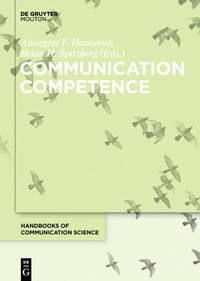
Communication Competence
Description

Almost everything that matters to humans is derived from and through communication. Just because people communicate every day, however, does not mean that they are communicating
competently
. In fact, evidence indicates that there is a substantial need for better interpersonal skills among a significant proportion of the populace. Furthermore, "dark side" experiences in everyday life abound, and features of modern society pose new challenges that make the concept of communication competence increasingly complex.
The
Handbook of Communication Competence
brings together scholars from across the globe to examine these various facets of communication competence, including its history, its essential components, and its applications in interpersonal, group, institutional, and societal contexts. The book provides a state-of-the-art review for scholars and graduate students, as well as practitioners in counseling, developmental, health care, educational, intercultural, and human resource management contexts, illustrating that communication competence is vital to health, relationships, and all collective human endeavors.
More details
Other editions
Additional editions
Persons
Content
- Intro
- Preface to Handbooks of Communication Science series
- Contents
- I. Introduction
- . Welcome to the Handbook of Communication Competence
- II. Paradigms and perspectives
- 2. Communication competence: Historical synopsis, definitions, applications, and looking to the future
- 3. Theoretical approaches to communicative competence
- 4. Epistemological approaches to communication competence
- III. Codes
- 5. Competence in speaking in interactions
- 6. Nonverbal skills in emotional communication
- 7. Computer-mediated communication competence
- IV. Components
- 8. Motivational factors and communication competence
- 9. Competence knowledge
- 10. The composition of competence: Communication skills
- V. Personal factors
- 11. Genetics and communication competence
- 12. Culture and competence: Ethnicity and race
- VI. Contexts
- 13. Relational competence
- 14. Communication competence in the management of conflict
- 15. Developing negotiation competencies
- 16. Communication competence in organizations and groups: Historic and emerging perspectives
- 17. Functional forms of competence: Interviewing
- 18. Instructional communication competence in higher education
- 19. Managing uncertainty in clinical encounters
- 20. Intercultural and intergroup communication competence: Toward an integrative perspective
- 21. Social communicative competencies across the life span
- VII. Intervention and assessment
- 22. Assessing the state of assessment: Communication competence
- 23. Outcomes and the criterion problem in communication competence research
- 24. The transformation of everyday talk: The impact of communication technology on notions of communication competence
- 25. Training and intervention
- VIII. The dark side of communication competence
- 26. The dark underbelly of communication competence: How something good can be bad?
- 27. Miscommunication and error
- 28. Verbal and physical aggression
- IX. Epilogue
- 29. Problems, paradoxes, and prospects in the study of communication competence
- Biographical sketches
- Subject index
- Author index
