

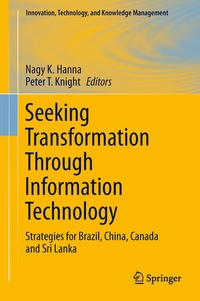
Seeking Transformation Through Information Technology
Description

The ability to harness Information Communication Technologies (ICTs) is increasingly at the heart of national competitiveness and sustainable development. As countries seek a way out of the present period of economic contraction, they are trying to weave ICT into their development strategies, in the same way enterprises have learned to use ICT to transform their business models and strategies. This integration offers a new path to development that is responsive to the challenges of our times.
In Seeking Transformation Through Information Technology , Nagy Hanna and Peter Knight provide a framework for assessing the opportunities, challenges, and prospects for "e-transformation." Featuring contributions from country experts, the editors and authors provide in-depth case studies of ICT deployment in Brazil, China, Canada, and Sri Lanka, and asses the progress of such efforts. The result is an essential resource for academic researchers, policy analysts, policymakers, and industry leaders interested in the role of ICT in national development, innovation, and economic growth.
More details
Other editions
Additional editions
Persons
Nagy K. Hanna is an author, international development strategist, and thought leader, with over 30 years of experience in advising countries and aid agencies on designing and
implementing programs to leverage information and communication technology (ICT) in
support of competitiveness, private sector development, and public sector reform. He has worked with stakeholders cutting across public, private and civil society leadership. From 1975 to 2005 he served in a variety of positions at the World Bank, most recently as senior advisor on e-strategies, where he established a global community of practice on e-development and chaired a seminar series to develop e-government and e-leadership. Currently, he advises countries on developing policies, institutions, and leadership capabilities for coordinating ICT for development programs, and has served as a Visiting Professor at Duke University and Senior Fellow at the University of Maryland. He has lectured and published extensively on e-development, strategic planning, change management, executive education, and institutional development. He holds a Ph.D. in Socio-Economic Planning from the Wharton School, University of Pennsylvania, and Masters degrees in Operations Research and Industrial Engineering.
Peter T. Knight is an economist, training strategist, and information age change agent with broad international experience in distance education, training strategy/evaluation, e-government, electronic media, telecommunications reform, international banking, foundation work, teaching, and research. He has worked extensively in Africa (especially South Africa), Latin America (especially Brazil), and Eastern Europe and Asia (especially Russia). He is a partner in Knight, Moore and President of Telemática e Desenvolvimento Ltda, advising such clients as the World Bank, Inter-American Development Bank, SRI International/National Science Foundation, US Departmentof
