

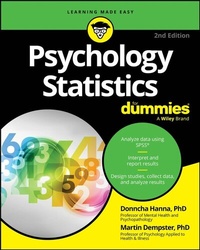
Psychology Statistics For Dummies
Description

Untangle statistics and make correct, dependable conclusions
Psychology Statistics For Dummies, 2nd Edition makes statistics accessible to psychology students, covering all the content in a typical undergraduate psychology statistics class. Built on a foundation of jargon-free explanations and real-life examples, this book focuses on information and techniques that psychology students need to know (and nothing more). You'll learn to use the popular SPSS statistics software to calculate statistics and look for patterns in psychological data. And, this helpful guide offers a brief introduction to using the R programming language for statistical analysis-an increasingly important skill for the digital age. You'll also find hands-on practice exercises and examples using recent, real datasets.
- Explore the use of statistical analysis in research for the psychology field
- Master basic statistics concepts such as means, standard deviations, and correlations
- Conduct data analysis using the SPSS software package
- Get clear explanations of everything in your psychology statistics course, so you can pass with flying colors
This guide is perfect to use as a readable supplement to psychology textbooks and overall coursework. Students in other social and behavioral sciences can also benefit from this stellar primer on statistics.
More details
Other editions
Additional editions
Previous edition
Content
Introduction 1
Part 1: Describing Data 1
Chapter 1: Statistics? I Thought This Was Psychology! 7
Chapter 2: Dealing with Different Types of Data. 15
Chapter 3: Inputting Data and Labels in SPSS 23
Chapter 4: Measures of Central Tendency 39
Chapter 5: Measures of Dispersion 51
Chapter 6: Generating Graphs and Charts 65
Part 2: Understanding Statistical Significance 77
Chapter 7: Understanding Probability and Inference 79
Chapter 8: Testing Hypotheses 87
Chapter 9: What's Normal about the Normal Distribution? 97
Chapter 10: Standardized Scores 111
Chapter 11: Effect Sizes and Power 119
Part 3: Analyzing Relationships between Variables 137
Chapter 12: Correlations 139
Chapter 13: Linear Regression 157
Chapter 14: Associations between Discrete Variables 187
Part 4: Analyzing Independent Groups Research Designs 203
Chapter 15: Independent t-Tests and Mann-Whitney Tests 205
Chapter 16: Between-Groups ANOVA 221
Chapter 17: Post-Hoc Tests and Planned Comparisons for Independent Groups Designs 243
Part 5: Analyzing Repeated Measures Research Designs 257
Chapter 18: Paired t-Tests and Wilcoxon Tests 259
Chapter 19: Within-Groups ANOVA 275
Chapter 20: Post-Hoc Tests and Planned Comparisons for Repeated Measures Designs 301
Part 6: The Part of Tens 317
Chapter 21: Ten Tips for Inferential Testing 319
Chapter 22: Ten Tips for Writing a Results Section 323
Index 327
