

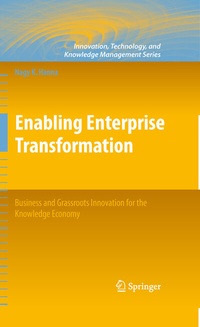
Enabling Enterprise Transformation
Description

Private enterprises in advanced economies have been learning to use information and communication technology (ICT) to innovate and transform their processes, products, services and business models, significantly improving productivity and competitiveness. Moreover, the ICT industry itself has become a major source of job creation and a contributor to economic growth and business transformation. A key question today is whether and how developing countries can learn to benefit from the ICT revolution, and what roles the government and private sector can play. Already, a number of developing countries have been inspired by the example of India and China, and are now seeking to jump on the outsourcing bandwagon.
Nevertheless, with few exceptions in the developing world, little attention has been paid by policymakers and practitioners to invest systematically and proactively in ICT-enabled growth, poverty reduction and grassroots innovation. Most communities and small and medium-sized enterprises in developing countries, for example, face multiple constraints to adopting and leveraging this general purpose technology, and lack the capabilities for maximizing its potential.
In "Enabling Enterprise Transformation", Nagy Hanna draws on his rich experience of over 35 years at the World Bank and other aid agencies as a development strategist and ICT policy expert, the most current research, and best practices from around the world to provide practical tools for promoting economic and social transformation through ICT. He assesses various initiatives to develop and diffuse ICT, such as innovation funds, incubators, parks, public-private partnerships, and comprehensive promotion programs. He argues for the strategic options now open for developing countries to participate in ICT production, to deploy ICT to transform industries and services, and to leverage ICT as a new national infrastructure for improving the business environment and enhancing the competitiveness of the whole economy.
The challenge for leaders in developing countries is to create such social and institutional dynamics for learning about ICT use and adaptation at many levels. Lessons gained so far from programs to build these social learning and innovation capabilities at the institutional and grassroots levels should be shared among developing countries, and a dialogue among business leaders, policymakers, development agencies, educational institutions, and the general citizenry must be advanced.
More details
Other editions
Additional editions
Person
Nagy Hanna is an author, international development strategist, and thought leader, with
over 30 years of experience in advising countries and aid agencies on designing and
implementing programs to leverage information and communication technology (ICT) in
support of competitiveness, private sector development, and public sector reform. He has worked with stakeholders cutting across public, private and civil society leadership. From 1975 to 2005 he served in a variety of positions at the World Bank, most recently as senior advisor on e-strategies, where he established a global community of practice on e-development and chaired a seminar series to develop e-government and e-leadership. Currently, he advises countries on developing policies, institutions, and leadership capabilities for coordinating ICT for development programs, and serves as a Visiting Professor at Duke University and Senior Fellow at the University of Maryland. He has lectured and published extensively on e-development, strategic planning, change management, executive education, and institutional development. He holds a Ph.D. in Socio-Economic Planning from the Wharton School, University of Pennsylvania, and Masters degrees in Operations Research and Industrial Engineering.
