

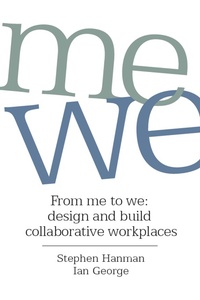
From Me to We
Design and Build Collaborative Workplaces
Published on 8. December 2014
192 pages
978-1-925280-04-3 (ISBN)
Description

This book demonstrates that long-term win-win collaboration approaches work. Principals and contractors don't have to end up in conflict or litigation. I would recommend these ideas be adopted by companies eager to improve productivity.' - John Mulcahy, Chairman, Mirvac
'In an industry dominated by conflict and unproductive activity, this book offers a refreshing and practical way for all parties in the building industry to achieve more from their capital and labour inputs. Stephen Hanman and Ian George have shown through application that by introducing trust, respect and meaningful communication into relationships, results improve for all stakeholders. Moreover, the investment required to do the first job carries over to future work, resulting in improved performance with each project. I applaud the efforts of the authors in both creating the environment for their clients to 'do better' in their construction businesses and for sharing their work with the wider business and labour communities. One wonders what benefits could flow to other industries should the broader principles so successfully adopted in this book be applied more widely.' - Terry Henderson, company director and businessman
'This book provides wonderful insights into the way in which economic and social relationships associated with building and construction can be transformed. The participants involved in CGA Bryson projects have experienced considerable benefits in their working and personal lives. There is also evidence of significant economic benefits for all within the project supply chains. In the context of the broader building and construction industry, this account contains lessons which offer solutions for some of the seemingly intractable problems of conflict, waste, poor quality work and alienation that bedevil this industry. We have a lot to learn from these two professionals who are writing about their direct experience in transforming a construction enterprise.' - Professor Tony Dalton, RMIT Australian Housing and Urban Research Institute Research Centre, School of Global, Urban and Social Studies, RMIT University
'In our own research, we have documented in financial terms the benefits of cross-functional, cross-firm collaboration. However, for many executives, building a culture that supports collaboration is not easy. Ian and Stephen not only report on the benefits of collaboration in an industry where such behaviour has not been the norm, but they provide guidelines for building organisations with a culture of collaboration.' - Dr Douglas M Lambert, Fisher College of Business, The Ohio State University, founder of the Supply Chain Management Institute
'In an industry dominated by conflict and unproductive activity, this book offers a refreshing and practical way for all parties in the building industry to achieve more from their capital and labour inputs. Stephen Hanman and Ian George have shown through application that by introducing trust, respect and meaningful communication into relationships, results improve for all stakeholders. Moreover, the investment required to do the first job carries over to future work, resulting in improved performance with each project. I applaud the efforts of the authors in both creating the environment for their clients to 'do better' in their construction businesses and for sharing their work with the wider business and labour communities. One wonders what benefits could flow to other industries should the broader principles so successfully adopted in this book be applied more widely.' - Terry Henderson, company director and businessman
'This book provides wonderful insights into the way in which economic and social relationships associated with building and construction can be transformed. The participants involved in CGA Bryson projects have experienced considerable benefits in their working and personal lives. There is also evidence of significant economic benefits for all within the project supply chains. In the context of the broader building and construction industry, this account contains lessons which offer solutions for some of the seemingly intractable problems of conflict, waste, poor quality work and alienation that bedevil this industry. We have a lot to learn from these two professionals who are writing about their direct experience in transforming a construction enterprise.' - Professor Tony Dalton, RMIT Australian Housing and Urban Research Institute Research Centre, School of Global, Urban and Social Studies, RMIT University
'In our own research, we have documented in financial terms the benefits of cross-functional, cross-firm collaboration. However, for many executives, building a culture that supports collaboration is not easy. Ian and Stephen not only report on the benefits of collaboration in an industry where such behaviour has not been the norm, but they provide guidelines for building organisations with a culture of collaboration.' - Dr Douglas M Lambert, Fisher College of Business, The Ohio State University, founder of the Supply Chain Management Institute
More details
Other editions
Additional editions
Book
12/2014
Collaborative Enquiry
€35.74
Shipment within 10-20 days
Content
- Intro
- Contents
- Acknowledgments
- Introduction
- part 1 - Discussion
- In the beginning
- Collaboration
- A living process
- Grounds for a new management approach
- Conversation! Or lack thereof
- The Cole Report
- How we became different
- part 2 - Action
- Developing the collaborative framework
- The impact of changing the system
- The first group workshop
- Explaining the idea
- The first project
- Following a lead
- Red Blue
- Defining the vision, mission and values
- Formation of a steering group
- Red Blue 2 and 3
- Interface conversations
- Other developments
- Look ahead site planning
- Builder interface conversations
- Additional education sessions to stay on track
- Review of the first project
- The overall process of building the system
- Thoughts on other construction projects
- Further developments on subsequent projects
- Connecting with art
- part 3 - Reflection
- Value delivered to the builder and others
- Impact of the Global Financial Crisis
- Other outcomes of the collaborative system
- Collaboration: 'How to' and the future Stephen Hanman
- In conclusion Ian George
- In conclusion Stephen Hanman
- We walk this way
- Bibliography
- The authors
