

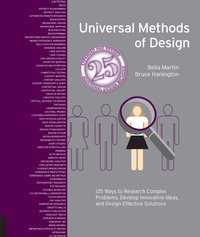
Universal Methods of Design Expanded, and Revised
Published on 22. October 2019
272 pages
978-1-63159-749-7 (ISBN)
Description

This expanded and revised version of the best-selling Universal Methods of Design is a comprehensive reference that provides a thorough and critical presentation of 125 research methods, synthesis/analysis techniques, and research deliverables for human-centered design.
The text and accompanying photos and graphics of this classic resource are delivered in a concise and accessible format perfect for designers, educators, and students. Information can be easily referenced and utilized by cross-disciplinary teams in nearly any design project.
This new, expanded edition includes a comprehensive index for referencing. Earlier chapters have been updated to include new information on digital design and software for A/B testing, content analysis, and territory maps. The addition of 25 chapters brings fresh relevance to the text with new and innovative design methods, such as subtraction and position maps, that have emerged since the first edition.
Universal Methods of Design distills each method down to its essence, in a format that helps design teams select and implement the most credible research methods suited to their design culture.
The text and accompanying photos and graphics of this classic resource are delivered in a concise and accessible format perfect for designers, educators, and students. Information can be easily referenced and utilized by cross-disciplinary teams in nearly any design project.
This new, expanded edition includes a comprehensive index for referencing. Earlier chapters have been updated to include new information on digital design and software for A/B testing, content analysis, and territory maps. The addition of 25 chapters brings fresh relevance to the text with new and innovative design methods, such as subtraction and position maps, that have emerged since the first edition.
Universal Methods of Design distills each method down to its essence, in a format that helps design teams select and implement the most credible research methods suited to their design culture.
More details
Edition
Revised Edition
Language
English
Place of publication
Beverly
United States
Publishing group
Quarto Publishing Group USA Inc
Edition type
Revised edition
File size
31,81 MB
ISBN-13
978-1-63159-749-7 (9781631597497)
Copyright in bibliographic data and cover images is held by Nielsen Book Services Limited or by the publishers or by their respective licensors: all rights reserved.
Schweitzer Classification
Other editions
Additional editions
Bruce Hanington | Bella Martin
Universal Methods of Design, Expanded and Revised
125 Ways to Research Complex Problems, Develop Innovative Ideas, and Design Effective Solutions
Book
12/2019
Rockport Publishers
€33.00
Shipment within 3-4 weeks
Persons
Bruce Hanington is a professor and head of the School of Design at Carnegie Mellon University in Pittsburgh, Pennsylvania. Prior to this, he was director of graduate studies, and program chair of industrial design. Bruce has dedicated his teaching and research to methods and practices for human centered design, with an emphasis on design ethnography, participatory design, and the meaning of form in context. In addition to working with industry partners through collaborative projects and executive education, his work has been published in Design Issues, The Design Journal, and Interactions, with chapters in Affective Sciences in Human Factors and Human-Computer Interaction and The Routledge Handbook of Sustainable Design.Bella Martin is a Lead User Experience Researcher in Atlanta, Georgia. After contributing to award-winning design projects for Microsoft Research, the US Postal Service, GlaxoSmithKline, and Allstate Financial, she now invests much of her time working with organizations who are new to the methods of user-centered research, but eager to give their users a voice in the design process. Bella holds a Master of Design from Carnegie Mellon University, where she first began her ongoing work in visualizing user-centered research methods.
Content
- Cover
- Title
- Copyright
- Dedication
- Contents
- INTRODUCTION
- 01. A/B Testing
- 02. AEIOU
- 03. Affinity Diagramming
- 04. Artifact Analysis
- 05. Automated Remote Research
- 06. Backcasting
- 07. Behavioral Design
- 08. Behavioral Mapping
- 09. Blockbusting
- 10. Bodystorming
- 11. Brainstorm Graphic Organizers
- 12. Brand Experience Workshop
- 13. Bull's-Eye Diagramming
- 14. Business Origami
- 15. Card Sorting
- 16. Case Studies
- 17. Civic Design & Policy
- 18. Cognitive Mapping
- 19. Cognitive Walkthrough
- 20. Collage
- 21. Competitive Testing
- 22. Concept Mapping
- 23. Content Analysis
- 24. Content Inventory & Audit
- 25. Contextual Design
- 26. Contextual Inquiry
- 27. Creative Matrix
- 28. Creative Toolkits
- 29. Critical Incident Technique
- 30. Critiques
- 31. Crowdsourcing
- 32. Cultural Probes
- 33. Customer Experience Audit
- 34. Data Physicalization
- 35. Data Visualization
- 36. Design Charette
- 37. Design Ethnography
- 38. Design Fiction
- 39. Design Workshops
- 40. Desirability Testing
- 41. Diary Studies
- 42. Directed Storytelling
- 43. Drawing
- 44. Elito Method
- 45. Empathy Maps
- 46. Ergonomic Analysis
- 47. Evaluative Research
- 48. Evidence-based Design
- 49. Experience Prototyping
- 50. Experience Sampling Method
- 51. Experiments
- 52. Exploratory Research
- 53. Eyetracking
- 54. Flexible Modeling
- 55. Fly-on-the-Wall Observation
- 56. Focus Groups
- 57. Gap Analysis
- 58. Generative Research
- 59. Graffiti Walls
- 60. Heuristic Evaluation
- 61. Highlight Reels
- 62. Horizon Scanning
- 63. How Might We
- 64. Image Boards
- 65. Importance-Difficulty Matrix
- 66. Interviews
- 67. KJ Technique
- 68. Kano Analysis
- 69. Key Performance Indicators
- 70. Laddering
- 71. Literature Reviews
- 72. The Love Letter & the Breakup Letter
- 73. Mental Model Diagrams
- 74. Metaphors
- 75. Mind Mapping
- 76. Observation
- 77. Parallel Prototyping
- 78. Participant Observation
- 79. Participatory Action Research (PAR)
- 80. Participatory Design
- 81. Personal Inventories
- 82. Personas
- 83. Photo Studies
- 84. Picture Cards
- 85. Prototyping
- 86. Questionnaires
- 87. Rapid Iterative Testing & Evaluation
- 88. Remote Moderated Research
- 89. Research Through Design
- 90. Role-playing
- 91. Rose Thorn Bud
- 92. Scenarios
- 93. Secondary Research
- 94. Semantic Differential
- 95. Service Blueprint
- 96. Service Design
- 97. Shadowing
- 98. Simulations
- 99. Site Search Analytics
- 100. Speed Dating
- 101. Stakeholder Maps
- 102. Stakeholder Walkthrough
- 103. Storyboards
- 104. Surveys
- 105. Swimlanes
- 106. Task Analysis
- 107. Territory Maps
- 108. Thematic Networks
- 109. Think-aloud Protocol
- 110. Time-aware Research
- 111. Touchstone Tours
- 112. Transition Design
- 113. Tree Testing
- 114. Triading
- 115. Triangulation
- 116. Unobtrusive Measures
- 117. Usability Report
- 118. Usability Testing
- 119. User Journey Maps
- 120. Value Opportunity Analysis
- 121. Values-Based Assessment
- 122. Web Analytics
- 123. Weighted Matrix
- 124. Wizard of Oz
- 125. Word Clouds
- ACKNOWLEDGMENTS
- INDEX
- A
- B
- D
- E
- G
- I
- O
- P
- Q
- R
- S
- T
- ABOUT THE AUTHORS
