

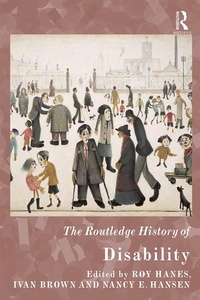
The Routledge History of Disability
Published on 25. October 2017
540 pages
978-1-351-77404-8 (ISBN)
Description

The Routledge History of Disability explores the shifting attitudes towards and representations of disabled people from the age of antiquity to the twenty-first century. Taking an international view of the subject, this wide-ranging collection shows that the history of disability cuts across racial, ethnic, religious, cultural, gender and class divides, highlighting the commonalities and differences between the experiences of disabled persons in global historical context.
The book is arranged in four parts, covering histories of disabilities across various time periods and cultures, histories of national disability policies, programs and services, histories of education and training and the ways in which disabled people have been seen and treated in the last few decades. Within this, the twenty-eight chapters discuss topics such as developments in disability issues during the late Ottoman period, the history of disability in Belgian Congo in the early twentieth century, blind asylums in nineteenth-century Scotland and the systematic killing of disabled children in Nazi Germany.
Illustrated with images and tables and providing an overview of how various countries, cultures and societies have addressed disability over time, this comprehensive volume offers a global perspective on this rapidly growing field and is a valuable resource for scholars of disability studies and histories of disabilities.
The book is arranged in four parts, covering histories of disabilities across various time periods and cultures, histories of national disability policies, programs and services, histories of education and training and the ways in which disabled people have been seen and treated in the last few decades. Within this, the twenty-eight chapters discuss topics such as developments in disability issues during the late Ottoman period, the history of disability in Belgian Congo in the early twentieth century, blind asylums in nineteenth-century Scotland and the systematic killing of disabled children in Nazi Germany.
Illustrated with images and tables and providing an overview of how various countries, cultures and societies have addressed disability over time, this comprehensive volume offers a global perspective on this rapidly growing field and is a valuable resource for scholars of disability studies and histories of disabilities.
Reviews / Votes
"Taking a truly global view of disability history, The Routledge History of Disability brings together an impressive range of scholarship that places the lives of individuals with disabilities in their social, cultural and historical context. Moving beyond the national or local focus of many disability histories, and exploring a variety of impairments, The Routledge History of Disability provides a means for examining disability history comparatively, shedding new light on how social policy, education and civil rights have evolved in different parts of the world."David Turner, Swansea University, UK
"This book is timely and phenomenal in nationally and internationally highlighting historical events that have affected disabled people. It exposes the origins of issues and controversies about disability, interpreting historical documents and legislation and discussing significant topics such as the eugenics movement and the civil rights movement."
Irene Carter, University of Windsor, Canada"In many ways, The Routledge History of Disability is an impressive work: twenty-eight chapters, forty-nine authors, nineteen countries or geographic regions, and more than two thousand years of human history. Contributors to The Routledge History of Disability cover topics familiar to disability studies scholars and disability historians, such as the freak show, eugenics, and Nazi Germany. There are also less familiar topics included in this volume, such as disability in Nigeria, Belgian-Congo, Ireland, Hong Kong, and Singapore. Authors write on topics as varied as gender and disability in ancient Greece and "dull" students in a Norwegian folk school. They ponder societal responses to "the intellectually disabled" and expose developments in disability issues in Ottoman Turkey. The scope of the material presented in The Routledge History of Disability alone ma
More details
Series
Language
English
Place of publication
London
United Kingdom
Publishing group
Taylor & Francis Ltd
Target group
College/higher education
Illustrations
33 s/w Abbildungen, 23 s/w Tabellen
23 Tables, black and white; 33 Illustrations, black and white
File size
6,03 MB
ISBN-13
978-1-351-77404-8 (9781351774048)
Copyright in bibliographic data and cover images is held by Nielsen Book Services Limited or by the publishers or by their respective licensors: all rights reserved.
Schweitzer Classification
Other editions
Additional editions
Roy Hanes | Ivan Brown | Nancy E. Hansen
The Routledge History of Disability
Book
09/2020
1st Edition
Routledge
€65.00
Shipment within 15-20 days
Roy Hanes | Ivan Brown | Nancy E. Hansen
The Routledge History of Disability
Book
11/2017
1st Edition
Routledge
€364.52
Shipment within 10-20 days
Persons
Roy Hanes is Associate Professor at Carleton University, Canada. He was a founding member of the Canadian Disability Studies Association and is well known for his disability rights activism.
Ivan Brown was Head of the Centre of Excellence for Child Welfare at the University of Toronto, Canada, and a founding editor of the Journal on Developmental Disabilities.
Nancy E. Hansen is Director of the Interdisciplinary Master's Program in Disability Studies at the University of Manitoba, Canada, and past president of the Canadian Disability Studies Association.
Ivan Brown was Head of the Centre of Excellence for Child Welfare at the University of Toronto, Canada, and a founding editor of the Journal on Developmental Disabilities.
Nancy E. Hansen is Director of the Interdisciplinary Master's Program in Disability Studies at the University of Manitoba, Canada, and past president of the Canadian Disability Studies Association.
Content
Introduction Part I: Histories of Disabilities Across Time and Cultures Introduction to Part I CH. 1. Reason, value and persons: The construction of intellectual disability in western thought from antiquity to the romantic age CH. 2. The Courage of subordination: Women and intellectual disability in the ancient Greek World CH. 3. Jane Austen and Me: Tales from the Couch CH. 4. Developments in disability issues during the late Ottoman period of Turkish history from 1876 to 1909 CH. 5. A short history of disability in Italy CH.6. A short history of disability aspects from Israel Part II: Histories of national disability policies, programs and services Introduction to Part II CH. 7. The role of international institutions in the process of categorization of 'disabled people' (1930-1975) CH. 8. Disabilities and Disability Services in Nigeria: Past, Present and Future CH. 9. A Short History of Approaches to Disability in the Netherlands CH. 10. A Journey of Change - Histories of Disability in Hong Kong 1841-2014 CH. 11. Historical Development of Disability Services in Singapore: Enabling CH. 11. Historical Development of Disability Services in Singapore: Enabling Persons with Disabilities CH.12. Swedish disability policies: Ideas, values and practices in a historical perspective CH.13. One difference is enough: Towards a history of disability in Belgian-Congo, 1908-1960 Part III: Histories of Education and Training, Introduction to Part III CH. 14. From their own hands: Collecting oral testimony in signing communities CH.15. The history of access to education of people with visual impairments in Great Britain from 1790 to 1999 CH.16. Out of Sight, Out of Mind: Blind Asylums and Missions in Scotland CH.17. Exposure and recovery: Tracing disability history in the midst of cultural absence CH.18. Australian Histories of Intellectual Disabilities CH. 19. History and national policy documents on special education in Sweden CH. 20. The Italian Path to School and Social Inclusion: Problems, Strengths and Perspectives CH. 21. Education of People with Intellectual Disabilities and Hearing Impairments in Spain: A Historical Approach CH.22. The Case of the "Dull" Pupil in the Norwegian Folk School 1892-1930 Part IV: Spectacle, Science, Services and Civil Rights Introduction to Part IV CH. 23. The freak show act: Science and spectacle in the nineteenth century CH. 24. Three Illusions in clinical photographs of the feeble minded during the Eugenics era CH. 25. When is life unworthy of living? Lessons from the systematic killing of children with disabilities in Nazi Germany Ch. 26. The Genesis of Societies for Crippled Children in Canada and their American Roots CH. 27. Breaking the rules: Summer camping experiences and the lives of Ontario children growing up with polio in the 1940s and 1950s CH. 28. Changing America's consciousness: A brief history of the Independent Living Civil Rights Movement in the United States. Concluding Remarks, Index
