

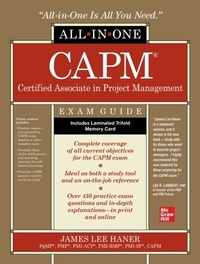
CAPM Certified Associate in Project Management All-in-One Exam Guide
1st Edition
Published on 8. September 2023
608 pages
978-1-260-46760-4 (ISBN)
Available for download
Description

Complete coverage of all objectives in the 2023 release of the CAPM examTake the Certified Associate in Project Management (CAPM) exam with confidence using this highly effective self-study guide. Written by a project management expert and bestselling author, CAPM Certified Associate in Project Management All-in-One Exam Guide offers complete coverage of every objective on the current version of the test. To help you study, each chapter contains unique design elements that emphasize important points and aid in retention. An appendix, 50 Confusing Terms on the CAPM Exam, will help you understand the differences in terms that sound similar but have different meanings. In addition, the book includes more than 450 practice questions along with detailed answer explanations. Designed to help you pass the exam with ease, this comprehensive guide also serves as an essential on-the-job reference for project management professionals.Covers all exam topics, including:Project Management Fundamentals and Core ConceptsPredictive, Plan-Based MethodologiesAgile Frameworks/MethodologiesBusiness Analysis FrameworksOnline content includes:Practice exams test yourself by CAPM exam domain or take a complete examPrintable flash cards, word puzzles, and matching exercises for self-directed learningPrintable CAPM memory card for on-the-go study
More details
Other editions
Additional editions
Book
10/2023
McGraw-Hill Education
€53.29
Available immediately
Content
- Intro
- Cover
- Title Page
- Copyright Page
- Dedication
- About the Author
- Contents at a Glance
- Contents
- Foreword
- Acknowledgments
- Introduction
- Part I Project Management Foundation
- Chapter 1 Working as a Project Manager
- Exploring the Project Manager Role
- Defining the Adaptive Project Manager
- Leading the Project Team
- Communicating Project Information
- Negotiating Project Terms and Conditions
- Active Problem-Solving
- Identifying the Project Manager Influence
- Influencing the Project
- Influencing the Organization
- Considering Social, Economic, and Environmental Project Influences
- Considering International Influences
- Considering Cultural and Industry Influences
- Building Project Management Skills
- Enhancing Skills and Competencies
- Introducing the PMI Talent Triangle
- Managing Politics in Projects
- Serving as a Leader and Manager
- Learning Leadership Styles
- Creating a Leadership Persona
- Performing Project Integration
- Integrating Processes
- Building Your Cognitive-Level Integration
- Examining Context-Level Integration
- Chapter Summary
- Questions
- Answers
- References
- Chapter 2 Managing a Project in Different Environments
- Exploring Agile Methodologies for Project Management
- Scrum
- Kanban Method
- Lean Principles
- Extreme Programming
- Hybrid Agile Approaches
- Disciplined Agile
- Working with Enterprise Environmental Factors
- Working with Internal Enterprise Environmental Factors
- Considering External Enterprise Environmental Factors
- Leveraging Organizational Process Assets
- Adhering to Processes, Policies, and Procedures
- Leveraging Organizational Knowledge Repositories
- Working Within an Organizational System
- Working in a System
- Operating Within a Governance Framework
- Identifying the Organizational Influences
- Completing Projects in Different Organizational Structures
- Recognizing Organizational Structures
- Managing Project Teams
- Working with a Project Management Office
- Case Study: Managing Projects from Start to Completion
- Examining the Project Deliverables
- Examining the Project Phases
- Controlling Project Changes
- Chapter Summary
- Questions
- Answers
- References
- Part II CAPM Testing Areas
- Chapter 3 Project Management Fundamentals and Core Concepts
- Demonstrate an Understanding of the Various Project Life Cycles and Processes
- Examining a Project Life Cycle
- Working with Project Management Processes
- Exploring the Project Management Processes
- Distinguish Between a Project, Program, and a Portfolio
- Distinguish Between a Project and Operations
- Distinguish Between Predictive and Adaptive Approaches
- Distinguish Between Issues, Risks, Assumptions, and Constraints
- Review/Critique Project Scope
- Apply the Project Management Code of Ethics to Scenarios
- Explain How a Project Can Be a Vehicle for Change
- Demonstrate an Understanding of Project Management Planning
- Developing the Project Management Plan
- Creating the Project Management Plan
- Describe the Purpose and Importance of Cost, Quality, Risk, Schedule, etc.
- Distinguish Between the Different Deliverables of a Project Management Plan Versus Product Management Plan
- Distinguish Differences Between a Milestone and a Task Duration
- Determine the Number and Type of Resources in a Project
- Use a Risk Register in a Given Situation
- Use a Stakeholder Register in a Given Situation
- Explain Project Closure and Transitions
- More on Project Closure and Transitions
- Demonstrate an Understanding of Project Roles and Responsibilities
- Compare and Contrast the Roles and Responsibilities of Project Managers and Project Sponsors
- Compare and Contrast the Roles and Responsibilities of the Project Team and the Project Sponsor
- Explain the Importance of the Role the Project Manager Plays
- Explain the Differences Between Leadership and Management
- Explain Emotional Intelligence and Its Impact on Project Management
- Determine How to Follow and Execute Planned Strategies or Frameworks
- Give Examples of How It Is Appropriate to Respond to a Planned Strategy or Framework
- Explain Project Initiation and Benefit Planning
- Demonstrate an Understanding of Common Problem-Solving Tools and Techniques
- Active Problem-Solving
- Evaluate the Effectiveness of a Meeting
- Explain the Purpose of Focus Groups, Standup Meetings, Brainstorming, etc.
- Chapter Summary
- Questions
- Answers
- References
- Chapter 4 Predictive, Plan-Based Methodologies
- Explain When It Is Appropriate to Use a Predictive, Plan-Based Approach
- Identify the Suitability of a Predictive, Plan-Based Approach for the Organizational Structure
- Determine the Activities Within Each Process
- Give Examples of Typical Activities Within Each Process
- Distinguish the Differences Between Various Project Components
- Demonstrate an Understanding of a Project Management Plan Schedule
- Apply Critical Path Methods
- Calculate Schedule Variance
- Explain Work Breakdown Structures
- Explain Work Packages
- Apply a Quality Management Plan
- Apply an Integration Management Plan
- Determine How to Document Project Controls of Predictive, Plan-Based Projects
- Identify Artifacts That Are Used in Predictive, Plan-Based Projects
- Calculate Cost and Schedule Variances
- Chapter Summary
- Questions
- Answers
- References
- Chapter 5 Agile Frameworks/Methodologies
- Explain When It Is Appropriate to Use an Adaptive Approach
- Compare the Pros and Cons of Adaptive and Predictive, Plan-Based Projects
- Identify the Suitability of Adaptive Approaches for the Organizational Structure
- Identify Organizational Process Assets and Environmental Factors that Facilitate the Use of Adaptive Approaches
- Determine How to Plan Project Iterations
- Distinguish the Logical Units of Iterations
- Interpret the Pros and Cons of the Iteration
- Translate This WBS to an Adaptive Iteration
- Determine Inputs for Scope
- Explain the Importance of Adaptive Project Tracking Versus Predictive, Plan-Based Tracking
- Determine How to Document Project Controls for an Adaptive Project
- Identify Artifacts that Are Used in Adaptive Projects
- Explain the Components of an Adaptive Plan
- Distinguish Between the Components of Different Adaptive Methodologies
- Determine How to Prepare and Execute Task Management Steps
- Interpret Success Criteria of an Adaptive Project Management Task
- Prioritize Tasks in Adaptive Project Management
- Chapter Summary
- Questions
- Answers
- References
- Chapter 6 Business Analysis Frameworks
- Demonstrate an Understanding of Business Analysis Roles and Responsibilities
- Distinguish Between Stakeholder Roles
- Outline the Need for Roles and Responsibilities
- Differentiate Between Internal and External Roles
- Determine How to Conduct Stakeholder Communication
- Recommend the Most Appropriate Communication Channel/Tool
- Demonstrate Why Communication Is Important for a Business Analyst Between Various Teams
- Determine How to Gather Requirements
- Gathering the Project Requirements
- Match Tools to Scenarios
- Identify the Requirements Gathering Approach for a Situation
- Explain a Requirements Traceability Matrix/Product Backlog
- Demonstrate an Understanding of Product Roadmaps
- Explain the Application of a Product Roadmap
- Determine Which Components Go to Which Releases
- Determine How Project Methodologies Influence Business Analysis Processes
- Predictive, Plan-Based, and Adaptive Methodologies
- Determine the Role of a Business Analyst in Adaptive and/or Predictive and Plan-Based Approaches
- Validate Requirements Through Product Delivery
- Define Acceptance Criteria
- Determine If a Project/Product Is Ready for Delivery Based on a Requirements Traceability Matrix/Product Backlog
- Chapter Summary
- Questions
- Answers
- References
- Chapter 7 Understanding the Project Management Code of Ethics and Professional Conduct
- Exploring the Code
- Learning the Structure of the Code
- Serving Responsibly as a Project Manager
- Aspiring to Responsibility Expectations
- Adhering to the Mandatory Standards of Responsibility
- Upholding the Respect Value
- Aspiring to Respect
- Adhering to the Mandatory Values of Respect
- Being a Fair Project Manager
- Aspiring to Fairness
- Being an Honest Project Manager
- Aspiring to Honesty
- Living the Honesty Requirements
- Chapter Summary
- Questions
- Answers
- References
- Part III Appendixes and Glossary
- Appendix A 50 Confusing Terms on the CAPM Exam
- Appendix B About the Online Content
- System Requirements
- Your Total Seminars Training Hub Account
- Privacy Notice
- Single User License Terms and Conditions
- TotalTester Online
- Other Book Resources
- Technical Support
- Glossary
- Index

