

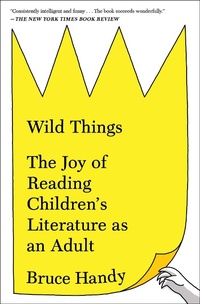
Wild Things
The Joy of Reading Children's Literature as an Adult
Published on 15. August 2017
336 pages
978-1-5011-5042-5 (ISBN)
Description

An irresistible, nostalgic, insightful?and "consistently intelligent and funny" (The New York Times Book Review)?ramble through classic children's literature from Vanity Fair contributing editor (and father of two) Bruce Handy.
The dour New England Primer, thought to be the first American children's book, was first published in Boston in 1690. Offering children gems of advice such as "Strive to learn" and "Be not a dunce," it was no fun at all. So how did we get from there to "Let the wild rumpus start"? And now that we're living in a golden age of children's literature, what can adults get out of reading Where the Wild Things Are and Goodnight Moon, or Charlotte's Web and Little House on the Prairie?
A "delightful excursion" (The Wall Street Journal), Wild Things revisits the classics of every American childhood, from fairy tales to The Very Hungry Caterpillar, and explores the back stories of their creators, using context and biography to understand how some of the most insightful, creative, and witty authors and illustrators of their times created their often deeply personal masterpieces. Along the way, Handy learns what The Cat in the Hat says about anarchy and absentee parenting, which themes are shared by The Runaway Bunny and Portnoy's Complaint, and why Ramona Quimby is as true an American icon as Tom Sawyer or Jay Gatsby.
It's a profound, eye-opening experience to re-encounter books that you once treasured decades ago. A clear-eyed love letter to the greatest children's books and authors from Louisa May Alcott and L. Frank Baum to Eric Carle, Dr. Seuss, Mildred D. Taylor, and E.B. White, Wild Things is "a spirited, perceptive, and just outright funny account that will surely leave its readers with a new appreciation for childhood favorites" (Publishers Weekly).
The dour New England Primer, thought to be the first American children's book, was first published in Boston in 1690. Offering children gems of advice such as "Strive to learn" and "Be not a dunce," it was no fun at all. So how did we get from there to "Let the wild rumpus start"? And now that we're living in a golden age of children's literature, what can adults get out of reading Where the Wild Things Are and Goodnight Moon, or Charlotte's Web and Little House on the Prairie?
A "delightful excursion" (The Wall Street Journal), Wild Things revisits the classics of every American childhood, from fairy tales to The Very Hungry Caterpillar, and explores the back stories of their creators, using context and biography to understand how some of the most insightful, creative, and witty authors and illustrators of their times created their often deeply personal masterpieces. Along the way, Handy learns what The Cat in the Hat says about anarchy and absentee parenting, which themes are shared by The Runaway Bunny and Portnoy's Complaint, and why Ramona Quimby is as true an American icon as Tom Sawyer or Jay Gatsby.
It's a profound, eye-opening experience to re-encounter books that you once treasured decades ago. A clear-eyed love letter to the greatest children's books and authors from Louisa May Alcott and L. Frank Baum to Eric Carle, Dr. Seuss, Mildred D. Taylor, and E.B. White, Wild Things is "a spirited, perceptive, and just outright funny account that will surely leave its readers with a new appreciation for childhood favorites" (Publishers Weekly).
More details
Other editions
Additional editions
Book
09/2018
Simon & Schuster
€19.00
Article exhausted; check different version
Bruce Handy
Wild Things
Book
08/2017
Simon & Schuster Children's Publishing
€43.92
Article exhausted; check different version
Person
Bruce Handy is a journalist, critic, humorist, and children's book author. His work has appeared in The New Yorker, Vanity Fair, The New York Times, and The Atlantic, among other publications. His book Wild Things: The Joys of Reading Children's Literature as an Adult was published in 2017. He is also the author of five picture books, including The Happiness of a Dog with a Ball in Its Mouth and What If One Day..., both of which were named New York Times Best Children's Books. He began his career as a writer and editor at Spy magazine, and also spent a season (1992-1993) writing for Saturday Night Live.
Content
- Intro
- Dedication
- Epigraph
- Introduction
- 1. New Eyes, New Ears: Margaret Wise Brown and Goodnight Moon
- 2. Runaways: Family Drama in Picture Books-and Well Beyond
- 3. Once upon a Time and In and Out of Weeks: Fairy Tales and Maurice Sendak
- 4. Why a Duck? The Uses of Talking Animals from Aesop to Beatrix Potter to Olivia the Pig
- 5. You Have to Know How: Dr. Seuss vs. Dick and Jane
- 6. Kids Being Kids: Ramona Quimby, American Pest
- 7. God and Man in Narnia
- 8. One Nation: Washington's Cherry Tree, Rosa Parks's Bus, and Oz
- 9. Going on Seventeen (Or Not): Little Women, Little Houses, and Peter Pans
- 10. The End: Dead Pets, Dead Grandparents, and the Glory of Everything
- Afterword
- Acknowledgments
- Appendix
- About the Author
- Bibliography
- Index
- Copyright
