

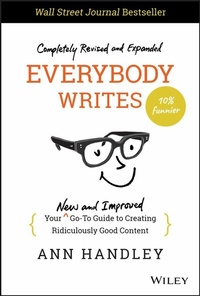
Everybody Writes
Description

In the newly revised and updated edition of Everybody Writes, marketer and author Ann Handley improves on her Wall Street Journal bestselling book that's helped hundreds of thousands become better, more confident writers.
In this brand-new edition, she delivers all the practical, how-to advice and insight you need for the process and strategy of content creation, production, and publishing.
This new edition also includes:
* All-new examples, tools, resources
* Updated step-by-step writing framework
* Added and expanded chapters that reflect the evolution of content marketing (and evolution of Ann's thinking about what works today)
* The same witty and practical how-to approach
* How to attract and retain customers with stellar online communication
* How to choose your words well, sparingly, and with honest empathy for your customers
* Best practices and ideas for crafting credible, trustworthy content
* "Things Marketers Write": The fundamentals of 19 specific kinds of content that marketers like you write
* Inspiration. Confidence. Fun.
In this book, you'll discover:
Content marketing has evolved. Yet writing matters more than ever.
In this new edition of Everybody Writes, you'll find the strategies, techniques, tips, and tools you'll need to refine, upgrade, and (most of all) inspire your own best content marketing.
More details
Other editions
Additional editions
Person
She is the world's first Chief Content Officer, a principal at training and education company MarketingProfs, and a regular speaker at events globally.
Ann is also a mom, dog person, and writer. Her favorite food is kale salad. But don't hold that against her.
Content
Start Here
Last Tuesday, for the first time in my life, I did a push-up. That wouldn't be remarkable for most of you, probably. It might seem even pathetic.
But for me it was an occasion to celebrate. It capped five (!) months of hard work that followed a lifetime of thinking of myself as spectacularly incapable.
I hail from a stunningly unathletic family: most of us are more Eeyore than Seabiscuit. We are the ones picked last for the team, the ones who are afraid of the ball. And I was (literally) a 100-pound weakling. So the idea of my being capable of a push-up (or 5, or 10, or-maybe, eventually-50 or more!) seemed as improbable as my writing this in Russian.
* * *
I wrote that ^^ in the Introduction of the first edition of this book, eight years ago.
Still today, when I meet fans of this book in person, the number one question they ask me isn't What's your best writing secret? Or Will you read my work? Or Oh I thought you were Tina Fey.
(That last one isn't a question; it was a comment I once got in a hotel lobby from a woman who bolted toward me from across the room, mistaking me for Tina. (Was it the glasses? The hair? Her bad eyesight? IDK.) She said it in a voice flat with disappointment and also . is that an accusation? Like I'd scammed her out of a million dollars?)
Anyway . the number one question isn't any of those. It's this:
How many push-ups can you do now?
It's a funny question. But it makes sense.
We all want to know . Did the effort deliver results? Did my single epic push-up become more . ? Did it actually become 5? Or 10? Or 50?
Is it true that learning to write better really just means working the right muscles? Does it actually pay off?
We want that assurance. We need answers.
Is it really as simple as showing up and strengthening your muscles?
* * *
Right now you might not consider yourself much of a writer, just as I never considered myself someone who could drop and pump out even a single push-up.
Many of us have the idea that the ability to write well is a gift bestowed on a chosen few. Writing well is considered an art, linked murkily to muse and mysticism and magic.
So we think there are two kinds of people: the writing haves-and the writing hapless, for whom writing well is a hopeless struggle. Like trying to carve a marble bust with a butter knife.
But I don't believe that. Neither should you.
The truth is this: Writing well is part habit, part knowledge of some fundamental rules, and part giving a damn.
We are all capable of producing good writing. We all have that magic within us.
"Writing is less about beckoning the muse than hanging in until the typing becomes writing," as the late, great journalist David Carr said.
So the two kinds of people are not the haves and the hapless. Instead, they are those who think they can write, and those who think they can't. (And often, both are wrong.)
In truth, most of us fall somewhere in the middle.
We're more capable than we think we are.
Choose Your Own Adventure
It's tricky writing this Introduction to you. There maybe be two kinds of writers . but there are many kinds of readers.
You might be picking this up for the first time. (Hi, new friend.)
Or you've read the first edition of this book and you're wondering what's new in this one. (Good to see you again.)
Or maybe you've cracked open these pages looking for answers to one or more of a few questions .
How is everybody actually a writer? Am I?
Does good writing matter anymore . ?
How is content marketing changing?
Has writing evolved since the first edition?
Does everybody really write in an age of TikFace and Web3 and robots spewing a spitcoin of social posts in less time than it took you to read this sentence . ?
Is the effort worth it . ? Is it as simple as showing up and working the muscles?
To speak to all that . I've organized this Introduction as a modified Choose Your Own Adventure format. As with the adventure book series, you decide what's interesting to you.
Answers to those questions and more are here. Wander through this section. Choose what you need; stop and read. Skip what you don't. You're in control here.
We'll all reconvene at the start of Part I.
Ready?
Yes, You Are a Writer
If you have a website, you are a publisher. If you are on social media, you are in marketing. And that means we are all writers.
Yeah, but who cares about writing anymore? In a digital world dominated by short and snappy, by quick and hit-by TikTok and Twitter and gifs and livestreaming and BRT and emojis and Web3 and robots that write . does the idea of our focusing on writing seem ordinary? And a little useless?
Heck no-it's neither ordinary nor useless.
Writing matters more now, not less.
There are a few reasons.
We are all creators. The first edition of this book talked about how we have become a planet of publishers-a world where marketing content is a wellspring, generating real business growth.
In the years since the first edition, we've jumped into the deep end of the content pool.
We've set up swim lanes in the form of structures and processes to consistently create content.
We've linked those efforts with strategic goals.
We've upped content budgets. We're using lots of tactics and channels. We're all-in on social media platforms. Look! We're even wearing metaverse arm floaties!
That's a lot of splashing around.
Yet many of us still struggle to stay afloat. We struggle to create the kind of content that connects with the people who matter to us.
Technology has given us access and power and water wings-yet we aren't taking full advantage of them.
We are a planet of publishers, yet many of us are polluting the pool with content rubbish. We are all creators, yet many of us are squandering the opportunity we have to communicate directly with those we care most about reaching.
Harsh, I know. But no hate. I'm here for you.
The challenge has shifted: Google and other search engines have made it clear that they'll love up the good stuff more than any polluted, brackish backwater.
We've embraced the idea that we are creators; the challenge that remains is the joy and craft of the creating-the writing. The publishing. The storytelling.
Your genuine, engaging voice matters. Robots might write drafts. Your competitor might generate as much content as you do (more, maybe?).
But! No one can copy your voice. No one can show up quite as you can. No robot will ever write as you do-not really, because none feel or think as you do.
(The best a robot might ever do is pantomime. Will they pantomime well? Maybe. Probably. But it's still just a pantomime.)
Your true voice is the best way for your audience to like and trust you. Your voice sets you apart from everyone else-from me, from the robot, and from your frenzied competitor treating content like an arms race.
Our online words are our emissaries ; they tell the world who we are, as author Beth Dunn puts it.1
I love that "emissaries" bit. I picture our words taking their role as diplomats for us very seriously-dressed up for a special mission, carrying important messages in their tiny attaché cases.
Our writing can make us look smart. Or it can make us look stupid.
Our writing can make us seem fun or warm or competent or trustworthy or likeable. Like someone who lightens the room just by showing up . hey, look who's here!
But it can also make us seem humdrum. Discombobulated. Flat-out boring. Or ugh not them again.
That means we need to choose words well. We need to write with style and honest empathy for readers.
Clarity counts. Clear writing matters in marketing. But it also is critical for us as professionals.
Yes you-sitting there in your home office, chatting on Slack, updating your colleagues or partners through internal blogs or messaging platforms or old-fashioned email.
Work today often gets done asynchronously-from various locations and with flexible work schedules. We communicate by (you guessed it) writing. (More about this in Part I.)
That's why we need to write clearly and succinctly: to communicate our ideas and thoughts in a way that doesn't meander maddeningly to and fro. To respect our readers. To write in a way that makes people want to read.
Being able to communicate well in writing isn't just nice; it's a necessity.
Craft counts, too. In an era of content superabundance, how we use our words matters. How we craft our communications, tell our stories, create or co-create customer experiences.
We need to place a high value on an overlooked skill in marketing: how to write (with style, flair, true emotion). And how to tell a true story well.
The very best marketing touches our hearts. It makes us pause, think,...
