

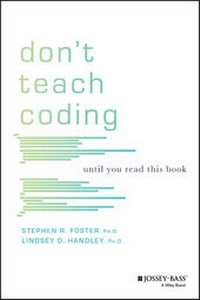
Don't Teach Coding
Description

Even though the vast majority of teachers, parents, and students understand the importance of computer science in the 21st century, many struggle to find appropriate educational resources. Don't Teach Coding: Until You Read This Book fills a gap in current knowledge by explaining exactly what coding is and addressing why and how to teach the subject. Providing a historically grounded, philosophically sensitive description of computer coding, this book helps readers understand the best practices for teaching computer science to their students and their children.
The authors, experts in teaching computer sciences to students of all ages, offer practical insights on whether coding is a field for everyone, as opposed to a field reserved for specialists. This innovative book provides an overview of recent scientific research on how the brain learns coding, and features practical exercises that strengthen coding skills. Clear, straightforward chapters discuss a broad range of questions using principles of computer science, such as why we should teach students to code and is coding a science, engineering, technology, mathematics, or language? Helping readers understand the principles and issues of coding education, this book:
* Helps those with no previous background in computer science education understand the questions and debates within the field
* Explores the history of computer science education and its influence on the present
* Views teaching practices through a computational lens
* Addresses why many schools fail to teach computer science adequately
* Explains contemporary issues in computer science such as the language wars and trends that equate coding with essential life skills like reading and writing
Don't Teach Coding: Until You Read This Book is a valuable resource for K-12 educators in computer science education and parents wishing to understand the field to help chart their children's education path.
More details
Other editions
Additional editions
Persons
LINDSEY D. HANDLEY, PHD, is a teacher, researcher, entrepreneur, author, and co-founder, with Stephen Foster, of ThoughtSTEM and MetaCoders.org, which have helped hundreds of thousands of beginning coders. She is a passionate advocate of both using science to improve education and of improving the teaching of science worldwide.
Content
- Intro
- Table of Contents
- About the Authors
- Acknowledgments
- Introduction
- Who Is This Book For?
- Let's Do It!
- CHAPTER 1: Prologues
- A WIZARD'S TALE
- A LANGUAGE WITHOUT
- A LANGUAGE WITHIN
- LANGUAGES WITHOUT
- LANGUAGES WITHIN
- CHAPTER 2: Beginnings
- A WIZARD'S TALE
- A LANGUAGE WITHOUT
- A LANGUAGE WITHIN
- LANGUAGES WITHOUT
- LANGUAGES WITHIN
- CHAPTER 3: Middles
- A WIZARD'S TALE
- A LANGUAGE WITHOUT
- A LANGUAGE WITHIN
- LANGUAGES WITHOUT
- LANGUAGES WITHIN
- CHAPTER 4: Ends
- A WIZARD'S TALE
- A LANGUAGE WITHOUT
- A LANGUAGE WITHIN
- LANGUAGES WITHOUT
- LANGUAGES WITHIN
- Conclusion
- NEXT STEPS: LEARNING SCIENCES
- NEXT STEPS: LANGUAGES TO LEARN
- NEXT STEPS: CODING
- NEXT STEPS: SOFTWARE ENGINEERING
- NEXT STEPS: HACKER CULTURE
- NEXT STEPS: HISTORY
- NAMING THINGS: COMPUTER SCIENCE
- NAMING THINGS: PHILOSOPHY OF MIND
- NAMING THINGS: LEARNING SCIENCE
- THANK YOU
- Bibliography
- Index
- End User License Agreement
CHAPTER 1
Prologues
"The programmers of tomorrow are the wizards of the future. You're going to look like you have magic powers compared to everyone else."
Gabe Newell, founder, Valve
"Any sufficiently advanced technology is indistinguishable from magic."
Arthur C. Clarke
"The programs we use to conjure processes are like a sorcerer's spells. They are carefully composed from symbolic expressions in arcane and esoteric programming languages."
Harold Abelson and Gerald Jay Sussman, Structure and Interpretation of Computer Programs
A WIZARD'S TALE
The Sorting of Wizards
"A sorting shall now commence!" an ancient wizard announced. "We must assign all of you into your various Houses. Each House at this prestigious school champions a slightly different way of learning how to become a coding wizard. I will now explain precisely how that works."
Henry, who could not pay attention to lectures for very long, leaned over and asked his new friends, "How does it work? How many Houses are there?"
His better-informed friend Harmony replied, "There are over a thousand, with more being added every day."
"Over a thousand!" hissed Henry. There was no way he was going to end up in the same House as his new friends.
"But," his goofy yet loyal friend Rob said, "I've heard that the sorting algorithm takes your preferences into account. So you can basically choose which House you start in."
Henry sighed with relief. "Good, which one are you both picking?"
"Definitely Python," said his friend Harmony, as if there were no doubt in the matter.
"Really?" says his friend Rob, doubtfully. "My dad said I should pick Scratch."
This sparked a debate between Harmony, whose position was that none of the great wizards actually use Scratch in their day-to-day work, and Rob, whose position was that Scratch was a better House for beginners to start in, and that they could always switch Houses later.
"You can switch?" asked Henry.
But Rob and Harmony didn't hear him. They were busy debating.
Henry's heart was starting to pound. The ancient wizard had already begun directing the students standing at the front of the Great Hall to start queuing up for the sorting process. One by one, they went onto the stage and sat on a stool. One by one, the ancient wizard placed upon them a weird cap with blinking lights. Each time, after a few moments of making beeps and boops, the cap's lights flashed green. Each time, it announced with a mechanical voice the House into which the candidate had been sorted:
"Java," it said for one. "C plus plus," it said for another. "Javascript," it said for another.
"Is Java part of the JavaScript House?" Henry tried to ask his friends. But they were too deep in conversation.
Henry noticed that he was being watched by a nearby group of "cool kids." One boy said to his friends, "This kid doesn't even know what JavaScript is."
Henry tried to ignore them, but their snickering hurt.
Meanwhile the hat continued to drone out the names of Houses. "C sharp," it said for one. "Ruby," it said for another. "C," it said for another. After receiving the hat's proclamation, each student grinned and exited the Great Hall through a door in the rear of the stage, presumably to meet the other students in their Houses. The number of students left in the Great Hall was beginning to thin.
Henry began to make his way through the crowd of students, toward the back of the Great Hall. Other kids gave him strange looks as he squeezed between them.
Finally, at the rear of the hall, just as he was about to curl into a fetal position between a suit of armor and a damp stone corner, he discovered that Harmony and Rob had followed him.
"What's wrong?" said Rob. "Where are you going?"
"It's just." said Henry.
"You don't know which House to pick, do you?" said Harmony. "Not to worry. I'll help. The top 10 Houses right now are JavaScript, Python, Java, C++, PHP, Swift, C#, Ruby, Objective-C, and SQL. But you obviously wouldn't want to go into the SQL House - because they don't do general purpose magic, just database magic. And you might want to be careful if you go into the Swift or Objective-C Houses - because their magic is proprietary. With C#, some people think that's proprietary magic too, but there's an open source -"
Henry covered his ears to stop the flood of words he didn't understand. "I wasn't born into a coding family. Maybe I'm just not cut out for -"
"Neither was Harmony," his friend Rob interrupted. "She just spends a lot of time on Google. My parents, on the other hand, were both wizards." He said this proudly. "My father sorted into Java, and my mother sorted into Ruby. But both of them always say that it doesn't really matter where you start." He gave Harmony a pointed look. "It's where you end up that matters."
"But," said Henry, frantic, "they can't ALL be equally good places to start. If they were all equally good, why are there so many different ones?"
"Each House does magic," said Harmony. "They just use a different language to express their magic. At the end of the day, though, magic is magic."
Meanwhile, over half of the students had already been sorted. Still the cap droned on. "Objective-C," it announced. "FORTRAN," it said. "HTML," it said.
Harmony and Rob both winced at the "HTML" announcement.
"See?" exclaimed Henry. "They aren't all equal. What is HTML? What was that face you both made?"
"Okay," said Harmony, "maybe they aren't ALL created equally. HTML is a kind of magic, don't get me wrong. But it's a less powerful kind of magic. You wouldn't want to spend your whole time here just studying HTML. If you did, you might not be able to get a job as a wizard afterward."
Henry sank to the ground and rested his head against the cold metal of the suit of armor.
"My mom and dad say you shouldn't worry about getting a job," said Rob. "You should just learn to love magic."
Henry said, "I just want to be in a House with you two. But even you two can't agree."
Rob and Harmony exchanged a look. "Give us a moment," said Rob, pulling Harmony aside. They conferred in hushed tones.
Henry couldn't hear them over the constant drone of the sorting hat: "Prolog. Scratch. Algol. Perl. XML. Scratch. Haskell. CSS. Racket. Bash. Ruby. Python. TypeScript. Scratch." And so on.
When they came back, Rob said:
"Okay, we've decided. You'll go first, and whatever you get sorted into, we'll pick that too."
Harmony didn't seem happy about it, but she nodded. "Wizards work in teams," she said. "At the end of the day, what matters is that we stay together."
Henry was dumbfounded. He didn't deserve friends like these. They helped him to his feet, where he did his best to hide that his knees were shaky and weak. Arm in arm, they joined the end of the queue - the last of the young wizards to be sorted.
By the time Henry stepped up on the stage, the Great Hall was empty, save his two friends behind him, and the ancient wizard in front of him. Henry sat upon the stool and closed his eyes as the hat settled upon his head.
He could hear it talking through a speaker near his ear. "Well, well, well.what have we here?" it said. "Henry doesn't know what House he wants to be in.Hmmm. I suppose we could put you in HTML, and -" Henry stiffened. "No? What about Scratch?" Henry didn't know what to say. "Why am I asking you, anyway? I could put you anywhere, and you wouldn't know the difference." Henry shifted uncomfortably. "Still, I sense a great power within you - greater even than any of the cool kids who came onto the stage before you." Henry wasn't sure whether he should feel complimented about his mysterious "great power" or worried that he was uncool. "Yes, the more information I gather, the more I'm certain of it. You're a very special young wizard. Much too special for the lesser Houses. Perhaps I could sort you into a venerable old House, such as C. Or perhaps an ancient House, such as Lisp. Or perhaps you'd excel in a hip, newer House, like Rust, or an obscure but powerful House like Prolog or Haskell. Or perhaps a solid, popular House, like Python or Java. Interesting. I've never had so much trouble sorting someone before," Henry's heart was beating so hard that he could barely hear the hat anymore. Was he really destined for greatness? The suspense was so painful that he wanted to just shout the name of a House at random in hopes that the hat would put an end to it all. Somehow, he didn't. "Hmmm, well, if I can't...
