

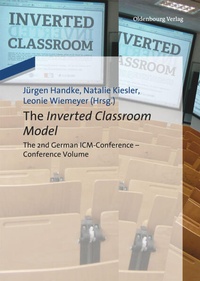
The Inverted Classroom Model
Description

When the 1st German Inverted Classroom Conference was staged in 2012, the organizers thought that it may have been the first and last conference of this kind: Too few teachers seemed to be familiar with this model in the first place and only a tiny fragment of them would actually apply this model to their own teaching scenarios. However, in the 2013 conference, we were overwhelmed with a large number of teachers who not only wanted to find out about this teaching and learning concept but had already used it.
Consequently, the focus of the 2nd German Inverted Classroom Conference to which this conference volume is dedicated was no longer the "installation" of the Inverted Classroom Model (ICM) but fine adjustments in the actual application of it.
This is reflected in the contributions to this volume. Even though all three central aspects of the ICM are addressed, (1) content production and delivery, (2) testing, and (3) the in-class phase, there has been a shift away from mere content production towards an expansion of the model as well as a move towards fine adjustments of the three components.
More details
Other editions
Additional editions
Persons
Content
- Intro
- Contents
- Preface
- The Authors
- I Recent Developments in ICM Implementation
- 1 The Inverted Classroom: Where to Go from Here
- 2 Beyond a Simple ICM
- 3 Activating Students by Inverting and Shuffling the Classroom - Experiences from Employing ICM and I²CM
- 4 Experiences with the Implementation of an Inverted Classroom Course to Promote Key Competences
- II Phase 1 of the Inverted Classroom Model: Content Delivery
- 5 Learning by Contribution - Using Wikis in Higher Education
- 6 The VLC Video Strategy
- 7 Using Videos in the Linguistics Classroom
- 8 Flipping Professional Training in Higher Education Didactics - Proposing an Open Video Platform
- III Phase 2 of the Inverted Classroom Model: In-Class Activities
- 9 Tutor of the Day - A New Didactic Concept for the Practice Phase of ICM-Based Teaching
- 10 Designing In-Class Activities in the Inverted Classroom Model
- 11 Clicker-Happy: Audience Response Systems as an Interface between Pre-Class Preparation and In-Class Session
- IV Implementation of the ICM in High School
- 12 Flipped Learning in the Science Classroom
- 13 Inverting the History Classroom - A First-Hand Report
- 14 Inverting a Competence-Based EFL Classroom - A Model for Advanced Learner Activation?
- References
- Index
