


Handbook of Terminology Management
Volume 1: Basic Aspects of Terminology Management
John Benjamins Publishing Company
1st Edition
Published on 21. March 1997
XIV, 372 pages
978-90-272-8557-7 (ISBN)
Description

The Handbook of Terminology Management is a unique work designed to meet the practical needs of terminologists, translators, lexicographers, subject specialists (e.g., engineers, medical professionals, etc.), standardizers and others who have to solve terminological problems in their daily work.
In more than 900 pages, the Handbook brings together contributions from approximately 50 expert authorities in the field. The Handbook covers a broad range of topics integrated from an international perspective and treats such fundamental issues as: practical methods of terminology management; creation and use of terminological tools (terminology databases, on-line dictionaries, etc.); terminological applications.
The high level of expertise provided by the contributors, combined with the wide range of perspectives they represent, results in a thorough coverage of all facets of a burgeoning field. The lay-out of the Handbook is specially designed for quick and for cross reference, with hypertext and an extensive index.
See also Handbook of Terminology Management set (volumes 1 and 2).
In more than 900 pages, the Handbook brings together contributions from approximately 50 expert authorities in the field. The Handbook covers a broad range of topics integrated from an international perspective and treats such fundamental issues as: practical methods of terminology management; creation and use of terminological tools (terminology databases, on-line dictionaries, etc.); terminological applications.
The high level of expertise provided by the contributors, combined with the wide range of perspectives they represent, results in a thorough coverage of all facets of a burgeoning field. The lay-out of the Handbook is specially designed for quick and for cross reference, with hypertext and an extensive index.
See also Handbook of Terminology Management set (volumes 1 and 2).
More details
Other editions
Additional editions
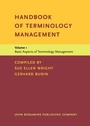
Handbook of Terminology Management
Volume 1: Basic Aspects of Terminology Management
Book
03/1997
John Benjamins Publishing Co
€132.50
Shipment within 10-15 days
Persons
Content
- HANDBOOK OF TERMINOLOGY MANAGEMENT
- Title page
- Copyright page
- Table of contents
- List of Illustrations
- The Handbook of Terminology Management Introduction
- THE NATURE OF A HANDBOOK
- TERMINOLOGY MANAGEMENT
- A POLYTHEORETTCAL, POLYMETHODOLOGICAL APPROACH
- THE SCOPE OF TERMINOLOGY MANAGEMENT
- VOLUME I: BASIC ASPECTS OF TERMINOLOGY MANAGEMENT
- VOLUME II: APPLICATIONS-ORIENTED TERMINOLOGY MANAGEMENT
- ORGANIZATIONAL PHILOSOPHY AND INFORMATION RETRIEVAL MECHANISMS
- How TO USE THIS BOOK
- 1. Fundamental Principles of Terminology Management
- Section 1.1 Term Selection: The Initial Phase of Terminology Management
- REFERENCES
- Section 1.2 Concept Representation
- 1.2.1 Term Formation
- REFERENCES
- 1.2.2 Graphic and Other Semiotic Forms of Knowledge Representation in Terminology Management
- ACKNOWLEDGMENTS
- Section 1.3 Concept Description
- 1.3.1 Terminological Definitions
- REFERENCES
- 1.3.2 Frames and the Display of Definitions
- REFERENCES
- 1.3.3 Terms and Contexts
- REFERENCE
- Section 1.4 Concept Systems
- 1.4.1 Representation of Concept Systems
- REFERENCES
- 1.4.2 Systematic Concept Analysis within a Knowledge-Based Approach to Terminology
- REFERENCES
- 1.4.3 Multifaceted/Multidimensional Concept Systems
- REFERENCES
- 1.4.4 Multidimensional Classification of Concepts and Terms
- REFERENCES
- 2. Types of Terminology Management
- Section 2.1 Descriptive Terminology
- 2.1.1 Terminology Management for Technical Translation
- REFERENCES
- 2.1.2 Medical Terminology Management
- REFERENCES
- 2.1.3 The Terms and Arts of Patentese: Wolves in Sheep's Clothing
- REFERENCES
- 2.1.4 Descriptive Terminology In the Social Sciences
- REFERENCES
- Section 2.2 Standardization
- 2.2.1 Terminology Standardization: Management Strategies
- REFERENCES
- 2.2.2 ISO 10241: Preparation and Layout of Terminology Standards
- REFERENCES
- 2.2.3 Terminology Management in International Standardization: ISO 472: Plastics - Vocabulary
- 2.2.4 Do's and Don'ts of Terminology Management
- REFERENCES
- 3. Language Policy and Technology
- Section 3.1 Multilingualism in Terminology Management
- REFERENCES
- Section 3.2 Language Planning and Terminology Planning: The Francophone Experience
- REFERENCES
- 4. Intellectual Property Rights
- Section 4.1 Copyright and Terminology
- REFERENCES
- 5. Terminology Training
- Section 5.1 Aspects of Terminology Training
- Information Boxes
- INFOBOX No. 1 Terminology Collections
- INFOBOX No. 2 Terminology Activities
- INFOBOX No. 3 Lexicography vs. Terminology
- INFOBOX No. 4 Descriptive and Prescriptive Terminology Management
- INFOBOX No. 5 Special Languages
- INFOBOX No. 6 Headwords
- INFOBOX No. 7 Part of Speech (Word Class)
- INFOBOX No. 8 Abbreviated Forms of Terms
- INFOBOX 9 Classification and Other Documentary Languages
- INFOBOX No. 10 Conceptual Relations
- INFOBOX No. 11 Intension and Extension
- INFOBOX No. 12 Standard Definitions
- INFOBOX No. 13 Hypertext
- INFOBOX No. 14 Entailed Terms
- INFOBOX No. 15 Product Media
- INFOBOX No. 16 Language Identifiers
- INFOBOX No. 17 Bibliographic Source Identifiers
- INFOBOX No. 18 Medical Etymology
- INFOBOX No. 19 Doctoral Level Training
- Appendix I Terminology Manuals
- REFERENCES
- Appendix II Abbreviations
- Acknowledgements
- Authors' Biographical Information
- Index
