

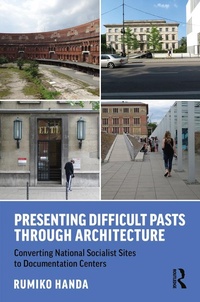
Presenting Difficult Pasts Through Architecture
Converting National Socialist Sites to Documentation Centers
1st Edition
Published on 24. March 2021
222 pages
978-0-429-55641-8 (ISBN)
Description

Architectural design can play a role in helping make the past present in meaningful ways when applied to preexisting buildings and places that carry notable and troubling pasts. In this comparative analysis, Rumiko Handa establishes the critical role architectural designs play in presenting difficult pasts by examining documentation centers on National Socialism in Germany.
Presenting Difficult Pasts Through Architecture analyzes four centers - Cologne, Nuremberg, Berlin, and Munich - from the point of view of their shared intent to make the past present at National Socialists' perpetrator sites. Applying original frameworks, Handa considers what more architectural design could do toward meaningful representations and interpretations of difficult pasts.
This book is a must-read for students, practitioners, and academics interested in how architectural design can participate in presenting the difficult pasts of historical places in meaningful ways.
Presenting Difficult Pasts Through Architecture analyzes four centers - Cologne, Nuremberg, Berlin, and Munich - from the point of view of their shared intent to make the past present at National Socialists' perpetrator sites. Applying original frameworks, Handa considers what more architectural design could do toward meaningful representations and interpretations of difficult pasts.
This book is a must-read for students, practitioners, and academics interested in how architectural design can participate in presenting the difficult pasts of historical places in meaningful ways.
Reviews / Votes
'This book provides an intelligibly conceptualized, clearly organized and well-illustrated architectural guide to the Munich, Nuremberg, Berlin, and also Cologne documentation centers that should be of interest to both architects, curators of historical museums-especially institutions devoted to the presentation of a difficult and/or contested past-and public historians who are interested in the ability of architects to contribute to an understanding of the past and an engagement with it in the public sphere. I have often thought that these buildings deserved a monograph, and to my delight, the complexity of their architectural rhetoric has found a match in the architectural criticism, sense of scholarly perseverance, and openness to the at times ironic dimensions of museums of perpetrator history brought to the subject by Rumiko Handa.'Pelt, Van, and Robert Jan. "Review: Presenting Difficult Pasts Through Architecture: Converting National Socialist Sites to Documentation Centers, by Rumiko Handa." The Public Historian 43, no. 4 (November 1, 2021): 153-55. https://doi.org/10.1525/tph.2021.43.4.153.
More details
Edition
1. Auflage
Language
English
Place of publication
London
United Kingdom
Publishing group
Taylor & Francis Ltd
Target group
College/higher education
Illustrations
86 Halftones, black and white; 86 Illustrations, black and white
ISBN-13
978-0-429-55641-8 (9780429556418)
Copyright in bibliographic data and cover images is held by Nielsen Book Services Limited or by the publishers or by their respective licensors: all rights reserved.
Schweitzer Classification
Other editions
Additional editions
Rumiko Handa
Presenting Difficult Pasts Through Architecture
Converting National Socialist Sites to Documentation Centers
Book
03/2021
1st Edition
Routledge
€192.21
Shipment within 15-20 days
Rumiko Handa
Presenting Difficult Pasts Through Architecture
Converting National Socialist Sites to Documentation Centers
Book
03/2021
1st Edition
Routledge
€49.59
Shipment within 15-20 days
Person
Rumiko Handa is Professor of Architecture at the University of Nebraska-Lincoln, USA. She holds a PhD in architectural theory from the University of Pennsylvania and a BArch from the University of Tokyo, Japan. Her writings have appeared in: Montreal Architecture Review; Interiors: Design, Architecture, Culture; The Journal of the Society of Architectural Historians; Preservation Education & Research; Design Studies; and so on. She co-edited Conjuring the Real: The Role of Architecture in Eighteenth- and Nineteenth-Century Fiction. She is also the author of Allure of the Incomplete, Imperfect, and Impermanent.
Content
Introduction; 1. Postwar Rebuilding and Coping with the Past; 2. Four Documentation Centers - Histories; 3. In the Shadow of Propaganda Architecture; 4. Presenting Pasts through Architecture - Intellectual Framework; 5. Formal Characteristics; 6. Physical Traces; 7. Designation; 8. Memento; Conclusion
