

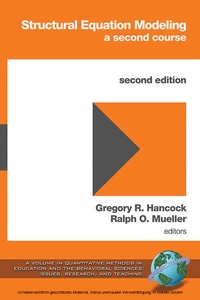
Structural Equation Modeling
A Second Course (2nd ed.)
1st Edition
Published on 1. March 2013
703 pages
978-1-62396-246-3 (ISBN)
Description

Sponsored by the American Educational Research Association's Special Interest Group for Educational Statisticians
This volume is the second edition of Hancock and Mueller's highly-successful 2006 volume, with all of the original chapters updated as well as four new chapters. The second edition, like the first, is intended to serve as a didactically-oriented resource for graduate students and research professionals, covering a broad range of advanced topics often not discussed in introductory courses on structural equation modeling (SEM). Such topics are important in furthering the understanding of foundations and assumptions underlying SEM as well as in exploring SEM, as a potential tool to address new types of research questions that might not have arisen during a first course. Chapters focus on the clear explanation and application of topics, rather than on analytical derivations, and contain materials from popular SEM software.
All prices
More details
Other editions
Additional editions
Book
03/2013
2nd Edition
Information Age Publishing
€121.40
Shipment within 3-4 weeks
Content
- Cover
- Structural Equation Modeling
- Quantitative Methods in Education and the Behavioral Sciences:Issues, Research, and Teaching
- Structural Equation Modeling
- Copyright
- CONTENTS
- ACKNOWLEDGEMENTS
- PREFACE
- SERIES INTRODUCTION
- INTRODUCTION TO THE SECOND EDITION OF STRUCTURE EQUATION MODELING :ASECOND COURSE
- THE PRESENT VOLUME:GOALS,CONTENT ,AND NOTATION
- LOOKING FORWARD
- NOTES
- REFERENCES
- I : FOUNDATIONS
- 1 : THE PROBLEM OF EQUIVALENT STRUCTURAL MODELS
- A DEFINITION OF EQUIVALENT MODELS
- WHY EQUIVALENT MODELS ARE IMPORTANT TO IDENTIFY
- TYPES OF MODEL EQUIVALENCE
- Observationally Equivalent/Covariance Equivalent
- Globally Equivalent/Locally Equivalent
- STRATEGIES FOR IDENTIFYING EQUIVALENT MODELS
- The Replacing Rule and Structural Models
- The Reversed Indicator Rule and Measurement Models
- Summary of Rules for Specifying EquivalentStructural Models
- Summary of Rules for Specifying EquivalentMeasurement Models
- Other Strategies Before and After Data Collection
- CONCEPTUALIZATIONS OF MODEL EQUIVALENCE AND IDENTIFICATION
- SELECTING FROM AMONG EQUIVALENT MODELS
- Before Data Collection
- After Data Collection
- CONCLUSION
- NOTES
- REFERENCES
- 2 : REVERSE ARROW DYNAMICS
- NONRECURSIVE MODELS WITH FEEDBACK LOOPS
- Identification Requirements of Modelswith Feedback Loops
- Special Assumptions of Models with Feedback Loops
- Example Analysis of a Nonrecursive Model with aFeedback Loop
- FORMATIVE MEASUREMENT MODELS
- Identification Requirements of Models with Latent Composites
- Example Analysis of a Model with Risk as a Latent Composite
- PLS Path Modeling as an Alternative to SEM in the Analysis of Composites
- SUMMARY, PRACTICAL SUGGESTIONS, AND EXEMPLARS
- APPENDIX A
- Method for Checking Rank Condition
- APPENDIX B EQS Syntax
- Feedback Loop
- Formative Measurement
- APPENDIX C LISREL (SIMPLIS) Syntax
- Feedback Loop
- Formative Measurement
- APPENDIX D Mplus Syntax
- Feedback Loop
- Formative Measurement
- NOTES
- REFERENCES
- 3 : PARTIAL LEAST SQUARES PATH MODELING
- Origin of PLS Path Modeling
- HOW DOES PLS PATH MODELING WORK?
- Constructs
- Relations Among Constructs
- Observed Variables
- Model Estimation
- Standard Errors
- Evaluating Results
- Diagnostics
- EMPIRICAL EXAMPLE: NATIONAL PARTNERSHIP FOR REINVENTING GOVERNMENT EMPLOYEE SURVEY
- Overall Results
- Parameter Estimates
- Standard Errors
- Stone-Geisser Q2
- WHY USE PLS PATH MODELING?
- RECENT DEVELOPMENTS IN PLS PATH MODELING
- COMPOSITE-BASED ALTERNATIVES TO PLS PATH MODELING
- SOFTWARE FOR PLS PATH MODELING AND RELATED TECHNIQUES
- CONCLUSION
- ACKNOWLEDGEMENTS
- REFERENCES
- 4 : POWER ANALYSIS IN STRUCTURAL EQUATION MODELING
- POWER ANALYSIS IN STRUCTURAL EQUATION MODELING
- Null and Alternative Hypotheses
- Test Statistics to Assess the Null Hypothesis
- Central and Noncentral Distributions
- Power
- POWER ANALYSIS FOR TESTING DATA-MODEL FIT
- Null and Alternative Hypotheses
- Test Statistics to Assess the Null Hypothesis
- Central Distributions (for H0) and Noncentral Distributions (for H1)
- Power and Examples
- Issues and Extensions
- POWER ANALYSIS FOR TESTING PARAMETERS WITHIN A MODEL
- Null and Alternative Hypotheses
- Test Statistics to Assess Null Hypotheses
- Central Distributions (for H0) and Noncentral Distributions (for H1)
- Power
- Example of Power Analysis for Testing Parameters Within a Model
- A Simplification for Models with Latent Variables
- Issues and Extensions
- MONTE CARLO APPROACHES TO POWER ANALYSIS IN SEM
- Evaluation of Data-Model Fit
- Evaluation of Power for Testing Parameters Within a Model
- FINAL THOUGHTS REGARDING POWER ANALYSIS IN STRUCTURAL EQUATION MODELING
- ACKNOWLEDGEMENTS
- APPENDIX:Mplus Input and Output for MC Power Analysis Example
- Input
- Output (highly edited)
- REFERENCES
- II : EXTENSIONS
- 5 : EVALUATING BETWEEN-GROUP DIFFERENCES IN LATENT VARIABLE MEANS
- GETTING IN THE MOOD FOR MODELING: SOME ADVANTAGES OF SEM FOR ASSESSING DIFFERENCES IN LATENT MEANS
- INTRODUCING MODELS FOR EVALUATING DIFFERENCES IN FACTOR MEANS
- Structured Means Modeling for Assessment of Mean Differences
- The MIMIC Model for Assessment of Mean Differences
- Assessment of Differences in Factor Means Under Partial Invariance
- Stepwise Method for Testing Differences in Factor Means under Partial Invariance
- Problems with Interpreting Mean Differences
- ACCOMMODATING MORE COMPLEX RESEARCH DESIGNS
- One-Way Designs with More Than Two Groups
- Multiway Designs
- Inclusion of Manifest and Latent Covariates
- SUMMARY AND CONCLUSIONS
- APPENDIX A Syntax for SMM and MIMIC Analyses for Dataset 1
- Syntax for SMM Analyses for Dataset 1
- EQS Program
- Mplus Program
- SIMPLIS Program
- Syntax for MIMIC Analyses for Dataset 1
- EQS Program
- Mplus Program
- SIMPLIS Program
- APPENDIX B The Comparative Fit Index and Measurement Invariance
- REFERENCES
- 6 : CONDITIONAL PROCESS MODELING
- WHAT IS CONDITIONAL PROCESS MODELING?
- INDIRECT, DIRECT, AND CONDITIONAL EFFECTS
- TRANSLATING A CONCEPTUAL MODEL INTO A STATISTICAL MODEL
- Step 1: Derive the Number of Linear Models Necessary to Model the Process Statistically
- Step 2: Label the Points of Moderation in the Conceptual Model
- Step 3: Construct Sequences of Variable Names for Each Consequent
- Step 4: Expansion of Sequences with at Least Three Variable Names
- Step 5. Use the List of Sequences to Generate the Linear Models for Each Consequent
- Step 6: Fine-Tuning the Models
- MODEL ESTIMATION
- DERIVATION AND INFERENCES ABOUT (CONDITIONAL) DIRECT AND INDIRECT EFFECTS
- Deriving Direct and Indirect Effects as Functions
- Quantification and Visualization of Conditional Direct and Indirect Effects
- Statistical Inference: Probing the Direct and Indirect Effects at Levels of the Moderator(s)
- EXTENSIONS TO LATENT VARIABLES
- CONCLUSION
- APPENDIX A
- APPENDIX B
- NOTES
- REFERENCES
- 7 : STRUCTURAL EQUATION MODELS OF LATENT INTERACTION AND QUADRATIC EFFECTS
- TRADITIONAL (NON-LATENT) APPROACHES TO INTERACTIONS BETWEEN OBSERVED VARIABLES
- LATENT APPROACHES TO INTERACTIONS
- Analyses of Factor Scores
- Multiple Groups Analysis
- Fully Latent Variable Approaches Using Structura lEquation Analyses
- PRODUCT-INDICATOR APPROACHES
- Constrained Approaches
- Interaction Effects: Constrained Approach
- Unconstrained Approach
- Robustness to Violations of Normality Assumptionsin Product Indicator Approaches
- Strategies in Forming Product Indicators
- Indicator Centering and Mean Structure in Product Indicator Method
- Appropriate Standardized Solution in Product-Indicator Models
- An Example Using the Unconstrained Approach
- DISTRIBUTION-ANALYTIC APPROACHES
- Comparison to Product-Indicator Approaches
- BAYESIAN APPROACH
- QUADRATIC AND NONLINEAR EFFECTS: UNCONSTRAINED AND OTHER APPROACHES
- SUMMARY AND LIMITATIONS
- APPENDIX A
- LISREL Syntax for Latent Interaction Model Without Mean Structure by the Unconstrained Approach
- APPENDIX B
- The PRELIS Syntax for Creating the Bootstrap Samples for Calculating Standard Errors for Appropriate Standardized Interaction Effects
- APPENDIX C
- LISREL Syntax for Latent Quadratic Model Without Mean Structure by the Unconstrained Approach
- REFERENCES
- 8 : USING LATENT GROWTH MODELING TO EVALUATE LONGITUDINAL CHANGE
- LGM METHODOLOGY FOR LINEAR DEVELOPMENTAL PATTERNS
- Example of a Linear Latent Growth Model
- Variations on the Linear Latent Growth Model
- LGM METHODOLOGY FOR NONLINEAR DEVELOPMENTAL PATTERNS
- Modeling with Nonlinear Functions
- Structured Latent Curve Models
- Piecewise Latent Growth Models
- ACCOMMODATING EXTERNAL VARIABLES IN LATENT GROWTH MODELS
- VARIATIONS, EXTENSIONS, AND CONCLUSIONS
- NOTES
- APPENDIX Software Syntax for Linear Latent Growth Model Example
- EQS (6.2)
- SIMPLIS (8.8)
- Mplus (6.12)
- Software Syntax for the Conditionally Linear LatentGrowth Model Example Using an Exponential Function
- Mplus (6.12)
- REFERENCES
- 9 : MEAN AND COVARIANCE STRUCTURE MIXTURE MODELS
- Group Membership Known
- Group Membership Unknown
- ABOUT MIXTURE MODELS
- Univariate Mixtures
- Multivariate Mixtures
- FACTOR MIXTURES
- Growth Mixtures
- PRACTICAL ISSUES IN MIXTURE MODELING
- Estimation
- Choosing Among Models Differing in Their Number of Classes
- Importance of Validity
- Choosing from Among a More Comprehensive Set of Models
- Other Alternative Explanations
- Indirect versus Direct Applications
- CONCLUSION
- APPENDIX
- General Syntax
- Example Specific Syntax
- Examples 1.1 and 1.2
- Examples 2.1 and 2.2
- Examples 3.1
- Examples 3.2
- Example 4.1
- ACKNOWLEDGMENTS
- NOTES
- REFERENCES
- 10 : EXPLORATORY STRUCTURAL EQUATION MODELING
- Previous Applications of ESEM
- Confirmatory Versus Exploratory Factor Analysis
- Organization of the Examples Provided in This Chapter
- THE ESEM APPROACH
- The ESEM Model and Rotational Indeterminacy
- Goodness of Fit
- DATA GENERATION AND ESEM ANALYSES
- ILLUSTRATING ESEM: PSYCHOMETRIC APPLICATIONS BASED ON THE ESEM MEASUREMENT MODEL
- Comparison of ESEM and CFA Models
- Measurement Invariance: The Multiple Group Approach
- Measurement Invariance: The Longitudinal Approach
- ILLUSTRATING ESEM: PREDICTIVE APPLICATIONS BASED ON THE ESEM STRUCTURAL MODEL
- The MIMIC Approach
- Autoregressive Cross Lagged ESEM Models
- EXTENDING ESEM: THE ESEM-WITHIN-CFA (EWC) APPROACH AND ILLUSTRATIONS
- CONCLUSION
- NOTE
- ACKNOWLEDGEMENTS
- REFERENCES
- III : ASSUMPTIONS
- 11 : NONNORMALAND CATEGORICAL DATA IN STRUCTURAL EQUATION MODELING
- NORMAL THEORY ESTIMATORS
- Assumptions of Normal Theory Estimators
- Defining Normal Theory Estimators
- NONNORMAL CONTINUOUS DATA
- Assessing Nonnormality
- Effects of Analyzing Nonnormal Continuous Data:Empirical Results
- Techniques to Address Nonnormal Continuous Data
- S-B Scaling Methods with Continuous Nonnormal Data: EmpiricalResults.
- ORDERED CATEGORICAL DATA
- Effects of Analyzing Approximately Normally Distributed Ordered Categorical Data Using ML Estimation: Empirical Results
- Effects of Analyzing Nonnormal Ordered Categorical Data using ML Estimation: Empirical Results
- Techniques to Address Ordered Categorical Data
- IRT Parameters via CVM
- SUGGESTIONS FOR HANDLING NONNORMALITY AND ORDERED CATEGORICAL DATA
- Recommendations
- Strategies Not Recommended
- DIRECTIONS FOR FUTURE RESEARCH AND CONCLUSIONS
- ML Estimation with Latent Correlation Input
- Interpretation of Fit Indices
- Full-Information Estimators
- APPENDIX A WLS Syntax
- Continuous Data
- LISREL 8.80
- SIMPLIS Command Language Employed Using LISREL 8.80
- EQS 6.1
- Mplus 6.0
- Ordered Categorical Data
- LISREL 8.80
- SIMPLIS Command Language Employed Using LISREL 8.80
- EQS 6.1
- Mplus 6.0
- APPENDIX B S-B Scaling Syntax
- Continuous and Ordered Categorical Data
- SIMPLIS Command Language Employed Using LISREL 8.80
- EQS 6.1
- Mplus 6.0
- APPENDIX C Robust DWLS Syntax
- SIMPLIS command language employed using LISREL 8.80
- Mplus 6.0
- ACKNOWLEDGEMENT
- NOTES
- REFERENCES
- 12 : ANALYZING STRUCTURAL EQUATION MODELS WITH MISSING DATA
- ARTIFICIAL DATA EXAMPLE
- THEORETICAL BACKGROUND
- AD HOC MISSING DATA HANDLING TECHNIQUES
- MAXIMUM LIKELIHOOD ESTIMATION
- Standard Error Computations
- Auxiliary Variables
- Nonnormal Data
- Incomplete Explanatory Variables
- Two-Stage Estimation
- Example Analysis
- MULTIPLE IMPUTATION
- Practical Issues
- Example Analysis
- SUMMARY AND CONCLUSIONS
- APPENDIX A: Mplus Syntax for Saturated Correlates Model
- APPENDIX B:Mplus Syntax for Imputation Phase of Multiple Imputation
- APPENDIX C:Mplus Syntax for Analysis and Pooling Phase of Multiple Imputation
- NOTE
- REFERENCES
- 13 : MULTILEVEL STRUCTURAL EQUATION MODELING WITH COMPLEX SAMPLE DATA
- REVIEW OF COMPLEX SAMPLING DESIGNS
- Multi-Stage (Cluster) Sampling
- Stratification
- Unequal Selection Probabilities
- ANALYSIS OPTIONS
- Design-Based Modeling
- Pooled Within-Group Covariance Matrix Modeling
- Multilevel Modeling
- THE MULTILEVEL STRUCTURAL EQUATION MODELING PROCESS
- Considering a Single-Level Analysis
- Considering a Multilevel Analysis
- Step 1. Evaluate Descriptive Information of All Variables
- Step 2. Run Baseline Models for Both the Within and Between-Cluster Levels
- Step 3. Run a Theoretical Model at the Within Level,Saturated at the Between Level
- Step 4. Run a Theoretical Model at the Between Level,Saturated at the Within Level
- Step 5. Run a Model with Theory Imposed at Both Levels
- Step 6. Evaluate Random Coefficients at the Within Level
- Other Software
- ADDITIONAL ISSUES IN MULTILEVEL SEM
- Additional Resources
- SUMMARY
- NOTES
- REFERENCES
- 14 : BAYESIAN STRUCTURAL EQUATION MODELING
- INTRODUCTION TO BAYESIAN INFERENCE
- Review of Frequentist Inference
- Bayesian Inference
- Bayes' Theorem and the Mechanics of Bayesian Inference
- On the Use of Distributions for Parameters in Modeling
- Choosing Prior Distributions
- Controversy about Bayesian Inference
- BAYESIAN SEM
- Traditional Formulation of SEM
- Bayesian SEM with Subject-Level Data
- The Conditional Probability of the Data
- The Prior Distribution-Begun
- Interlude-What Bayes and ML Share
- The Prior Distribution-Resumed
- Reconceiving Bayesian SEM
- Bayesian SEM with Summary-Level(or Moment-Level) Data
- Comparing the Individual-Level and Summary-Level Approaches
- Graphical Model Representation
- MARKOV CHAIN MONTE CARLO ESTIMATION
- Gibbs Sampling
- Metropolis-Hastings Sampling
- Metropolis Sampling
- Single-Component-Metropolis or Metropolis-Within-Gibbs
- How MCMC Overcomes the Obstacles of Bayesian Modeling
- Practical Issues with MCMC
- BAYESIAN APPROACHES TO ADDITIONAL ANALYSES
- Data-Model Fit Assessment
- Model Comparisons
- ILLUSTRATION OF BAYESIAN SEM
- ADVANTAGES OF, CHALLENGES WITH, AND OPPORTUNITIES FOR BAYESIAN SEM
- APPENDIX A
- APPENDIX B
- APPENDIX C
- APPENDIX D
- Mplus
- AMOS
- WinBUGS
- NOTES
- REFERENCES
- 15 : USE OF MONTE CARLO STUDIES IN STRUCTURAL EQUATION MODELING RESEARCH
- Alternatives to Monte Carlo Studies
- Advantages and Disadvantages of Monte Carlo Studies
- PLANNING MONTE CARLO STUDIES
- Determining the Research Question
- CHOICE OF INDEPENDENT VARIABLES AND THEIR LEVELS
- Choice of a Model and Model Characteristics
- Other Independent Variables
- CHOICE OF DEPENDENT VARIABLES
- Parameter Estimates
- Fit Indices
- Other Dependent Variables
- GENERATING DATA FOR MONTE CARLO STUDIES
- Generating a Population Matrix
- Setting the Random Seed
- Choosing the Number of Replications
- Generating the Sample Data
- AUTOMATING MONTE CARLO STUDIES
- Automating Monte Carlo Studies Using SAS IML
- Automating Monte Carlo Studies Using the R Software
- DATA ANALYSIS FOR MONTE CARLO STUDIES
- Issues of Data Management
- SUMMARY
- NOTES
- REFERENCES
- ABOUT THE CONTRIBUTORS

