

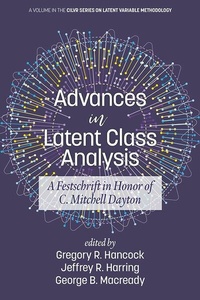
Advances in Latent Class Analysis
A Festschrift in Honor of C. Mitchell Dayton
1st Edition
Published on 5. January 2019
281 pages
978-1-64113-563-4 (ISBN)
Description

What is latent class analysis? If you asked that question thirty or forty years ago you would have gotten a different answer than you would today. Closer to its time of inception, latent class analysis was viewed primarily as a categorical data analysis technique, often framed as a factor analysis model where both the measured variable indicators and underlying latent variables are categorical. Today, however, it rests within much broader mixture and diagnostic modeling framework, integrating measured and latent variables that may be categorical and/or continuous, and where latent classes serve to define the subpopulations for whom many aspects of the focal measured and latent variable model may differ.
For latent class analysis to take these developmental leaps required contributions that were methodological, certainly, as well as didactic. Among the leaders on both fronts was C. Mitchell "Chan" Dayton, at the University of Maryland, whose work in latent class analysis spanning several decades helped the method to expand and reach its current potential. The current volume in the Center for Integrated Latent Variable Research (CILVR) series reflects the diversity that is latent class analysis today, celebrating work related to, made possible by, and inspired by Chan's noted contributions, and signaling the even more exciting future yet to come.
For latent class analysis to take these developmental leaps required contributions that were methodological, certainly, as well as didactic. Among the leaders on both fronts was C. Mitchell "Chan" Dayton, at the University of Maryland, whose work in latent class analysis spanning several decades helped the method to expand and reach its current potential. The current volume in the Center for Integrated Latent Variable Research (CILVR) series reflects the diversity that is latent class analysis today, celebrating work related to, made possible by, and inspired by Chan's noted contributions, and signaling the even more exciting future yet to come.
All prices
More details
Other editions
Additional editions
Gregory R. Hancock | Jeffrey R. Harring | George B. Macready
Advances in Latent Class Analysis
A Festschrift in Honor of C. Mitchell Dayton
Book
05/2019
Information Age Publishing
€122.60
Shipment within 3-4 weeks
Gregory R. Hancock | Jeffrey R. Harring | George B. Macready
Advances in Latent Class Analysis
A Festschrift in Honor of C. Mitchell Dayton
Book
05/2019
Information Age Publishing
€70.60
Shipment within 3-4 weeks
Content
- Cover
- Series page
- Advances in Latent Class Analysis
- Library of Congress Cataloging-in-Publication Data
- Contents
- Preface
- Biographic Sketch of Chauncey Mitchell Dayton
- Acknowledgments
- CHAPTER 1: On the Measurement of Noncompliance Using (Randomized) Item Response Models
- CHAPTER 2: Understanding Latent Class Model Selection Criteria by Concomitant-Variable Latent Class Models
- CHAPTER 3: Comparison of Multidimensional Item Response Models
- CHAPTER 4: Nonloglinear Marginal Latent Class Models
- CHAPTER 5: Mixture of Factor Analyzers for the Clustering and Visualization of High-Dimensional Data
- CHAPTER 6: Multimethod Latent Class Analysis
- CHAPTER 7: The Use of Graphs in Latent Variable Modeling
- CHAPTER 8: Logistic Regression With Floor and Ceiling Effects
- CHAPTER 9: Model Based Analysis of Incomplete Data Using the Mixture Index of Fit
- CHAPTER 10: A Systematic Investigation of Within-Subject and Between-Subject Covariance Structures in Growth Mixture Models
- CHAPTER 11: Latent Class Scaling Models for Longitudinal and Multilevel Data Sets
- CHAPTER 12: Modeling Structured Multiple Classification Latent Classes in Multiple Populations
- About the Editors

