

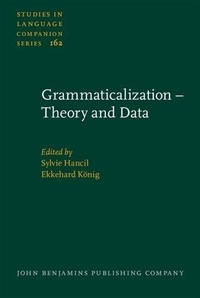
Grammaticalization - Theory and Data
Theory and Data
1st Edition
Published on 24. September 2014
VIII, 293 pages
978-90-272-6972-0 (ISBN)
Description

Since the 1980s theories and studies of grammaticalization have provided a major source of inspiration for the description and explanation of language change, giving rise to many publications and conferences. This collection presents original, empirical studies that explore various facets of grammaticalization research of both formal and functional orientation. The papers of this selection deal with general issues and specific empirical domains, such as personal pronouns; indefinite pronouns; final particles; tense and aspect markers; comitative markers and coordinating conjunctions. The languages covered include English, German, dialects of Italian, Japanese, Polish, and Walman (Papuan). The book will be of great interest to linguists working on language change in a wide variety of languages.
More details
Other editions
Additional editions
Sylvie Hancil | Ekkehard Koenig
Grammaticalization - Theory and Data
Book
09/2014
John Benjamins Publishing Co
€104.94
Shipment within 10-15 days
Persons
Content
- Grammaticalization - Theory and Data
- Editorial page
- Title page
- LCC data
- Table of contents
- Acknowledgements
- Introduction
- Part 1. General and theoretical issues
- Part 2. Case studies
- References
- Acquisition-based and usage-based explanations of grammaticalisation
- 1. Generative vs. functional approaches
- 2. Integration: Performance and parametrisation
- 3. Case examples
- 3.1 Romance futures
- 3.2 German perfect (cf. Öhl 2009a)
- 3.3 Remarks on the auxiliation of the copula
- 4. Conclusion
- References
- Grammaticalization and explanation
- 1. Introduction
- 2. A background of consensus
- 3. Arguments against the explanatory potential of grammaticalization
- 4. In defense of the explanatory potential of grammaticalization
- 5. Unidirectionality, the process question, and reductionism
- Unidirectionality
- Process vs. Processes
- Reductionism
- 6. Concluding remarks
- References
- The perfectivization of the English perfect
- 1. Introduction
- 2. The perfectivisation of the HAVE-perfect - prototypical grammaticalization?
- 3. The changing perfect in English
- a. HAVE-perfects with definite past time adverbials
- b. Narrative HAVE-perfects
- 4. An increase in HAVE-perfect with past time adverbials?
- 5. Which English are we discussing?
- 6. Conclusion
- References
- Explaining language structure
- 1. Introduction
- 2. Questions
- 3. Reconstruction
- 4. Conclusions
- Acknowledgements
- Abbreviations
- References
- Toward a constructional framework for research on language change
- 1. Introduction
- 2. The main features of the constructionalization model
- 3. A constructional approach to grammaticalization
- 4. A constructional approach to lexicalization
- 5. Major similarities and differences between contentful and procedural constructionalization
- 6. The value added of a constructional approach
- Data Bases
- References
- Grammaticalization of Polish mental predicate prefixes
- 1. Introduction
- 2. Grammaticalization
- 3. Prefix semantics and its contribution to the meaning of the mental verb
- 4. Classification of prefixes into pure perfectivizers and lexical prefixes: A case study on the verb myslec 'to think'
- 5. Conclusions
- References
- More thoughts on the grammaticalization of personal pronouns
- 1. Introduction
- 2. Referential shifting from third to second person: Heine and Song (2010, 2011)
- 3. Referential shifting of Japanese personal pronouns
- 3.1 From third to second person
- 3.2 From first to second person
- 3.2.1 Examples
- 3.2.2 Lexical origins
- 4. Why reference shifts in certain directions
- 4.1 A noun-pronoun continuum
- 4.2 Socio-cultural factors
- 4.3 Remaining issues
- 5. A short history of wrestling with 'person' in Japanese
- 6. Concluding remarks
- Acknowledgements
- Glossing conventions
- References
- Corpus
- Appendix
- The grammaticalization of nom? in the Eastern Abruzzese dialect Ortonese
- 1. Introduction
- 2. Characterizations of nom?
- 3. Omo in Old Abruzzese
- 4. Nom? in Ariellese
- 5. Nom? in written Ortonese
- 6. Nom? in spoken Ortonese
- 7. Conclusion
- References
- Sources
- Sequentiality in dialogue as a trigger for grammaticalization
- 1. Introduction
- 2. The corpus
- 3. Grammaticalization in interactive contexts
- 4. Dialogic language use
- 5. Final particles
- 6. Dialogic schema I: Implied conditional relations with final then
- 7. Dialogic schema II: Dissonant relations with final though
- 8. Dialogic schema III: Concessive conditional relations with final anyway
- 9. Others factors motivating the grammaticalization of final particles
- 10. Conclusion
- Corpora
- References
- "Final hanging but" in American English
- 1. Introduction
- 2. Final but: "hanging implication" and "final particle"
- 2.1 "Grammaticization continuum"
- 2.2 Truncation and backshift: Two pathways to final buts
- 3. Functional subordinators and and but
- 3.1 How English coordinators are translated?
- 3.2 Discourse-functions of [X and] and [X but] clauses
- 3.3 The terminal bracketing function of and and but in spontaneous conversation
- 4. From left-subordinating coordinators to final particles
- 4.1 Truncation type of final and
- 4.2 Truncation type of final but
- 5. From functional subordinators to final particles
- 5.1 The rise of an interpersonal function in final coordinators
- 5.2 Dependency and hanging implication
- 6. Conclusion
- Keys to abbreviations
- References
- Author index
- Subject index
