

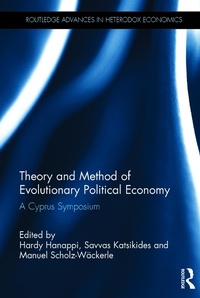
Theory and Method of Evolutionary Political Economy
A Cyprus Symposium
Published on 12. January 2017
278 pages
978-1-315-47020-7 (ISBN)
Description

The world is in turmoil, the dynamics of political economy seem to have entered a phase where a 'return to normal' cannot be expected. Since the financial crisis, conventional economic theory has proven itself to be rather helpless and political decision makers have become suspicious about this type of economic consultancy. This book offers a different approach. It promises to describe political and economic dynamics as interwoven as they are in real life and it adds to that an evolutionary perspective. The latter allows for a long-run view, which makes it possible to discuss the emergence and exit of social institutions.
The essays in this volume explore the theoretical and methodological aspects of evolutionary political economy. In part one, the authors consider the foundational contributions of some of the great economists of the past, while the second part demonstrates the benefits of adopting the methods of computer simulation and agent-based modelling. Together, the contributions to this volume demonstrate the richness, diversity and great explanatory potential of evolutionary political economy.
This volume is extremely useful for social scientists in the fields of economics, politics, and sociology who are interested to learn what evolutionary political economy is, how it proceeds and what it can provide.
The essays in this volume explore the theoretical and methodological aspects of evolutionary political economy. In part one, the authors consider the foundational contributions of some of the great economists of the past, while the second part demonstrates the benefits of adopting the methods of computer simulation and agent-based modelling. Together, the contributions to this volume demonstrate the richness, diversity and great explanatory potential of evolutionary political economy.
This volume is extremely useful for social scientists in the fields of economics, politics, and sociology who are interested to learn what evolutionary political economy is, how it proceeds and what it can provide.
Reviews / Votes
'The essays in this volume explore the theoretical and methodological aspects of evolutionary political economy. In part one, the authors consider the foundational contributions of some of the great economists of the past, while the second part demonstrates the benefits of adopting the methods of computer simulation and agent-based modelling. Together, the contributions to this volume demonstrate the richness, diversity and great explanatory potential of evolutionary political economy.' - www.urpe.org (February 15, 2017)More details
Series
Language
English
Place of publication
London
United Kingdom
Publishing group
Taylor & Francis Ltd
Target group
College/higher education
Illustrations
32 s/w Abbildungen, 12 s/w Tabellen, 1 s/w Photographie bzw. Rasterbild, 31 s/w Zeichnungen
12 Tables, black and white; 31 Line drawings, black and white; 1 Halftones, black and white; 32 Illustrations, black and white
File size
2,17 MB
ISBN-13
978-1-315-47020-7 (9781315470207)
Copyright in bibliographic data and cover images is held by Nielsen Book Services Limited or by the publishers or by their respective licensors: all rights reserved.
Schweitzer Classification
Other editions
Additional editions
Hardy Hanappi | Savvas Katsikides | Manuel Scholz-Waeckerle
Theory and Method of Evolutionary Political Economy
A Cyprus Symposium
Book
08/2020
1st Edition
Routledge
€65.60
Shipment within 15-20 days
Hardy Hanappi | Savvas Katsikides | Manuel Scholz-Waeckerle
Theory and Method of Evolutionary Political Economy
A Cyprus Symposium
Book
01/2017
1st Edition
Routledge
€217.50
Shipment within 10-20 days
Persons
Hardy Hanappi is ad personam chair for Political Economy of European Integration at the European Commission and professorial research associate at SOAS, University of London. He also is president of the Vienna Institute for Political Economy Research (VIPER), Austria.
Savvas Katsikides is University Professor and Jean Monnet Chair at the University of Cyprus.
Manuel Scholz-Waeckerle is Senior Lecturer at the Department of Socioeconomics, Vienna University of Economics and Business, Austria.
Savvas Katsikides is University Professor and Jean Monnet Chair at the University of Cyprus.
Manuel Scholz-Waeckerle is Senior Lecturer at the Department of Socioeconomics, Vienna University of Economics and Business, Austria.
Content
Introduction
Part I
Evolutionary Political Economy - Theory
1 Creative economy as a resource for specific local developments
Ismail Erturk and Pascal Petit
2 Creative industries between 'living labs' and 'robinsonnade'
Philippe Bouquillion and Pierre Moeglin
3 Population thinking vs. essentialism in biology and evolutionary economics
George Liagouras
4 The Relevance of Karl Polanyi
Ernst Hollander and Maria Fregidou-Malama
5 Marx through Goodwin
Carlo D'Ippoliti and Marco Ranaldi
6 The Role of Unions as Working Class Representation
Gloria Kutscher and Edeltraud Hanappi-Egger
7 The Emergence of Evolutionary-Institutional Thought in Russia
John Hall and Svetlana Kirdina
8 Market Performance - Liquidity or Knowledge? Evidence from the Market for Corporate Control
Killian McCarthy and Wilfred Dolfsma
Part II
Methods of Evolutionary Political Economy
9 Macroeconomic Policy in DSGE: Methodological Pitfalls, Patches or New Clothes?
Andrea Roventini and Giorgio Fagiolo
10 Macroeconomic Policy in Agent-Based Models: New Developments and Challenges Ahead 282
Giorgio Fagiolo and Andrea Roventini
11 Credit-driven business cycles in an agent-based macro model
Marco Raberto, Reynold Christian Nathanael, Bulent Ozel, Andrea Teglio and Silvano Cincotti
12 Fiscal policy and redistribution in an evolutionary macroeconomic model of an artificial monetary union
Bernhard Rengs and Manuel Scholz-Waeckerle
13 Agent-based simulations as an early warning system for natural disasters
Asjad Naqvi and Miriam Rehm
14 Dealing adequately with the political element in formal modelling
Claudius Graebner
Part I
Evolutionary Political Economy - Theory
1 Creative economy as a resource for specific local developments
Ismail Erturk and Pascal Petit
2 Creative industries between 'living labs' and 'robinsonnade'
Philippe Bouquillion and Pierre Moeglin
3 Population thinking vs. essentialism in biology and evolutionary economics
George Liagouras
4 The Relevance of Karl Polanyi
Ernst Hollander and Maria Fregidou-Malama
5 Marx through Goodwin
Carlo D'Ippoliti and Marco Ranaldi
6 The Role of Unions as Working Class Representation
Gloria Kutscher and Edeltraud Hanappi-Egger
7 The Emergence of Evolutionary-Institutional Thought in Russia
John Hall and Svetlana Kirdina
8 Market Performance - Liquidity or Knowledge? Evidence from the Market for Corporate Control
Killian McCarthy and Wilfred Dolfsma
Part II
Methods of Evolutionary Political Economy
9 Macroeconomic Policy in DSGE: Methodological Pitfalls, Patches or New Clothes?
Andrea Roventini and Giorgio Fagiolo
10 Macroeconomic Policy in Agent-Based Models: New Developments and Challenges Ahead 282
Giorgio Fagiolo and Andrea Roventini
11 Credit-driven business cycles in an agent-based macro model
Marco Raberto, Reynold Christian Nathanael, Bulent Ozel, Andrea Teglio and Silvano Cincotti
12 Fiscal policy and redistribution in an evolutionary macroeconomic model of an artificial monetary union
Bernhard Rengs and Manuel Scholz-Waeckerle
13 Agent-based simulations as an early warning system for natural disasters
Asjad Naqvi and Miriam Rehm
14 Dealing adequately with the political element in formal modelling
Claudius Graebner
