

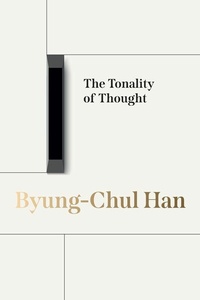
The Tonality of Thought
Description

In a lecture given in 2023, Byung-Chul Han likened his thinking to music: like the Goldberg Variations, his books present variations on themes, though in his case the variations are articulated in the form of fundamental concepts. He also explained that his thinking is rooted in German Romanticism and Far Eastern thought: 'If I may compare my thinking with a fruit, then its skin and flesh are deeply romantic. The seed, in contrast, is Far Eastern.' In the three lectures that make up this book, Han invites readers into his world, discusses some of the artists and thinkers who have shaped his thinking, and explores some of the central preoccupations of his work. 'If asked to summarize my philosophical thoughts in one sentence, I would say: The Other disappears.' The more we immerse ourselves in digital communication, the more we lose the sense of touch and the physical presence of the Other. We become entangled in our own egos and become more and more depressed. We live in a society that is becoming increasingly narcissistic, in which individuals are turned in on themselves, incapable of relating to the Other in the way that Eros, as distinct from sex, requires. Wide ranging in scope and conversational in style, these lectures are an ideal introduction to one of the most influential philosophers and cultural theorists writing today.
More details
Other editions
Additional editions
Persons
Byung-Chul Han is the author of more than twenty books including The Burnout Society, Saving Beauty and The Scent of Time.
Content
The Tonality of Thought, Leipzig
No. 2
On Eros, Porto
No. 3
On Hope, Lisbon
Notes
Leipzig, 23 April 2023
THE TONALITY OF THOUGHT
https://proassets.planetadelibros.com/usuaris/video/en_leipzing.html
[Goldberg Variations, BWV 988, Aria]
A very warm welcome to you all, good evening, God bless.
I have two 'Flügel', two wings. I say this in all its ambiguity. As this lecture is being recorded mainly for my Spanish readers, I should perhaps explain what the German word Flügel means. Flügel in Spanish is first of all 'ala', as in 'alas de mariposa', the wings of butterflies. But, as you know, the German word Flügel also means grand piano, in Spanish: 'piano de cola'. Flügel is really the nicer word; 'piano de cola' means 'piano with a tail'. Cola, however, does not only mean tail but also 'rear'. A vulgar translation of 'piano de cola' would be 'piano with an ass'. The French term for Flügel is 'piano a queue'. 'Queue' also means tail. 'Queue de boeuf' means 'ox tail'. The English call it 'grand piano'; they do not see the beautiful curved shape of it, only its size. I find it hard to like the English language. English, I would boldly claim, is essentially an economic language. In our thoroughly economized world we therefore only speak English. Now you can see why I love the German language so much. It is not an economic language but a poetic language through and through. German, as Theodor Wiesengrund Adorno pointed out, has a natural affinity to philosophy. There is no reason why you should not be proud of your language and be friendly and hospitable towards foreigners who speak or want to learn German.
When I say I have two Flügel, two wings, my Spanish readers will now be able to hear the ambiguity in the German word Flügel. I have two Flügel not only for playing music. They are also two wings, dos alas. My two pianos, dos pianos de cola, are my wings for taking off, alas para despegar. When I am thinking I often feel I am taking off with my wings. I love these flights of speculation that are accompanied by two wings, dos pianos de cola, and their music. Heidegger also experienced thinking as a speculative flight that uses two wings. In a letter to his wife, Heidegger writes - I quote: 'I call it Eros, the oldest of the gods according to Parmenides . The beat of that god's wings moves me every time I take a substantial step in my thinking and venture onto untrodden paths.'1 Without the beat of a wing, without the wings of Eros, thinking is impossible. Someone who thinks must take off on the wings of Eros onto untrodden paths, onto the not-yet-born, or the coming, even into the new.
Once, I was walking in Berlin-Prenzlauerberg. When I passed a very small piano shop, I saw a beautiful old grand piano through the window. I entered the shop. I fell in love with the grand piano. Thus, I bought it in order to learn how to play. Without ever having taken piano lessons, I tried to play the aria of the Goldberg Variations. I adored the aria. It was not enough for me just to listen to it. I wanted to play it. I had to practise for at least two years, some bars even for months, meaning endless repetition. I have infinite patience, a virtue which today is disappearing. These were proper spiritual exercises for me. Even two years of practising are not enough for someone who sets out to learn the piano by playing the Goldberg Variations - of all pieces! I also learned German by reading Hegel's Phenomenology of Spirit and Heidegger's Being and Time. As a result, my German is somewhat peculiar, a bit Swabian maybe. I love dialects. I think my German is a kind of dialect that took me great efforts to acquire, maybe a dialect of the angel.
By now I can play the Goldberg Variations by heart. In French, 'by heart' is 'apprendre par coeur'. The Goldberg Variations has become the music of my heart. Thus, I begin the day with the aria. This is a daily ritual for me, or a prayer, a morning prayer. The house rules where I live, however, do not allow me to finish the day with the aria. For some time, I did so nevertheless. I played the aria at two or three o'clock during the night, with melancholic feeling or with romantic fervour. The whole house became agitated. Thus, I stopped and apologized for this aria of the night.
The grand piano became my prayer wheel. I have an art nouveau writing desk. The central part of the top has a thin green inlay called 'Schreibwiese', literally 'writing meadow', a very beautiful expression. When I am thinking, I am wandering on the writing meadow. Every day, I walk to and fro between the green writing meadow and the black prayer wheel. This is the gait of my thinking. I think and write in the medium of music. The 'Flügel', you remember the double meaning, helps me very much in my thinking.
Beauty is always a paradox. Without paradox there would be no beauty. I strive for this beauty. Truth culminates and establishes itself fully in beauty. The tonality of my thinking is also paradoxical. I describe it with paradoxical expressions like 'dark light' or 'dark radiance' or 'bright mourning'.
Some people accuse me of too much repetition. But they do not understand that my books are not repetitions, they are variations. I weave a carpet, so to speak. I make sure that over time the carpet becomes denser and its colours more intense, while the patterns remain the same. The same is more beautiful than what is different. Theory always makes the same assumptions, which allow for variation. Thus, one needs to distinguish between the identical and the same. The identical does not allow for variations. It lacks openness and distance.
My books take the Goldberg Variations as a model. In the Goldberg Variations what is varied are not the melodies. The variations concern thirty-two bass notes. My books also follow bass lines with fundamental notes, like the Goldberg Variations, variations which in my case are articulated in the form of fundamental concepts. If I were to take The Burnout Society as the aria for the whole cycle of books, the essay would have to be followed by thirty variations. The aria of the Goldberg Variations, as we know, not only provides the fundamental bass note, it also ends the work as a da capo. Of course, we will end the night with the aria from the Goldberg Variations. The main protagonist of this evening is not me, not Byung-Chul Han, but the aria of the Goldberg Variations.
When I first listened to Bach's Chaconne for solo violin at the age of 17 or 18, the decision was made, even if unconsciously, that my spiritual-intellectual home would be German and Germany. I think, in a previous life I might have been a German, maybe a neighbour of Hölderlin, someone who revered him like a god. I was so deeply touched by the Chaconne. I immediately bought a cheap violin and tried to play the Chaconne. Needless to say, I failed. How can you learn to play the violin by playing the Chaconne? But I tried. And then I played the violin for more than twenty years. And yet, I did not succeed in playing the Chaconne. But I played the first movement of the Partita No. 2, the Allemande, thousands of times. The Allemande became my prayer during my years as a student in Germany, in Freiburg im Breisgau and Munich.
My second musical passion is singing. I have sung Schumann's Dichterliebe and Schubert's Winterreise hundreds of times, until the sheet music fell apart. These cycles of songs have entered my thinking, have almost set up house in it. They animate, even inhabit, my thinking. You may know that Schumann, after his happy marriage with Clara, composed Dichterliebe in Leipzig at Inselstrasse 18. The first melodies of Im wunderschönen Monat Mai, and the enchanting postlude to the last song, I could almost call the fundamental melodies, the fundamental concepts, of my thinking. My thinking is saturated, so to speak, with the bright mourning expressed in the Andante espressivo of Dichterliebe.
[Andante espressivo]
My thinking is rooted in German Romanticism. If I may compare my thinking with a fruit, then its skin and flesh are deeply romantic. The seed, in contrast, is Far Eastern. So a very exotic fruit. I dedicated the last chapter of Vita Contemplativa: In Praise of Inactivity to Novalis on his 250th birthday. Hölderlin is a part of my soul. His hymns and especially his late poems on the year's seasons - written after, as they say, he became benighted, though I would rather speak of an awakening - deeply animate my thinking. These late poems by Hölderlin announce a divine transcendence. They express that the world as creation is holy, even of a holy beauty.
I already told you that I have two 'Flügel', two wings, in Spanish dos pianos de cola. One is an old Blüthner. I love its warm, song-like sound. Blüthner, as you know, was from Leipzig. When I open the lid, I see 'Blüthner Leipzig' written there in golden letters. Bach's Goldberg Variations, Schumann's...
