

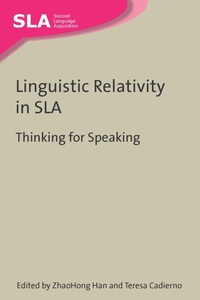
Linguistic Relativity in SLA
Thinking for Speaking
Published on 18. June 2010
240 pages
978-1-84769-399-0 (ISBN)
Description

Crosslinguistic influence is an established area of second language research, and as such, it has been subject to extensive scrutiny. Although the field has come a long way in understanding its general character, many issues still remain a conundrum, for example, why does transfer appear selective, and why does transfer never seem to go away for certain linguistic elements? Unlike most existing studies, which have focused on transfer at the surface form level, the present volume examines the relationship between thought and language, in particular thought as shaped by first language development and use, and its interaction with second language use. The chapters in this collection conceptually explore and empirically investigate the relevance of Slobin's Thinking-for-Speaking Hypothesis to adult second language acquisition, offering compelling and enlightening evidence of the fundamental nature of crosslinguistic influence in adult second language acquisition.
Reviews / Votes
This is a landmark publication - the first to concertedly address the implications for SLA of Slobin's thinking-for-speaking hypothesis. Do processes of conceptualisation that L1s predispose speakers to affect their L2 production, and if so in what ways? Can we 're-think' for L2 speaking, and what cognitive abilities enable this? The research issues this book raises are fundamentally important for SLA theory and pedagogy alike. -- Peter Robinson, Professor of Linguistics and SLA, Aoyama Gakuin University, Tokyo, Japan. Language affects how we think. Slobin's (1996) 'thinking-for-speaking' hypothesis concerns the ways that native language directs speakers' attention to pick those characteristics of events that are readily encodable therein. In this impressive collection, Han and Cadierno marshal strong support for effects of native language upon second language use, i.e. for 'rethinking-for-speaking'. A must-read for anybody interested in linguistic relativity and transfer in SLA. -- Nick Ellis, University of Michigan, USA. The volume provides valuable insight into the challenges for the TfS model and SLA research. Rather than seeing the disparities in outcomes as a negative, they should be seen as a call for more research in the area. -- Anne Marie Devlin, Department of French, University College Cork * Linguist List 22.649 * This collection is unique in that there are no dull moments: all the articles stand out as excellent contributions to a rapidly growing field of interest. Moreover, the contributions are remarkably consistent in that they all follow, or at least significantly refer to, the book's subtitle: "thinking for speaking", and illustrate this general theme with carefully chosen examples from a number of different language...Han and Cadierno's book represents a very worthwhile contribution, both to the "thinking for speaking" discussion and to various other matters in the theory and practice of L2 acquisition, such as the thorny problem of "L2 fossilization" and issues surrounding "native-like" L2 competence. -- Jacob L. Mey, University of Southern Denmark, Denmark * Pragmatics and Society 5:1 (2014) *More details
Series
Language
English
Place of publication
Bristol
United Kingdom
Publishing group
Channel View Publications Ltd
Target group
Professional and scholarly
ISBN-13
978-1-84769-399-0 (9781847693990)
Copyright in bibliographic data and cover images is held by Nielsen Book Services Limited or by the publishers or by their respective licensors: all rights reserved.
Schweitzer Classification
Other editions
Additional editions
Book
06/2010
Multilingual Matters
€158.20
Shipment within 10-20 days
E-Book
06/2010
1st Edition
Multilingual Matters
€91.09
Available for download
Persons
ZhaoHong Han is Associate Professor in Linguistics and Education at Teachers College, Columbia University. Her research interests lie broadly in second language learnability and second language teachability. She is the author of Fossilization in Adult Second Language Acquisition (2004) and editor/co-editor of a number of volumes on topics of second language process, second language reading, and fossilization. She was the recipient of the 2003 International TESOL Heinle and Heinle Distinguished Research Award.
Teresa Cadierno is Associate Professor at the Institute of Language of Communication, University of Southern Denmark. Her research interests include instructed second language acquisition, with special focus on the acquisition of grammar by L2 learners, L2 input processing and the role of formal instruction in L2 acquisition; and applied cognitive linguistics, especially the acquisition and teaching of L2 constructions for the expression of motion events, and the investigation of re-thinking for speaking processes in a foreign language.
Teresa Cadierno is Associate Professor at the Institute of Language of Communication, University of Southern Denmark. Her research interests include instructed second language acquisition, with special focus on the acquisition of grammar by L2 learners, L2 input processing and the role of formal instruction in L2 acquisition; and applied cognitive linguistics, especially the acquisition and teaching of L2 constructions for the expression of motion events, and the investigation of re-thinking for speaking processes in a foreign language.
Content
Chapter 1 Motion in Danish as a Second Language: Does the Learner's L1 Make a Difference? - Teresa Cadierno
Chapter 2 The Role of Thinking for Speaking in Adult L2 Speech: The Case of (Non)Unidirectionality Encoding by American Learners of Russian - Viktoria Driagina-Hasko
Chapter 3 Can a L2 Speaker's Patterns of Thinking for Speaking Change? - Gale A. Stam
Chapter 4 Thinking for Speaking and Immediate Memory for Spatial Relations - Kenny R. Coventry, Berenice Valdes & Pedro Guijarro-Fuentes
Chapter 5 The Gloss Trap - David Stringer
Chapter 6 Linguistic Effects on Thinking for Writing: The Case of Articles in L2 English - Monika Ekiert
Chapter 7 Grammatical Morpheme Inadequacy as a Function of Linguistic Relativity: A Longitudinal Case Study - ZhaoHong Han
Chapter 8 Conclusion: On the Interdependence of Conceptual Transfer and Relativity Studies - Terence Odlin
Chapter 2 The Role of Thinking for Speaking in Adult L2 Speech: The Case of (Non)Unidirectionality Encoding by American Learners of Russian - Viktoria Driagina-Hasko
Chapter 3 Can a L2 Speaker's Patterns of Thinking for Speaking Change? - Gale A. Stam
Chapter 4 Thinking for Speaking and Immediate Memory for Spatial Relations - Kenny R. Coventry, Berenice Valdes & Pedro Guijarro-Fuentes
Chapter 5 The Gloss Trap - David Stringer
Chapter 6 Linguistic Effects on Thinking for Writing: The Case of Articles in L2 English - Monika Ekiert
Chapter 7 Grammatical Morpheme Inadequacy as a Function of Linguistic Relativity: A Longitudinal Case Study - ZhaoHong Han
Chapter 8 Conclusion: On the Interdependence of Conceptual Transfer and Relativity Studies - Terence Odlin
