

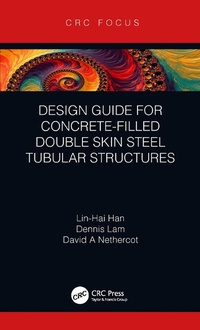
Design Guide for Concrete-filled Double Skin Steel Tubular Structures
1st Edition
Published on 12. October 2018
125 pages
978-0-429-80295-9 (ISBN)
Description

This is the first design guide on concrete filled double skin steel tubular (CFDST) structures. It addresses in particular CFDST structures with plain concrete sandwiched between circular hollow sections, and provides the relevant calculation methods and construction provisions for CFDST structures.
These inherit the advantages of conventional concrete-filled steel tubular (CFST) structures, including high strength, good ductility and durability, high fire resistance and favourable constructability. Moreover, because of their unique sectional configuration, CFDST structures have been proved to possess lighter weight, higher bending stiffness and better cyclic performance than conventional CFST. Consequently CFDST can offer reduced concrete consumption and construction costs.
This design guide is for engineers designing electrical grid infrastructures, wind power towers, bridge piers and other structures requiring light self-weight, high bending stiffness and high bearing capacity.
These inherit the advantages of conventional concrete-filled steel tubular (CFST) structures, including high strength, good ductility and durability, high fire resistance and favourable constructability. Moreover, because of their unique sectional configuration, CFDST structures have been proved to possess lighter weight, higher bending stiffness and better cyclic performance than conventional CFST. Consequently CFDST can offer reduced concrete consumption and construction costs.
This design guide is for engineers designing electrical grid infrastructures, wind power towers, bridge piers and other structures requiring light self-weight, high bending stiffness and high bearing capacity.
More details
Edition
1. Auflage
Language
English
Place of publication
London
United Kingdom
Publishing group
Taylor & Francis Ltd
Target group
College/higher education
Professional and scholarly
Illustrations
8 Tables, black and white; 15 Line drawings, black and white; 14 Halftones, black and white; 29 Illustrations, black and white
File size
8,73 MB
ISBN-13
978-0-429-80295-9 (9780429802959)
Copyright in bibliographic data and cover images is held by Nielsen Book Services Limited or by the publishers or by their respective licensors: all rights reserved.
Schweitzer Classification
Other editions
Additional editions
Lin-Hai Han | Dennis Lam | David Nethercot
Design Guide for Concrete-filled Double Skin Steel Tubular Structures
Book
06/2021
1st Edition
CRC Press
€32.00
Shipment within 10-20 days
Lin-Hai Han | Dennis Lam | David Nethercot
Design Guide for Concrete-filled Double Skin Steel Tubular Structures
Book
10/2018
1st Edition
CRC Press
€130.50
Shipment within 10-20 days
Persons
Lin-Hai Han is Professor and Associate Dean of the School of Civil Engineering at Tsinghua University, China. He is Vice President of the China Society of Fire Protection on Steel Construction, and of the China Society of Steel-Concrete Composite Construction and is a fellow of the Institution of Structural Engineers and of the Institution of Civil Engineers in UK.
Dennis Lam is Chair of Structural Engineering and the Director of the Centre for Sustainable Environments at the University of Bradford, UK. He was also formerly Chief Structural Engineer for the City of Wakefield, UK and is a Fellow of the Institution of Structural Engineers. He is the President of Association of Steel-Concrete Composite Structures. He is also a member of the British Standard Institute and European Committee on Standardization (CEN) responsible for the Eurocode 4 and chairs the working group for the revision of the Eurocode 4 (EN1994-1-1).
David A. Nethercot is former Head of the Department of Civil and Environmental Engineering at Imperial College, London. He was for more than 10 years chairman of the BSI Committee responsible for BS5950 and for UK input into EC3, is a past chairman of IABSE's technical committee, past Deputy Chairman of the Council of the Steel Construction Institute. He is Past President of the IStructE and a former Council Member of the Royal Academy of Engineering, 2008 recipient of the Charles Massonnet prize from the European Convention for Structural Steelwork and received a Gold Medal from the Institution of Structural Engineers in 2009.
Dennis Lam is Chair of Structural Engineering and the Director of the Centre for Sustainable Environments at the University of Bradford, UK. He was also formerly Chief Structural Engineer for the City of Wakefield, UK and is a Fellow of the Institution of Structural Engineers. He is the President of Association of Steel-Concrete Composite Structures. He is also a member of the British Standard Institute and European Committee on Standardization (CEN) responsible for the Eurocode 4 and chairs the working group for the revision of the Eurocode 4 (EN1994-1-1).
David A. Nethercot is former Head of the Department of Civil and Environmental Engineering at Imperial College, London. He was for more than 10 years chairman of the BSI Committee responsible for BS5950 and for UK input into EC3, is a past chairman of IABSE's technical committee, past Deputy Chairman of the Council of the Steel Construction Institute. He is Past President of the IStructE and a former Council Member of the Royal Academy of Engineering, 2008 recipient of the Charles Massonnet prize from the European Convention for Structural Steelwork and received a Gold Medal from the Institution of Structural Engineers in 2009.
Content
Introduction. Materials and Properties. Design of CFDST Structures. Joints and Connections. Fire-resistance Design. Construction. Appendices: Calculation of the shrinkage of the sandwiched concrete; Stability coefficient of members under axial compression; Examples for the bearing capacity calculation of CFDST members.
