

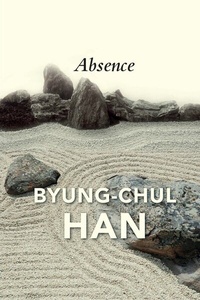
Absence
Description

Drawing on this fundamental distinction between essence and absence, Byung-Chul Han explores the differences between Western and Far Eastern philosophy, aesthetics, architecture and art, shedding fresh light on a culture of absence that may at first sight appear strange and unfamiliar to those in the West whose ways of thinking have been shaped for centuries by the preoccupation with essence.
More details
Other editions
Additional editions
Persons
Content
Preface
Essencing and Absencing - Living Nowhere
Closed and Open - Spaces of Absencing
Light and Shadow - The Aesthetics of Absencing
Knowledge and Daftness - On the Way to Paradise
Land and Sea - Strategies of Thinking
Doing and Happening: Beyond Active and Passive
Greeting and Bowing - Friendliness
Notes
Closed and Open - Spaces of Absencing
In the Far East, far more than in the West, the way things flow into each other is openly visible. In the narrow shopping lanes, it is not always clear where one shop ends and another one begins. Often, they overlap. In a Korean market, pots and pans appear next to dried squid. Lipstick and peanuts lie next to each other. Skirts hang above rice cakes. The tangle of electricity poles, wiring and colourful advertisements one often finds in Japanese cities does not allow for an unambiguous separation of spaces. The old wooden houses in Japanese backstreets (roji) appear to nestle in one another. It is not easy to see where one house ends and the next one begins. This spatiality of in-difference is reminiscent of a Zen saying: 'When snow covers the white flowers, it's hard to distinguish the outlines.'1 It is difficult to distinguish between the white of the flowers and the white of the snow. Essence is difference. Thus, essences block transitions. Absencing is in-difference. It liquefies and un-bounds. The river landscape in snow (illustration 1) is a landscape of absencing. Nothing imposes itself. Nothing demarcates itself from other things. Everything appears to retreat into an in-difference.
Illustration 1: Hovering landscape
One rarely finds flowing transitions in the West. The presence of strong boundaries and delimitations creates a feeling of narrowness. By contrast, despite the crowds of people and the density of the housing, Far Eastern cities appear as places of emptiness and absencing.
An absencing gaze has an emptying effect. Flowing transitions create places of absencing and emptiness. Essences have a closing and excluding effect. Absencing, by contrast, makes space more permeable. Thus, it widens space. A space makes space for another space. A space opens itself up for another space. There is no final closure.2 The space of emptiness, the de-internalized space, consists of transitions and in-between spaces. Amid the hustle and bustle of Far Eastern cities there is thus a soothing emptiness, even a bustling emptiness.
In-difference also fosters an intense side-by-side of what is different. It creates an optimal degree of cohesion with a minimal amount of organic, organized connection. Synthetic composition gives way to a syndetic continuum of closeness in which things do not come together as a unity. They are not members in the sense of elements of an organic totality. This gives them a friendly appearance. Membership does not create a friendly neighbourhood. In the syndetic continuum, there is no need for a dialogue to mediate between things or reconcile them. They do not have much to do with each other. Rather, they empty themselves into an in-different closeness.
Western culture is determined to pursue closedness and closure. Interestingly, this determination is reflected not only in the metaphysical figure of 'substance' but also in Western architecture. For example, Leibniz's monadic, windowless soul finds a counterpart in that fundamental form of the Romantic architecture that Hegel calls 'the fully enclosed house'.3 Beauty finds its perfection in classical art. But Romantic art, according to Hegel, expresses something superior to classical art, because Romantic art is about inwardness. As opposed to classical art, which simply radiates outwards, Romantic art radiates an inner brilliance, a brilliance of inwardness. This Romantic inwardness unfolds in a 'fully enclosed house', a 'totally enclosed' space in which the outside is blotted out.4 According to Hegel, the Christian religion is a religion of inwardness, and therefore finds its external correlate in the fully closed place of worship
Just as the Christian spirit concentrates itself in the inner life, so the building becomes shut in on every side for the assembly of the Christian congregation and the collection of its thoughts. The spatial enclosure corresponds to the concentration of mind within, and results from it.5
The portal of the place of worship initiates the process of internalization by narrowing towards the inside. This 'narrowing due to perspective' announces 'that the exterior has to shrink, contract, and disappear'.6 The colonnades, originally half inside, half outside, are moved inside the building, where they form an internalized, even internal, outside. Natural light is not allowed to shine directly into the inner space because it would disturb the inner concentration. It is therefore 'excluded or it only glimmers dimly through windows of the stained glass necessary for complete separation from the outside world'.7 The external natural light is blocked. Everything external as such has to be shed in favour of inwardness. The external distracts, and thereby impairs inner concentration. The place of worship has to be filled with a purely inner light, a divine light. The windows are actually not openings; rather, they serve the purpose of 'complete separation from the outside world'. Hegel emphasizes that they are 'only half-transparent'.8 Their dimming of the light lends inwardness to the space. The windowpanes are also not empty. They are painted, that is, saturated with meaning. The glass paintings, which often depict Christ's Passion, suffuse the light with meaningfulness, thereby further intensifying the inwardness, the fullness of the inner space.
Illustration 2: City without thresholds
A Buddhist temple is not a completely open house. A Greek temple, by contrast, is fully open; its open passageways and halls represent a passing-through of the divine, of divine wind.9 This openness, however, is a being-exposed. A Buddhist temple is neither fully closed nor fully open. Its spatiality effects neither an inwardness nor a being-exposed. Rather, its spaces are empty. The space of emptiness maintains the in-difference between open and closed, within and without. The Buddhist temple hall has barely any walls. On its sides, it is surrounded by numerous doors of translucent rice paper. The function of the paper is not to make sure that light 'only glimmers dimly' inside so that, as in the case of a cathedral, the inwardness of the space is not affected. As opposed to stained-glass windows, the paper does not serve the purpose of 'complete separation from the outside world'. Because of the low roof, only faint light - like a re-flected brilliance [Ab-glanz] - reaches the doors anyhow. This light is already characterized by an absence. Like a sponge, the matt-white paper softly soaks up the already dimmed light and brings it to a total standstill, so to speak. The result is a standing light, a light that is therefore not blinding. The low roof also removes all verticality from the light. The light does not fall down from above as it does in a cathedral. And the paper takes away all of the light's movement and directionality. There thus emerges a standing pool of still light. This special light is, to use a Daoist expression, 'without direction'. It does not illumine or shine on anything. The standing light, which has become fully indeterminate, in-different, does not emphasize the presence of things: it submerges them in an absence. White is, after all, the colour of in-difference par excellence. The white, empty paper is opposed to the colourful, stained-glass windows. Colours intensify presence. The matt-white light has the same effect as that snow along the riverbank that creates a landscape of absence, of in-difference. This light of in-difference, this in-between light, enwraps everything in an atmosphere of emptiness and absence.
Illustration 3: Where does the inside begin?
The light that comes to stand still at the opaque, white sliding paper doors also distinguishes the openness of Far Eastern architecture from the unimpeded transparency of modern glass architecture, a transparency that gives this form of architecture an appearance of unfriendliness. Light, in this case, aggressively falls into the inside. This architecture is not indebted to Far Eastern openness but to Plato's and Plotinus' metaphysics of light. Plato's dark cave and the blinding light of the sun outside belong to the same topography of being. Far Eastern spatiality, by contrast, elevates itself above the dichotomy of open and closed, inside and outside, light and shadow, and creates an in-difference, an in-between. The smooth, glittering surface of glass and metal also emphasizes presence, and it is therefore opposed to the friendly restraint and reticence of the matt-white rice paper. Rice paper possesses a materiality of emptiness and absence. Its surface does not shine, and it is as soft as silk. When folded, it hardly makes a noise, as if it were stillness itself, condensed in matt white.
The verticality of the light that enters a cathedral is strengthened by the arrangement of the windows. The upper windows of the nave and the choir are so massive that they cannot be taken in in one glance, so the gaze is pulled upwards. This vertical movement of the gaze generates a 'restlessness of rising up'.10 Other architectural elements, such as pillars and pointed arches, also generate a feeling of upward striving or rising:
The pillars become thin and slender and rise so high...
