

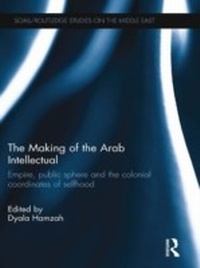
The Making of the Arab Intellectual
Empire, Public Sphere and the Colonial Coordinates of Selfhood
1st Edition
Published on 27. November 2012
296 pages
978-1-136-16758-4 (ISBN)
Description

In the wake of the Ottoman Empire's nineteenth-century reforms, as guilds waned and new professions emerged, the scholarly 'estate' underwent social differentiation. Some found employment in the state's new institutions as translators, teachers and editors, whilst others resisted civil servant status. Gradually, the scholar morphed into the public writer. Despite his fledgling status, he catered for the public interest all the more so since new professionals such as doctors, engineers and lawyers endorsed this latest social role as an integral part of their own self-image.
This dual preoccupation with self-definition and all things public is the central concern of this book. Focusing on the period after the tax-farming scholar took the bow and before the alienated intellectual prevailed on the contemporary Arab cultural scene, it situates the making of the Arab intellectual within the dysfunctional space of competing states' interests known as the 'Nahda'. Located between Empire and Colony, the emerging Arab public sphere was a space of over- and under-regulation, hindering accountability and upsetting allegiances.
The communities that Arab intellectuals imagined, including the Pan-Islamic, Pan-Arab and socialist sat astride many a polity and never became contained by post-colonial states. Examining a range of canonical and less canonical authors, this interdisciplinary approach to The Making of the Modern Arab Intellectual will be of interest to students and scholars of the Middle East, history, political science, comparative literature and philosophy.
This dual preoccupation with self-definition and all things public is the central concern of this book. Focusing on the period after the tax-farming scholar took the bow and before the alienated intellectual prevailed on the contemporary Arab cultural scene, it situates the making of the Arab intellectual within the dysfunctional space of competing states' interests known as the 'Nahda'. Located between Empire and Colony, the emerging Arab public sphere was a space of over- and under-regulation, hindering accountability and upsetting allegiances.
The communities that Arab intellectuals imagined, including the Pan-Islamic, Pan-Arab and socialist sat astride many a polity and never became contained by post-colonial states. Examining a range of canonical and less canonical authors, this interdisciplinary approach to The Making of the Modern Arab Intellectual will be of interest to students and scholars of the Middle East, history, political science, comparative literature and philosophy.
Reviews / Votes
"This compilation presents a very rich analysis of the intellectual profile of the Arab World, which was lost somewhere between history and historiography. In addition, this book reintroduces the Jewish contribution to the Arab intellectual movements, which was almost forgotten."Omair Anas
Insight Turkey Volume 17 No. 1 Book Reviews
More details
Series
Language
English
Place of publication
London
United Kingdom
Publishing group
Taylor & Francis Ltd
Target group
College/higher education
File size
1,93 MB
ISBN-13
978-1-136-16758-4 (9781136167584)
Copyright in bibliographic data and cover images is held by Nielsen Book Services Limited or by the publishers or by their respective licensors: all rights reserved.
Schweitzer Classification
Other editions
Additional editions
Dyala Hamzah
The Making of the Arab Intellectual
Empire, Public Sphere and the Colonial Coordinates of Selfhood
Book
05/2017
1st Edition
Routledge
€84.36
Shipment within 10-20 days
Dyala Hamzah
The Making of the Arab Intellectual
Empire, Public Sphere and the Colonial Coordinates of Selfhood
Book
11/2012
1st Edition
Routledge
€232.10
Shipment within 15-20 days
Person
Dyala Hamzah is Assistant Professor of Middle East History at the Universite de Montreal. She holds an M. Phil. in Philosophy from the Sorbonne and a Ph.D. in History and Islamic Studies from the Freie Universitaet Berlin and the EHESS (Paris). She is currently completing a book entitled Muhammad Rashid Rida (1865-1935) ou le "Tournant Salafiste". Interet general, Islam et Opinion Publique dans l'Egypte Coloniale.
Content
1. Introduction: The Making of the Arab Intellectual: Empire, Public Sphere and the Colonial Coordinates of Selfhood 2. Pharaoh's Revenge: Translation, Literary History and Colonial Ambivalence 3. Public Deliberations of the Self in Fin-de-Siecle Egypt (1880-1910) 4. Inscribing Socialism into the Nahda: al-Muqtataf, al-Hilal, and the Construction of a Leftist Reformist Worldview, 1880-1914 5. From 'Ilm to Sihafa or the Politics of the Public Interest (Maslaha): Muhammad Rashid Rida and his journal al-Manar (1898-1935) 6. Partitioned Pasts: Arab Jewish Intellectuals and the Case of Esther Azhari Moyal, 1873-1948 7. The "Mahjar" as literary and political territory in the first decades of the 20th century: the example of Amin Rihani (1876-1940) 8. The Generation of Broad Expectations: Nationalism, Education, and Autobiography in Syria and Lebanon, 1930-1958 9. Waiting for the Superman: A New Generation of Arab Nationalists in 1930s Iraq 10. Afterword
