

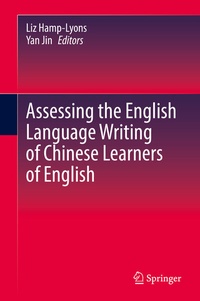
Assessing the English Language Writing of Chinese Learners of English
Description

This book focuses on the assessment of English language writing in China mainland, the territories of Hong Kong and Macau, and Taiwan. The first part of the book describes how writing in English has been assessed in Chinese contexts in the past 25 years, and how it continues to be assessed at present. The second part of the book presents reports of work such as formative classroom-based assessment, feedback-based or feedback-led approaches, learning-oriented assessment, portfolios, as well as the important issue of teacher professional development in writing assessment. This two-part division relates to and reflects what has been happening in writing assessment internationally, in the UK from the 1940s, and in the US in the past 25 years.
The use of English for international business communication, for international political negotiations and its rapidly increasing use as a medium of instruction in some subject areas has led to a rapid increase in the numbers of Chinese L1 speakers who are learning and being assessed in English. This is often done with an emphasis on reading and writing. The vast majority of assessments of English language writing are done through large-scale direct testing that uses simple prompts/tasks and short writing samples. This book explores best practices in assessing the writing in English of native speakers of Chinese.
Assessing the English Language Writing of Chinese Learners of English edited by long-time experts Liz Hamp-Lyons and Yan Jin clearly demonstrates the authors' collective years of writing and teaching about writing assessment. The book's 13 chapters, written by recognized experts in assessment of Chinese speakers learning English, represent a wide array of important topics written in reader friendly language and offering evidence for pedagogical practices as well as high-stakes testing of writing. Teachers, researchers, administrators of writing programs in China, and test developers who seek counsel about this population need look no further than to add Assessing the English Language Writing of Chinese Learners of English to their reading list.
Deborah Crusan, Wright State University, USA
More details
Other editions
Additional editions
Persons
Content
Part I: Investigating Present Practice.- Introduction.- Rating scale impact on the CET-4 Writing: Amixed-methods study; S. Zou.- The writing performance of Chinese test takers in PTE-Academic; Y. Chen.- To whom do I write? Chinese EFL test-takers' conceptualization and construction of their audience in the Aptis writing test; Y. Chen and X. Guan.- Strategy use and performance on writing for the GEPT; N. Li.- Validating a curriculum-based rating scale for a university-based writing assessment: The RUC-TWPE experience; L. Lium, L. Tian and G. Jia.- Construct validation of an integrated listening-to-write task in a high-stakes English proficiency test: A multi-dimensional analysis of register variation; Y. Hao and J. J. Fan.- Part II: New Directions.- Introduction.- Theory-based approach to academic writing assessment: A conceptual framework for assessment design and development; C. G. Zhao.- A new agenda in writing assessment: Combining argumentative writing pedagogy with critical thinking cultivation; X. Tang and F. Liu.- Source material use across different types of integrated writing tasks by Chinese college EFL learners: A comparative study; Y. Zhou.- Factors impacting upon writing teachers' feedback choices; J. Yang.- Error patterns of Secondary 3 students in Hong Kong; I. Lee.- Assessment training in the use of portfolios: Voices from writing teachers; R. Lam.- The validation of a business English writing proficiency scale for Chinese EFL learners; L. Wang.- Applying the writing sub-scales of the China's Standards of English Language Ability to writing assessments in China; M. Pan.- Conclusion.
