

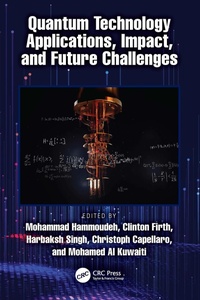
Quantum Technology Applications, Impact, and Future Challenges
1st Edition
Published on 18. March 2025
204 pages
978-1-040-29848-0 (ISBN)
Description

This book presents a comprehensive exploration of quantum computing, exploring its wide-ranging applications across industries, elucidating its transformative impact on diverse sectors, and addressing the forthcoming challenges and future directions within this rapidly evolving field.
Quantum Technology Applications, Impact, and Future Challenges explores the current state of quantum hardware and software, providing readers with a clear understanding of the challenges and opportunities posed by this technology. It also examines how quantum computing is being used today in industries such as energy, finance, healthcare, and logistics, offering real-world examples of the potential impact of this technology. Readers will gain an understanding of quantum computing's potential applications and its profound implications for businesses, individuals, and society at large. Through a blend of theoretical insights, practical examples, and thought-provoking discussions, this book equips readers with the knowledge and vision to navigate quantum technology with confidence. Authored and edited by leading academics and industry experts in the field, the book offers authoritative insights and perspectives, ensuring readers receive credible and up-to-date information on quantum computing advancements and applications.
This book navigates readers through the intricate landscape of quantum computing and communications, offering valuable perspectives for scholars, researchers, and practitioners alike.
Quantum Technology Applications, Impact, and Future Challenges explores the current state of quantum hardware and software, providing readers with a clear understanding of the challenges and opportunities posed by this technology. It also examines how quantum computing is being used today in industries such as energy, finance, healthcare, and logistics, offering real-world examples of the potential impact of this technology. Readers will gain an understanding of quantum computing's potential applications and its profound implications for businesses, individuals, and society at large. Through a blend of theoretical insights, practical examples, and thought-provoking discussions, this book equips readers with the knowledge and vision to navigate quantum technology with confidence. Authored and edited by leading academics and industry experts in the field, the book offers authoritative insights and perspectives, ensuring readers receive credible and up-to-date information on quantum computing advancements and applications.
This book navigates readers through the intricate landscape of quantum computing and communications, offering valuable perspectives for scholars, researchers, and practitioners alike.
More details
Edition
1. Auflage
Language
English
Place of publication
London
United Kingdom
Publishing group
Taylor & Francis Ltd
Target group
College/higher education
Professional and scholarly
Illustrations
7 Tables, black and white; 14 Line drawings, black and white; 4 Halftones, black and white; 18 Illustrations, black and white
File size
2,18 MB
ISBN-13
978-1-040-29848-0 (9781040298480)
Copyright in bibliographic data and cover images is held by Nielsen Book Services Limited or by the publishers or by their respective licensors: all rights reserved.
Schweitzer Classification
Other editions
Additional editions
Mohammad Hammoudeh | Clinton M. Firth | Harbaksh Singh
Quantum Technology Applications, Impact, and Future Challenges
Book
03/2025
1st Edition
CRC Press
€111.30
Shipment within 10-20 days
Mohammad Hammoudeh | Clinton M. Firth | Harbaksh Singh
Quantum Technology Applications, Impact, and Future Challenges
Book
03/2025
1st Edition
CRC Press
€133.00
Shipment within 10-20 days
Persons
Mohammad Hammoudeh is the Saudi Aramco Cybersecurity Chair Professor at King Fahd University of Petroleum and Minerals. His research interests include quantum communication technologies, quantum-safe encryption methods, and quantum adoption strategies in both IT and OT systems. He has hands-on experience in working with quantum hardware and algorithms. He developed practical ways of evaluating the real applications of new technologies in cyberspace such as quantum computing, digital twins, and blockchains.
Clinton Firth is a Partner at PwC focusing on digital, cyber, and resilience. He is an experienced cybersecurity consulting executive, holding many senior and global roles for large consulting and system integrator firms. He has diverse experience working with commercial, government, and defence clients. Clinton leads a passionate team of industry specialists to address some of the most complex technology trust problems of our time.
Harbaksh Singh is a seasoned leader with 21+ years of experience in the IT industry and has worked with Telecom organizations like Bharti Airtel, COLT, and British Telecom. He is currently working as Cybersecurity Architect at Ernst & Young. He has a double masters and is a long-standing member of IEEE. He is a musician at heart and likes to stay updated on AI, tech-gadgets, and cars in his free time.
Christoph Capellaro received his Ph.D. in mathematics at the Technical University Munich. He started his career in corporate R&D at Siemens and is now working with EY Consulting in Germany. His focus is on C-level advisory and major transformation projects in the context of cybersecurity and IT governance. Latest engagements are with financial institutions as well as industrial enterprises to improve cyber resilience while adopting latest technology like cloud and AI. Christoph holds several patents in cryptography and has authored articles and books on security management, digital currencies, and IT compliance. He is a passionate chess and piano player and mountain enthusiast. Dr. Al Kuwaiti was appointed by the Cabinet as Head of Cyber Security for the UAE Government in 2020. As Head of Cyber Security for the UAE Government by investiture, Dr. Al Kuwaiti has legal authority over all aspects pertaining to securing the cyberspace for the entire nation.
Dr. Al Kuwaiti holds a Doctorate in Computer Engineering and Network Security from George Washington University in the U.S. and a master's degree in Telecommunications and Computer Networks. He also holds an M.A. degree in International and Civil Security. Dr. Al Kuwaiti is an honorable member of the Society of Engineers, IEEE Society, Golden Key National Honor Society, and Computer Society. His research interests are detecting, monitoring, and responding to cyber warfare, network forensics, corporate governance and processes, and national cyber policy.
Clinton Firth is a Partner at PwC focusing on digital, cyber, and resilience. He is an experienced cybersecurity consulting executive, holding many senior and global roles for large consulting and system integrator firms. He has diverse experience working with commercial, government, and defence clients. Clinton leads a passionate team of industry specialists to address some of the most complex technology trust problems of our time.
Harbaksh Singh is a seasoned leader with 21+ years of experience in the IT industry and has worked with Telecom organizations like Bharti Airtel, COLT, and British Telecom. He is currently working as Cybersecurity Architect at Ernst & Young. He has a double masters and is a long-standing member of IEEE. He is a musician at heart and likes to stay updated on AI, tech-gadgets, and cars in his free time.
Christoph Capellaro received his Ph.D. in mathematics at the Technical University Munich. He started his career in corporate R&D at Siemens and is now working with EY Consulting in Germany. His focus is on C-level advisory and major transformation projects in the context of cybersecurity and IT governance. Latest engagements are with financial institutions as well as industrial enterprises to improve cyber resilience while adopting latest technology like cloud and AI. Christoph holds several patents in cryptography and has authored articles and books on security management, digital currencies, and IT compliance. He is a passionate chess and piano player and mountain enthusiast. Dr. Al Kuwaiti was appointed by the Cabinet as Head of Cyber Security for the UAE Government in 2020. As Head of Cyber Security for the UAE Government by investiture, Dr. Al Kuwaiti has legal authority over all aspects pertaining to securing the cyberspace for the entire nation.
Dr. Al Kuwaiti holds a Doctorate in Computer Engineering and Network Security from George Washington University in the U.S. and a master's degree in Telecommunications and Computer Networks. He also holds an M.A. degree in International and Civil Security. Dr. Al Kuwaiti is an honorable member of the Society of Engineers, IEEE Society, Golden Key National Honor Society, and Computer Society. His research interests are detecting, monitoring, and responding to cyber warfare, network forensics, corporate governance and processes, and national cyber policy.
Content
1- Quantum Computing for Future Energy Systems
2- Application of Quantum Computing in the Energy Industry, Decarbonization and Sustainability
3- The Role of Quantum Technologies in Driving Change in Business and Personal Domains
4- Fundamentals of Quantum Machine Learning, Applications and Tools
5- Optimization and Machine learning - Quantum Annealing, Quantum and Neural Network
6- Exploring Security Risks in Data Privacy Mechanism
7- Hybrid Quantum-Classical Computing Architectures
8- Quantum Data Centers and Quantum Cloud
9- Quantum as a Service in Cloud Computing
10- Future Directions and Challenges, Quantum Supremacy and Beyond
11- A peek into the Post-Quantum Era (PQA/PQC): "What will happen in 2030?"
2- Application of Quantum Computing in the Energy Industry, Decarbonization and Sustainability
3- The Role of Quantum Technologies in Driving Change in Business and Personal Domains
4- Fundamentals of Quantum Machine Learning, Applications and Tools
5- Optimization and Machine learning - Quantum Annealing, Quantum and Neural Network
6- Exploring Security Risks in Data Privacy Mechanism
7- Hybrid Quantum-Classical Computing Architectures
8- Quantum Data Centers and Quantum Cloud
9- Quantum as a Service in Cloud Computing
10- Future Directions and Challenges, Quantum Supremacy and Beyond
11- A peek into the Post-Quantum Era (PQA/PQC): "What will happen in 2030?"
