

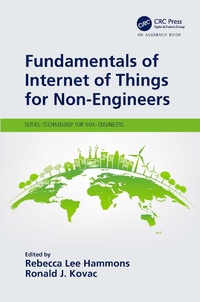
Fundamentals of Internet of Things for Non-Engineers
1st Edition
Published on 7. June 2019
446 pages
978-1-000-00034-4 (ISBN)
Description

The IoT is the next manifestation of the Internet. The trend started by connecting computers to computers, progressed to connecting people to people, and is now moving to connect everything to everything. The movement started like a race-with a lot of fanfare, excitement, and cheering. We're now into the work phase, and we have to figure out how to make the dream come true.
The IoT will have many faces and involve many fields as it progresses. It will involve technology, design, security, legal policy, business, artificial intelligence, design, Big Data, and forensics; about any field that exists now. This is the reason for this book. There are books in each one of these fields, but the focus was always "an inch wide and a mile deep." There's a need for a book that will introduce the IoT to non-engineers and allow them to dream of the possibilities and explore the work venues in this area. The book had to be "a mile wide and a few inches deep." The editors met this goal by engaging experts from a number of fields and asking them to come together to create an introductory IoT book.
Fundamentals of Internet of Things for Non-Engineers
Provides a comprehensive view of the current fundamentals and the anticipated future trends in the realm of Internet of Things from a practitioner's point of view
Brings together a variety of voices with subject matter expertise in these diverse topical areas to provide leaders, students, and lay persons with a fresh worldview of the Internet of Things and the background to succeed in related technology decision-making
Enhances the reader's experience through a review of actual applications of Internet of Things end points and devices to solve business and civic problems along with notes on lessons learned
Prepares readers to embrace the Internet of Things era and address complex business, social, operational, educational, and personal systems integration questions and opportunities
The IoT will have many faces and involve many fields as it progresses. It will involve technology, design, security, legal policy, business, artificial intelligence, design, Big Data, and forensics; about any field that exists now. This is the reason for this book. There are books in each one of these fields, but the focus was always "an inch wide and a mile deep." There's a need for a book that will introduce the IoT to non-engineers and allow them to dream of the possibilities and explore the work venues in this area. The book had to be "a mile wide and a few inches deep." The editors met this goal by engaging experts from a number of fields and asking them to come together to create an introductory IoT book.
Fundamentals of Internet of Things for Non-Engineers
Provides a comprehensive view of the current fundamentals and the anticipated future trends in the realm of Internet of Things from a practitioner's point of view
Brings together a variety of voices with subject matter expertise in these diverse topical areas to provide leaders, students, and lay persons with a fresh worldview of the Internet of Things and the background to succeed in related technology decision-making
Enhances the reader's experience through a review of actual applications of Internet of Things end points and devices to solve business and civic problems along with notes on lessons learned
Prepares readers to embrace the Internet of Things era and address complex business, social, operational, educational, and personal systems integration questions and opportunities
More details
Series
Edition
1. Auflage
Language
English
Place of publication
London
United Kingdom
Publishing group
Taylor & Francis Ltd
Target group
Professional and scholarly
ISBN-13
978-1-000-00034-4 (9781000000344)
Copyright in bibliographic data and cover images is held by Nielsen Book Services Limited or by the publishers or by their respective licensors: all rights reserved.
Schweitzer Classification
Other editions
Additional editions
Rebecca Lee Hammons | Ronald J. Kovac
Fundamentals of Internet of Things for Non-Engineers
Book
06/2019
1st Edition
CRC Press
€88.19
Shipment within 10-20 days
Persons
Dr. Rebecca Hammons has extensive technology industry experience in establishing and leading software quality assurance, development lifecycle services, and project management teams. She has worked for Ontario Systems, Apple, Raytheon, Tivoli Systems and Wang, in addition to several niche software firms. She is a Certified Quality Manager and Certified Software Quality Engineer with the American Society for Quality (ASQ) and a Certified Scrum Master and Certified Scrum Product Owner with Scrum Alliance. Dr. Hammons is an Associate Professor at Ball State University. Her technology research interests include Slow Tech, Usability, Burnout Theory, and Gold-Collar Workers. Dr. Hammons thrives on leading organizational change initiatives and coaching individuals and teams to reach their full potential.
Ron Kovac, PhD, is a full professor in the Center for Information and Communication Sciences at Ball State University in Indiana. The center prepares graduate students in the field of telecommunications. Previous to this position, Dr. Kovac was the telecommunication manager for the state of New York and a CIO for a large computing center located on the east coast. Dr. Kovac's previous studies included electrical engineering, photography, and education. Dr. Kovac has published two books and over 50 articles and has completed numerous international consulting projects in both the education and telecommunications field. Additionally, he speaks worldwide on issues related to telecommunications and holds numerous certifications, including the CCNA, the CCAI, and the almost complete CCNP. Dr. Kovac is also a Fulbright Scholar and loves life, education and technology.
Ron Kovac, PhD, is a full professor in the Center for Information and Communication Sciences at Ball State University in Indiana. The center prepares graduate students in the field of telecommunications. Previous to this position, Dr. Kovac was the telecommunication manager for the state of New York and a CIO for a large computing center located on the east coast. Dr. Kovac's previous studies included electrical engineering, photography, and education. Dr. Kovac has published two books and over 50 articles and has completed numerous international consulting projects in both the education and telecommunications field. Additionally, he speaks worldwide on issues related to telecommunications and holds numerous certifications, including the CCNA, the CCAI, and the almost complete CCNP. Dr. Kovac is also a Fulbright Scholar and loves life, education and technology.
Content
Preface
Acknowledgments
Editors
Contributors
Section I THE BASICS OF IoT
1 The Yin and Yang of IoT
REBECCA LEE HAMMONS
2 IoT System Integration
DAVID HUA, BIJU BAJRACHARYA, SAGAR KAJA, CHRISTOPHER DAVISON, AND VAMSI GONDI
3 IoT Positioning in the Verticals
RONALD J. KOVAC
4 Emerging Wireless Communication
LAUREN McNALLY, AARON KHOURY, JERRY WALKER, AND STEPHAN JONES
Section II IoT ELEMENTS AND ISSUES
5 IoT End Devices
RONALD J. KOVAC
6 IoT Architecture and Compatibility with Current Infrastructure
FRANK GROOM
7 Ethics and Policy of IoT
GERALD DeHONDT
8 Empowering Older Adults with IoT
REBECCA LEE HAMMONS
9 Data Analytics with IoT
FRANK GROOM AND ANGELIA YOUNT
10 Redefining Artificial Intelligence through IoT
AARON KHOURY
11 Launching an IoT Startup
DENNIS TRINKLE
12 IoT Future Challenges
REBECCA LEE HAMMONS
13 Security with IoT
KEVIN KEATHLEY
14 Legal Issues with IoT
GERALD DeHONDT
15 IoT: A Business Perspective
THOMAS HARRIS
Section III IoT CASE STUDIES
Case Study 1: Agile Development for IoT Applications: Lessons Learned from a Case Study on Hydrants
TIMON HEINIS, JOHANNES HECK, FILIPPO FONTANA, AND MIRKO MEBOLDT
Case Study 2: Automotive IoT
ALEX PECZYNSKI
Case Study 3: Butler University and Academic Scheduling: A Platform for IoT
RUTH SCHWER AND TIMOTHY ROE
Case Study 4: Connectible Me: On Using the Internet of Things to Collect Points for Wellness Tracking
JARED LINDER
Glossary
Index
Acknowledgments
Editors
Contributors
Section I THE BASICS OF IoT
1 The Yin and Yang of IoT
REBECCA LEE HAMMONS
2 IoT System Integration
DAVID HUA, BIJU BAJRACHARYA, SAGAR KAJA, CHRISTOPHER DAVISON, AND VAMSI GONDI
3 IoT Positioning in the Verticals
RONALD J. KOVAC
4 Emerging Wireless Communication
LAUREN McNALLY, AARON KHOURY, JERRY WALKER, AND STEPHAN JONES
Section II IoT ELEMENTS AND ISSUES
5 IoT End Devices
RONALD J. KOVAC
6 IoT Architecture and Compatibility with Current Infrastructure
FRANK GROOM
7 Ethics and Policy of IoT
GERALD DeHONDT
8 Empowering Older Adults with IoT
REBECCA LEE HAMMONS
9 Data Analytics with IoT
FRANK GROOM AND ANGELIA YOUNT
10 Redefining Artificial Intelligence through IoT
AARON KHOURY
11 Launching an IoT Startup
DENNIS TRINKLE
12 IoT Future Challenges
REBECCA LEE HAMMONS
13 Security with IoT
KEVIN KEATHLEY
14 Legal Issues with IoT
GERALD DeHONDT
15 IoT: A Business Perspective
THOMAS HARRIS
Section III IoT CASE STUDIES
Case Study 1: Agile Development for IoT Applications: Lessons Learned from a Case Study on Hydrants
TIMON HEINIS, JOHANNES HECK, FILIPPO FONTANA, AND MIRKO MEBOLDT
Case Study 2: Automotive IoT
ALEX PECZYNSKI
Case Study 3: Butler University and Academic Scheduling: A Platform for IoT
RUTH SCHWER AND TIMOTHY ROE
Case Study 4: Connectible Me: On Using the Internet of Things to Collect Points for Wellness Tracking
JARED LINDER
Glossary
Index
