

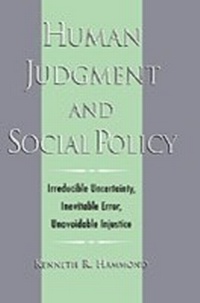
Human Judgment and Social Policy
Irreducible Uncertainty, Inevitable Error, Unavoidable Injustice
1st Edition
Published on 19. September 1996
449 pages
978-0-19-535704-2 (ISBN)
Description

From the O.J. Simpson verdict to peace-making in the Balkans, the critical role of human judgement--complete with its failures, flaws, and successes--has never been more hotly debated and analyzed than it is today. This landmark work examines the dynamics of judgement and its impact on events that take place in human society, which require the direction and control of social policy. Research on social policy typically focuses on content. This book concentrates instead on the decision-making process itself. Drawing on 50 years of empirical research in decision theory, Hammond examines the possibilities for wisdom and cognitive competence in the formation of social policies, and applies these lessons to specific examples, such as the space shuttle Challenger disaster and the health care debate. Uncertainly, he tells us, can seldom be fully eliminated; thus error is inevitable, and injustice for some unavoidable. But the capacity for make wise judgments increases to the extent that we understand the potential pitfalls and their origin. The judgment process for example involves an ongoing rivalry between intuition and analysis, accuracy and rationality. The source of this tension requires an examination of the evolutionary roots of human judgement and how these fundamental features may be changing as our civilization increasingly becomes an information and knowledge-based society. With numerous examples from law, medicine, engineering, and economics, the author dramatizes the importance of judgment and its role in the formation of social policies which affect us all, and issues the first comprehensive examination of its underlying dynamics.
More details
Other editions
Additional editions
Kenneth R. Hammond
Human Judgment and Social Policy
Irreducible Uncertainty, Inevitable Error, Unavoidable Injustice
Book
11/2000
Oxford University Press Inc
€101.70
Shipment within 15-20 days
Kenneth R. Hammond
Human Judgment and Social Policy
Irreducible Uncertainty, Inevitable Error, Unavoidable Injustice
Book
10/1996
Oxford University Press Inc
€191.60
Shipment within 15-20 days
Content
- Intro
- Contents
- Introduction
- I: RIVALRY
- 1. Irreducible Uncertainty and the Need for Judgment
- Determinism in the Objective World
- Indeterminism in the Objective World
- Human Judgment and Uncertainty
- Different Consequences of Different Errors
- Duality of Error in Law and Medicine
- 2. Duality of Error and Policy Formation
- Misconceiving Probabilities and Its Consequences
- The Slow Formal Recognition of the Duality of Error
- Are Cycles of Differential Injustice to Individuals and Society Inevitable?
- 3. Coping with Uncertainty: The Rivalry Between Intuition and Analysis
- Intuition and Analysis in the History of Thought
- Rivalry Between Intuition and Analysis in the Psychology of Judgment and Decision Making
- Which View Is Correct?
- Implications for Policy formation
- II: TENSION
- 4. Tension Between Coherence and Correspondence Theories of Competence
- Engineering
- Medicine
- Economics
- Science
- Coherence and Correspondence Theories Introduced into Judgment and Decision Making
- A Framework for Evaluation of the Competence of Human Judgment
- Current Conclusions About the Competence of Human Judgment
- 5. The Evolutionary Roots of Correspondence Competence
- Mating Judgments
- Navigation
- Combat
- Use of Multiple Fallible Indicators by Apes
- Use of Multiple Fallible Indicators by Early Homo Sapiens
- The Construction of Multiple Fallible Indicators for Policymaking
- III: COMPROMISE AND RECONCILIATION
- 6. Reducing Rivalry Through Compromise
- Premise 1: A Cognitive Continuum
- Premise 2: Common Sense
- 7. Task Structure and Cognitive Structure
- Premise 3: Theory of Task Structures
- Premise 4: Dynamic Cognition
- Premise 5: Pattern Recognition and Functional Relations
- Summary
- 8. Reducing Tension Through Complementarity
- Critiques of Negative Views of Coherence Competence
- Resolving the Tension Between Coherence and Correspondence Through Complementarity
- Correspondence and Coherence in Popper's "Three Worlds
- Part III: Summary
- IV: POSSIBILITIES
- 9. Is It Possible to Learn by Intervening?
- An Example
- The Modes of Inquiry Matrix as a Predictor
- Trapped" Administrators
- Desperate Administrators
- Experimenting Administrators
- Mode l: Methods of Physical Science
- Mode 2: Randomized, Experimental-Control Group Experiments
- Mode 3: Quasi-experimentation
- Summary
- 10. Is It Possible to Learn from Representing?
- Mode 4A: Hypothetical Intervention and Manipulation of Variables and Conditions: The Coherence Approach
- Mode 4B: The Correspondence Approach
- Mode 4C: The Cognitive Activity of Policymakers
- Mode 5: Expert Judgment
- Mode 6: Unrestricted Judgment
- Summary
- 11. Possibilities for Wisdom
- Hadley Cantril and Friends: Franklin Roosevelt and Dwight Eisenhower
- The "Romantic" Period
- Janis's Attempts to Link Psychology and Policy Making
- My Turn at the White House
- Suedfeld and Tetlock: Broadening the Perspective
- The Reappearance of Common Sense: Philip Howard and His Friends-President Clinton, Senator Dole, and Company
- The Conventional Road to Wisdom: Dependence on the Elders
- 12. The Possible Future of Cognitive Competence
- Past
- Present
- Future
- 13. Rivalry, Tension-Forever?
- The Persistence of Rivalry Between Intuition and Analysis at the Supreme Court
- The Persistence of Tension Between Correspondence and Coherence in Sentencing
- Conclusion
- Some Conjectures About Competence
- Epilogue
- Notes
- References
- Indexes
- Author Index
- A
- B
- C
- D
- E
- F
- G
- H
- I
- J
- K
- L
- M
- N
- O
- P
- Q
- R
- S
- T
- U
- V
- W
- Y
- Z
- Subject Index
- A
- B
- C
- D
- E
- F
- G
- H
- I
- J
- K
- L
- M
- N
- O
- P
- Q
- R
- S
- T
- U
- V
- W
- Z
