

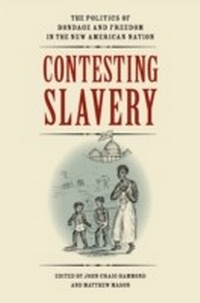
Contesting Slavery
Description

Recent scholarship on slavery and politics between 1776 and 1840 has wholly revised historians' understanding of the problem of slavery in American politics. Contesting Slavery builds on the best of that literature to reexamine the politics of slavery in revolutionary America and the early republic.
The original essays collected here analyze the Revolutionary era and the early republic on their own terms to produce fresh insights into the politics of slavery before 1840. The collection forces historians to rethink the multiple meanings of slavery and antislavery to a broad array of Americans, from free and enslaved African Americans to proslavery ideologues, from northern farmers to northern female reformers, from minor party functionaries to political luminaries such as Henry Clay.
The essays also delineate the multiple ways slavery sustained conflict and consensus in local, regional, and national politics. In the end, Contesting Slavery both establishes the abiding presence of slavery and sectionalism in American political life and challenges historians' long-standing assumptions about the place, meaning, and significance of slavery in American politics between the Revolutionary and antebellum eras.
Contributors: Rachel Hope Cleves, University of Victoria * David F. Ericson, George Mason University * John Craig Hammond, Penn State University, New Kensington * Matthew Mason, Brigham Young University * Richard Newman, Rochester Institute of Technology * James Oakes, CUNY Graduate Center * Peter S. Onuf, University of Virginia * Robert G. Parkinson, Shepherd University * Donald J. Ratcliffe, University of Oxford * Padraig Riley, Dalhousie University * Edward B. Rugemer, Yale University * Brian Schoen, Ohio University * Andrew Shankman, Rutgers University, Camden * George William Van Cleve, University of Virginia * Eva Sheppard Wolf, San Francisco State University
All prices
More details
Other editions
Additional editions
Persons
John Craig Hammond is Associate Professor of History at Penn State University, New Kensington, and the author of Slavery, Freedom, and Expansion in the Early American West (Virginia). Matthew Mason is Associate Professor of History at Brigham Young University and the author of Slavery and Politics in the Early American Republic.
Content
- Cover
- Contents
- Acknowledgments
- Foreword
- INTRODUCTION: Slavery, Sectionalism, and Politics in the Early American Republic
- PART I: SLAVERY AND IDEOLOGY, ACTION AND INACTION
- Necessary but Not Sufficient: Revolutionary Ideology and Antislavery Action in the Early Republic
- Early Free-Labor Thought and the Contest over Slavery in the Early Republic
- ''Manifest Signs of Passion'': The First Federal Congress, Antislavery, and Legacies of the Revolutionary War
- ''Good Communications Corrects Bad Manners'': The Banneker-Jefferson Dialogue and the Project of White Uplift
- Caribbean Slave Revolts and the Origins of the Gag Rule: A Contest between Abolitionism and Democracy, 1797-1835
- PART II: THE STATE AND SLAVERY
- Founding a Slaveholders' Union, 1770-1797
- ''Uncontrollable Necessity'': The Local Politics, Geopolitics, and Sectional Politics of Slavery Expansion
- Positive Goods and Necessary Evils: Commerce, Security, and Slavery in the Lower South, 1787-1837
- Slave Smugglers, Slave Catchers, and Slave Rebels: Slavery and American State Development, 1787-1842
- PART III: SLAVERY, SECTIONALISM, AND PARTISAN POLITICS
- ''Hurtful to the State'': The Political Morality of Federalist Antislavery
- Slavery and the Problem of Democracy in Jeffersonian America
- Neither Infinite Wretchedness nor Positive Good: Mathew Carey and Henry Clay on Political Economy and Slavery during the Long 1820s
- The Decline of Antislavery Politics, 1815-1840
- COMMENTARY: Conflict vs. Racial Consensus in the History of Antislavery Politics
- Notes on Contributors
- Index
- A
- B
- C
- D
- E
- F
- G
- H
- I
- J
- K
- L
- M
- N
- O
- P
- Q
- R
- S
- T
- V
- W
