

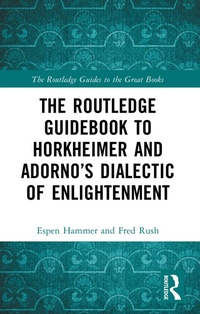
The Routledge Guidebook to Horkheimer and Adorno's Dialectic of Enlightenment
Published on 27. October 2025
262 pages
978-1-040-42670-8 (ISBN)
Description

Composed whilst in exile in the United States during the Second World War, Max Horkheimer and Theodor W. Adorno's Dialectic of Enlightenment is the most famous and influential text of the Frankfurt School. A theoretical exploration of history, modernity, and culture, its core warning of crisis and regression remains highly relevant today. However, it is also a notoriously complex work of philosophy.
The Routledge Guidebook to Horkheimer and Adorno's Dialectic of Enlightenment is the first fully contextualized introduction to this foundational text in philosophy and social theory, addressing its central themes, reception, and influence. This Guidebook examines:
The conceptual and intellectual background to Dialectic of Enlightenment.
The ideas, themes, and arguments of the text.
The reception and legacy of Dialectic of Enlightenment.
A comprehensive and clearly written guide to this important text, The Routledge Guidebook to Horkheimer and Adorno's Dialectic of Enlightenment will be invaluable to students coming to the work for the first time, as well as more advanced students and researchers in philosophy, politics, sociology, and the history of ideas.
The Routledge Guidebook to Horkheimer and Adorno's Dialectic of Enlightenment is the first fully contextualized introduction to this foundational text in philosophy and social theory, addressing its central themes, reception, and influence. This Guidebook examines:
The conceptual and intellectual background to Dialectic of Enlightenment.
The ideas, themes, and arguments of the text.
The reception and legacy of Dialectic of Enlightenment.
A comprehensive and clearly written guide to this important text, The Routledge Guidebook to Horkheimer and Adorno's Dialectic of Enlightenment will be invaluable to students coming to the work for the first time, as well as more advanced students and researchers in philosophy, politics, sociology, and the history of ideas.
Reviews / Votes
'In their commentary on Dialectic of Enlightenment, Hammer and Rush achieve the almost impossible: they explain its intellectual context and the individual sources from which it draws in such an unmistakably clear manner that the line of argument and the historical-philosophical substance of the individual chapters become almost completely comprehensible for the first time. For anyone who wants to grasp the dark timelessness of this book today, this commentary is essential reading.' - Axel Honneth, Columbia University, USA'Presents the background and main steps of Horkheimer's and Adorno's seminal work masterfully, succinctly exposing and evaluating its controversial features. Precisely because these highly controversial considerations of the Dialectic account for its undiminished topicality, this Guidebook is the ideal aid for anyone who exposes themselves to its claims and attempts to think with it.' - Christoph Menke, Goethe Universitaet Frankfurt am Main, Germany
'In this impressive work of patient reconstruction Hammer and Rush - two of the field's leading scholars - have made a remarkable contribution to elucidating Dialectic of Enlightenment's key ideas whilst, at the same time, insightfully drawing attention to a range of philosophical, political, and contextual ideas previously neglected in the literature.' - Brian O'Connor, University College Dublin, Ireland
'Hammer and Rush have produced an exceptionally clear and accessible guide to the most important text of the Frankfurt School critical theory tradition. It not only situates the Dialectic of Enlightenment in its intellectual and historical context, guiding readers through each of its chapters and core concepts, but also equips them to grasp the enduring significance of its central thesis: that what we take to be progress, guided by reason, contains regressive, barbaric, and even self-destructive tendencies.' - Kyla Bruff, Carleton University, Canada
'Students are often keen to study Dialectic of Enlightenment, but find it tough-going. This book is an excellent aid in unriddling the context, structure, and goals of the Dialectic. Scholars will find it is equally well suited for the purpose of getting acquainted with the deeper features of the Dialectic, and as a teaching aid in discussing it with others.' - Owen Hulatt, University of York, UK
More details
Series
Language
English
Place of publication
London
United Kingdom
Publishing group
Taylor & Francis Ltd
Target group
College/higher education
File size
5,08 MB
ISBN-13
978-1-040-42670-8 (9781040426708)
Copyright in bibliographic data and cover images is held by Nielsen Book Services Limited or by the publishers or by their respective licensors: all rights reserved.
Schweitzer Classification
Other editions
Additional editions
Espen Hammer | Fred Rush
The Routledge Guidebook to Horkheimer and Adorno's Dialectic of Enlightenment
Book
10/2025
1st Edition
Routledge
€39.70
Shipment within 10-20 days
Espen Hammer | Fred Rush
The Routledge Guidebook to Horkheimer and Adorno's Dialectic of Enlightenment
Book
10/2025
1st Edition
Routledge
€215.41
Shipment within 10-20 days
Persons
Espen Hammer is Professor of Philosophy at Temple University, USA. He is the author of Stanley Cavell: Skepticism, Subjectivity, and the Ordinary (2002), Adorno and the Political (Routledge, 2006), Philosophy and Temporality from Kant to Critical Theory (2011), Adorno's Modernism: Art, Experience, and Catastrophe (2015), and After the Death of God: Secularization as a Philosophical Challenge from Kant to Nietzsche (2025). He edited German Idealism (Routledge, 2007), Theodor W. Adorno II (Routledge, 2015), and Kafka's The Trial (2019), and co-edited The Routledge Companion to the Frankfurt School (2019) and A Companion to Adorno (2020).
Fred Rush is Professor of Philosophy at the University of Notre Dame, USA. He is the author of On Architecture (Routledge, 2009) and Irony and Idealism (2016). He edited The Cambridge Companion to Critical Theory (2004) and co-edited Philosophy of Sculpture: Historical Problems, Contemporary Approaches (Routledge, 2020).
Fred Rush is Professor of Philosophy at the University of Notre Dame, USA. He is the author of On Architecture (Routledge, 2009) and Irony and Idealism (2016). He edited The Cambridge Companion to Critical Theory (2004) and co-edited Philosophy of Sculpture: Historical Problems, Contemporary Approaches (Routledge, 2020).
Content
Acknowledgments Introduction 1. The Historical Background 2. The Dialectic of Enlightenment 3. Odysseus between Myth and Enlightenment 4. From Kant to Sade 5. Culture and Commodification 6. Conjectures on Antisemitism 7. The Reception of Dialectic of Enlightenment Concluding Remarks. Bibliography Index
