

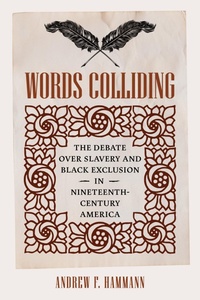
Words Colliding
Description

The long history and lasting impact of the rhetoric of Black exclusion in American politics and culture
In 1787, Thomas Jefferson declared that the United States was destined to become a nation free of slavery-and of its entire Black population. Following his cue, Henry Clay and other prominent politicians founded the American Colonization Society in 1816, launching the Black expatriation ("colonization") movement, a political force that, over the next eighty years, promoted the removal, with federal support, of the nation's Black population. Throughout this time, the vast majority of Black Americans, Frederick Douglass among them, opposed this movement with great vigor and conviction, characterizing it as one of their greatest enemies, second only to slavery itself.
Words Colliding offers the fullest account to date of this political debate, highlighting its dramatic impact on the national conversations regarding slavery and Black civil rights. From the beginning, Black Americans expressed grave concern that the rhetoric of colonization framed Black freedom as a national problem. Throughout the nineteenth century, even after the Civil War and through the Jim Crow era, they argued that the colonization movement, no matter its professed aim, functioned mainly to encourage and justify racial oppression in America.
More details
Other editions
Additional editions
Person
Andrew F. Hammann is a Senior Historian of the New American History initiative at the University of Richmond. He taught for several years at Stanford University, where he earned his PhD, and has been a fellow at the International Center for Jefferson Studies and at the Kinder Institute at the University of Missouri.
