

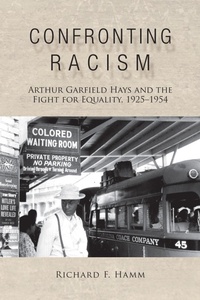
Confronting Racism
Description

Explores how and why an elite member of the legal profession, Arthur Garfield Hays, confronted and fought against the ingrained racism of his society, illuminating key aspects of the long civil rights era.
Beginning in 1925 the corporate lawyer and civil libertarian Arthur Garfield Hays began battling segregation. This book details Hays's work on the Mayor's Commission that investigated the1935 Harlem riot; his role in a 1937 restrictive covenant case in Westchester, County; his representing a challenger to the segregated draft in World War II; his part in ending the exclusion of African Americans from the American Bar Association; and his opposition to strong fair employment legislation. Motivated by his conception of a good society that valued civil liberties, democracy, and individualism, Hays fought for African Americans' legal rights under the Constitution. His activism was limited by his conservative economic views and his fear of an active state that intervened in private matters. His career illuminates the potential and perils of interracial co-operation during the long civil rights movement. Because the issues he confronted continue today-police mistreatment of African Americans, housing discrimination, limits on African Americans in the professions, racial discrimination in the military, and how to build government structures to limit discrimination-this book speaks to our time as well as his.
More details
Other editions
Additional editions
Person
Richard F. Hamm is Distinguished SUNY Teaching Professor at the University at Albany, State University of New York. He is the author of Murder, Honor, and Law: Four Virginia Homicides from Reconstruction to the Great Depression and coeditor, with Michael Lewis, of Prohibition's Greatest Myths: The Distilled Truth About America's Anti-Alcohol Crusade.
Content
Preface
Introduction
1. Arthur Garfield Hays: Roots and Branches
2. "The stupidity of the city police": The Harlem Riot Commission
3. "What is a Negro?": Cockburn v. Ridgway
4. "The effective moment to shoot the gun": The Campaign Against the Color Line in the American Bar Association
5. "The educational effect would be worth the investment": Lynn v. Downer
6. Prejudice: The Limits of Hays's Racial Liberalism
Conclusion
Notes
Select Bibliography
Index
